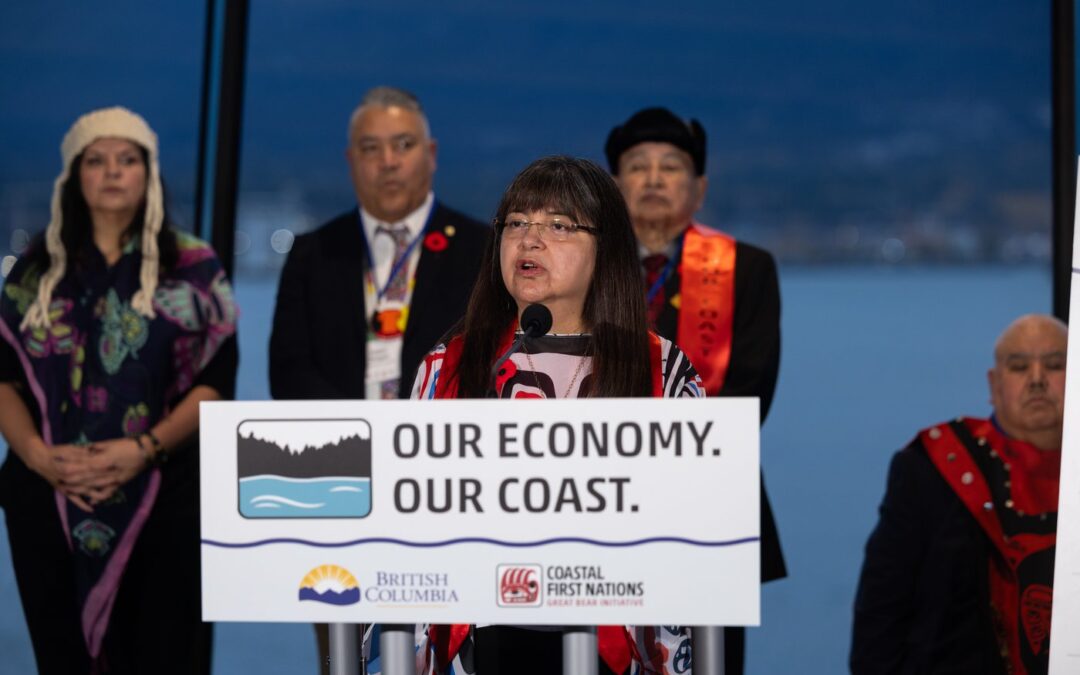
Photo: Marilyn Slett, Elected chief councillor of the Heiltsuk Tribal Council, and president of the Coastal First Nations/Great Bear Initiative at the First Nations Leadership Council gathering in British Columbia on Nov. 5, 2025. / Photo: Flickr / Province of BC.
By Sonal Gupta
Local Journalism Initiative Reporter
Canada’s National Observer
Disagreements over a proposal to build a pipeline to the BC coast has ignited a debate over who has the right to speak on behalf of First Nations.
After Prime Minister Mark Carney signed a memorandum of understanding with Alberta to advance a new bitumen pipeline to the Pacific coast, he met with Coastal First Nations (CFN) leaders in January.
BC Conservative leadership candidate Yuri Fulmer jumped in on X (formerly Twitter) to label CFN “just an advocacy group,” like a brand name. Fulmer claimed it is funded by foreign anti-energy groups and said if he becomes premier he will ban any foreign-funded organizations that attempt to influence BC politics.
The Coastal First Nations are an alliance of eight First Nations and nine communities along BC’s central and north coasts and Haida Gwaii, who are opposed to the project.
Fulmer’s criticism carries on from an idea that has been circulating in right-wing media since the days after the meeting. Beginning with Rebel News, an assortment of right-wing and media columnists have tried to discredit the legitimacy of the Coastal First Nations. National Post columnist Tristin Hopper wrote that the Prime Minister “didn’t meet with an Indigenous governing body of any kind” and called CFN “an environmentalist group.” A few days later, far-right media outlet Juno News followed up with its own column on the group.
CFN rejects and clarifies
CFN representatives were quick to respond, rejecting Fulmer’s allegations as misleading.
“Mr. Fulmer should be ashamed of spreading the kind of disinformation and propaganda we’ve come to expect from politicians in the US, not here in Canada,” CFN president and Heiltsuk chief councillor Marilyn Slett said in a press release.
Coastal First Nations have received seed money from US philanthropies such as the Gordon and Betty Moore and Tides Foundations, supporting conservation and economic programs on Canada’s north pacific coast. Currently, they are funded by government and philanthropic donors for marine stewardship and economic programs in the Great Bear Sea region.
“Like many non-profit organizations, we rely on diversified funding to remain stable and independent. No funder – whether government, philanthropic or corporate – directs our position or activities. CFN takes direction only from the leadership of its member nations,” a CFN spokesperson said.
Slett told Canada’s National Observer that the criticism misrepresents how Indigenous governance works and that critics are attacking their institutions without bothering to understand them first.
“It’s an important distinction that Hopper is trying to exploit by saying that ‘CFN is not a governing body,’” Slett said. “That is correct, but the member nations of CFN are the governing bodies of their territories, which stand to be impacted by this proposed pipeline route and the oil tankers it would bring to our waters.”
The member nations have worked together successfully for over two decades because they share ancient cultural connections and traditional protocols that tie them together as communities with relationships spanning thousands of years, Slett said.
Each nation holds its own rights and title over its territory. Each has elected chiefs and hereditary leaders. Coastal First Nations, as a group, does not make decisions for the individual nations. It is a shared non-profit organization they created to provide policy, technical and administrative support on issues that affect them all, she added.
Slett added that while CFN speaks with one voice in opposing oil tankers and pipelines, the rights and title of member nations are held individually, not by CFN.
Pipeline opposition
CFN leaders have restated their longstanding opposition to the proposed pipeline and oil tankers on the north coast after the latest deal was announced by Carney and Alberta Premier Danielle Smith. Opposition from the CFN was instrumental in stopping Enbridge’s Northern Gateway pipeline more than 10 years ago. The group said they were not properly consulted and that running tankers full of bitumen along the northwest coast poses too great a risk of a catastrophic spill.
“Our interest isn’t about money in this situation, it’s about [the] responsibility of looking after our territories and again nurturing the sustainable economies that we currently have here,” Gaagwiis Jason Alsop, president of the Council of the Haida Nation and CFN vice president, said at a press conference after the meeting with Carney.
If a pipeline were built to a port such as Prince Rupert, oil tankers would travel through the waters of several CFN member territories. Construction and operation of the pipeline would impact the territories of Lax Kw’alaams and the Haisla Nation, both of which also oppose the project, the Slett said.
Other First Nations in BC are located hundreds of kilometres away from the coast, meaning a potential spill would not directly affect their territories, so they would not be first in line for consultation. However, Slett noted that when the Northern Gateway pipeline was proposed, more than 130 First Nations opposed it, including many whose lands the project would have crossed.
BC’s duty to consult First Nations is outlined in policy and statutory frameworks, focusing on those potentially affected by decisions impacting their rights or territories.
Canada’s National Observer reached out to Lax Kw’alaams and the Haisla Nation for comment but did not hear back before the publication deadline.
The Haisla Nation was previously part of CFN and left the group in 2012 following disagreements related to a liquefied natural gas project. However, in November, leaders from the Haisla Nation and the District of Kitimat told Smith that although they support liquefied natural gas projects like LNG Canada, they remain opposed to any oil or bitumen pipelines running through their territory. Their stance hasn’t changed since Kitimat residents voted against Northern Gateway in 2014.
The Lax Kw’alaams First Nation sent a letter in September 2025 to Carney and BC Premier David Eby opposing any plans to repeal or weaken the federal Oil Tanker Moratorium Act, saying oil pipelines or tanker traffic on the north coast would threaten their territory and the environment.
The CFN alliance is best known for the Great Bear Initiative, which protects 6.4 million hectares of coastal temperate rainforest on BC’s central and north coast — from the Discovery Islands to the BC-Alaska border. Coastal First Nations, working with the BC government since the 2006 agreements, established conservancies covering 85 per cent of the forest, alongside ecosystem-based rules for sustainable forestry, carbon projects and marine planning across First Nations’ territories.
Slett pointed out that Fulmer’s own company donated to Coastal First Nations’ Great Bear Rainforest Carbon Project in 2022 and promoted the investment publicly on his website. Now his attack against the organization — while claiming his earlier support was unrelated to his current criticism — is hypocritical, she said. “We just don’t understand where that is coming from,” Slett said.
Slett added that nobody from the National Post or Fulmer’s team reached out to ask for Coastal First Nations’ perspective before making public attacks. She pointed out that people in political leadership roles have an obligation to tell the truth. “These tactics are not new, but in this digital world, they can spread so much quicker than ever before on social media,” she said. “I’ve received really terrible emails directly to me about the work that we’re doing.”
Canada’s National Observer contacted Fulmer’s office for comment on Tuesday but did not receive a response before the publication deadline.