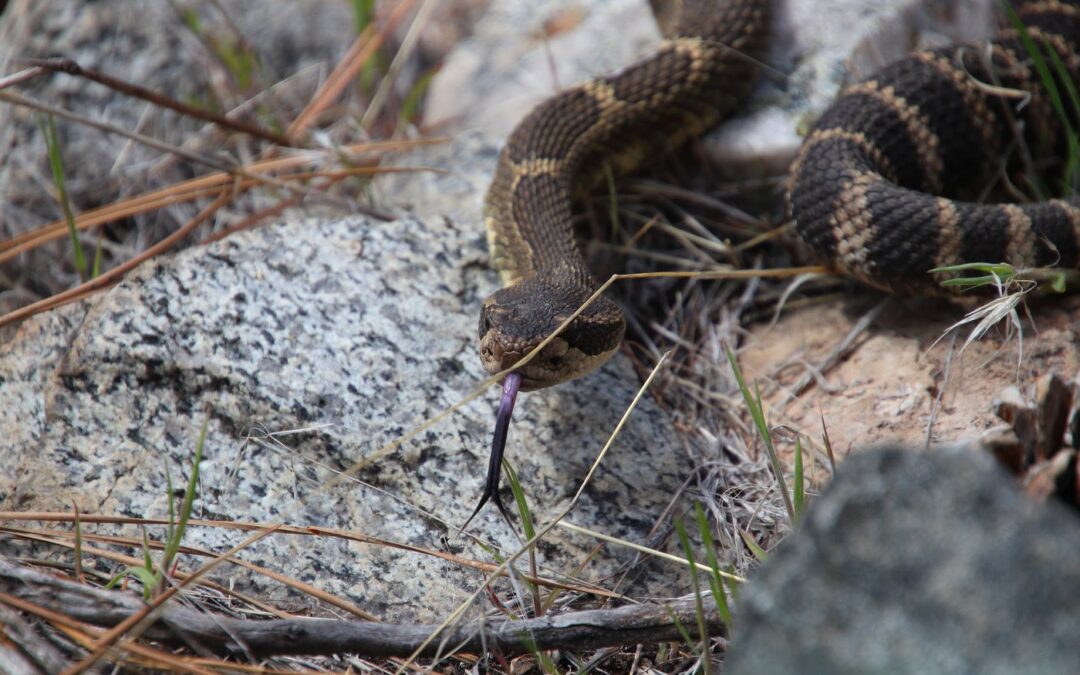
Photo: The Western rattlesnake is the only venomous snake species found only in BC’s dry interior regions such as the Okanagan. / Photo submitted by Lindsay Whitehead.
By Sonal Gupta
Local Journalism Initiative Reporter
Canada’s National Observer
For a long time, killing rattlesnakes was just a part of life in British Columbia’s South Okanagan. Jenna Bower, member of Okanagan Syilx Nation and Osoyoos Indian Band, said that her great-grandfather, now 93 years old, remembers that one of his first jobs was being paid to kill rattlesnakes when the area was first being cleared to make way for vineyards.
As new orchards and farms took over native grasslands, the rattlesnakes had to vacate their habitats. “Everyone saw them as a big problem,” Bower said.
By 2004, the western rattlesnake was listed as a threatened species.
Since then, an Indigenous-led research program has been working to change the relationship between snakes and humans. The Nk’Mip Desert Cultural Centre, run by the Osoyoos Indian Band, has been studying rattlesnakes just north of the Canada–US border since 2002.
Thompson Rivers University has been a key partner in the project and when Lindsay Whitehead joined the program as a graduate student, she said she was also afraid of snakes.
“There’s a photo of me holding my first rattlesnake with tears in my eyes, thinking, ‘What am I doing?’” she said. “But it’s amazing how being out there, hands-on, changes your perspective.”
The western rattlesnake is currently federally listed as Special Concern and provincially listed as vulnerable in BC.
The new federal funding will allow continued monitoring and expand research on how wildfire, climate change and habitat loss affect rattlesnakes as well as other rare species like the western yellow-bellied racer.
A major focus for which the funding will be used is understanding the impact of the 2021 wildfire that burned through the South Okanagan. Whitehead, a biologist and now the program’s manager, said the fire burned more than 19,000 hectares — and “burned through a large portion of the 450-hectare study area.”
“That actually burnt all known den locations, as well as all known birthing locations,” she added.
Rattlesnakes rely on specific dens — known as hibernacula — to survive the winter, and usually return to the same one each year. While their population seems stable so far, Whitehead said their behaviour has changed. Researchers have seen a sixfold increase in “den switching,” a rare behaviour where snakes stop returning to their usual winter dens.
The snakes are also moving less directly and covering smaller areas than before, which might show the habitat has changed since the wildfire, she added.
Climate change is adding more stress. Sudden cold snaps in the fall or spring can trap snakes away from their dens or shorten their hunting and mating seasons.
The project is funded through Environment and Climate Change Canada’s Indigenous Partnerships for Species at Risk program. The investment supports 19 Indigenous-led projects for 2025-2026 to protect species at risk and their habitats on Indigenous lands.
Bower, the cultural centre’s executive director, said long-term federal funding has been key to keeping the program running. “Otherwise we wouldn’t be able to even have biologists here and be able to do the research that we do,” she said.
The new funding is also being used to expand the research to include other species, including the western yellow-bellied racer. While research on rattlesnakes has been conducted for many years, little is known about the other snakes that live at the northern edge of their range in Canada. Whitehead said such research is key to the future of conservation in one of the county’s most biologically diverse regions.
As part of the new funding, local youth will be hired as interpreters and field assistants to help with monitoring and outreach. “We’re always on the lookout for band youth passionate about biology,” Whitehead said.
Bower said involving youth helps pass on knowledge and supports their long-term stewardship. In Syilx culture, rattlesnakes are sacred — elders share their stories to teach lessons about respect, responsibility and living in harmony with the land and each other.
While the current funding runs until spring 2028, Whitehead noted the future of the program remains uncertain, as the grant competition grows tighter with more applicants. “Every time we send in an application, I’m always like, this is the year we’re not going to get it,” she said.
The snake program began as a response to safety concerns about bringing visitors onto the land. “If we’re going to be taking people through the centre, walking through the trails, how are we going to do that with a rattlesnake problem,” Bower said.
With the help of public education, guided walks and live presentations, staff have taught visitors how to identify local snake species, move safely through snake habitat and respond appropriately if bitten by a snake. They also correct myths about treatments that stem from old Western movies. “Snake kits — they don’t work. They’re more of a novelty item,” Bower said.