
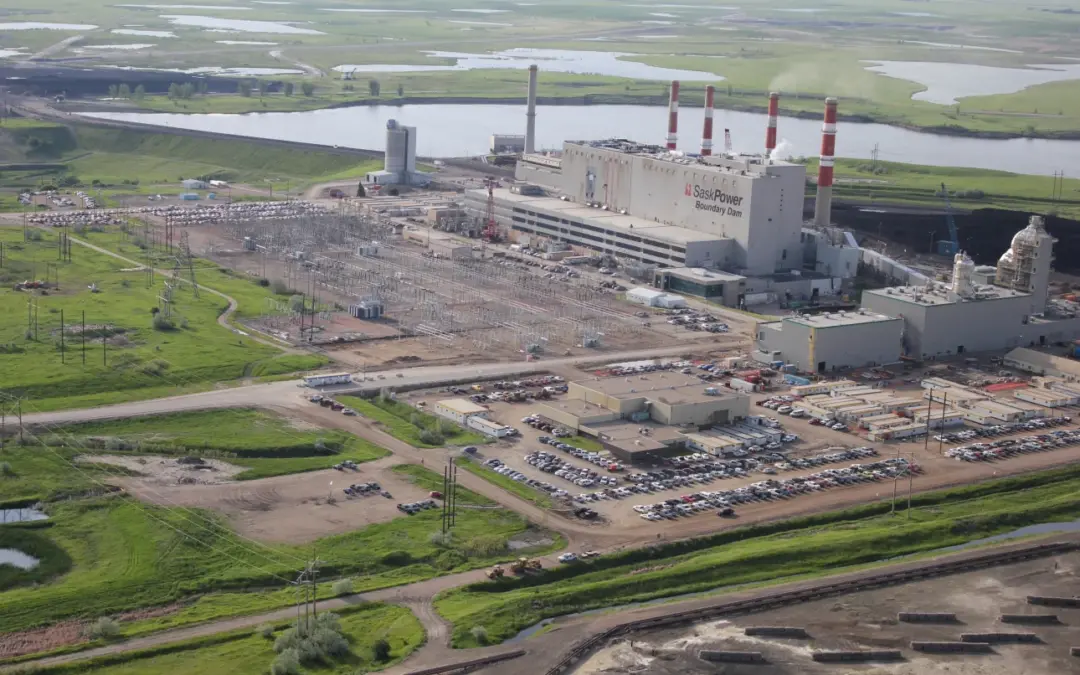
Photo:
An aerial shot of the Boundary Dam power station in Saskatchewan with the CCS facility to the right of the power plant. At the facility, exhaust from the Unit 3 turbine is sent for CO2 capture and compression into the pipeline that takes it away for underground storage. Photo courtesy of the International CCS Knowledge Centre
By Natasha Bulowski
Local Journalism Initiative Reporter
Canada’s National Observer
A citizen-led climate justice challenge to the Saskatchewan government’s plan to continue using coal power failed when a court sided with the province earlier this week.
Last summer, the provincial government and SaskPower laid out a plan to continue using coal-fired generation despite federal regulations aimed at phasing out the polluting power source by 2030. Residents and citizen groups responded by filing a judicial challenge arguing the province’s decision is “unreasonable” and should be reviewed by the courts due to a lack of public consultation, a disregard for Canadian and international law and potential implications on Canadian Charter rights.
A Court of King’s Bench justice sided with the province and dismissed the application on Jan. 12 on the grounds that the court’s role is not to dictate climate policy or directing the day-to-day policy of a government.
The Saskatchewan government said in an emailed statement sent to Canada’s National Observer it is “pleased” with the court’s ruling, which “determined that the issue is essentially one of government policy and, as such, is not for the courts to decide.”
The applicants (the Saskatchewan Environmental Society, Citizens for Public Justice and three individuals from Saskatchewan and Manitoba) say a judicial review is the only means of holding the government to account for its “unprecedented” decision to continue burning coal and ensuring evidence of the government’s decision-making is “justified, transparent, and intelligible,” said Glenn Wright, the lawyer representing the applicants, in a Jan. 16 press release.
“Saskatchewan has been planning to phase out coal for 15 years, and the Coal Decision is a marked departure from that long-standing objective. We believe that a near billion-dollar administrative decision to double down on the most polluting form of energy generation — a decision which, we believe, violates the rule of law — is something that the Courts can and should review.”
After the lower court disagreed with them, the applicants said they are in discussion with counsel and are considering their options, including a potential appeal of the decision to the Saskatchewan Court of Appeal.
Coal is the dirtiest fossil fuel and produces more planet-warming carbon dioxide when burned than either oil or gas.
The province’s Saskatchewan First Energy Security Strategy and Supply Plan lays out its strategy to use coal as a bridge to nuclear energy but does not contain any cost estimates, just a demand that the federal government pay for 75 per cent of its first nuclear reactor.
It is going to cost the province an estimated $900 million over four years to extend the lives of its coal power plants.
“The environmental and health risks posed by extending coal use for many more years remain just as serious as ever,” said Margret Asmuss, president of the Saskatchewan Environmental Society, in a press release. “Saskatchewan residents deserve responsible, evidence-based energy planning that protects people, communities, the economy and the environment.”
The group noted the $900 million for coal plant refurbishment could — and should — be going to up-and-coming technology and industries such as battery storage and renewables, but instead the province is choosing to delay these opportunities by doubling down on coal.
Ontario was the first province to phase out coal-fired electricity under Premier Kathleen Wynne in 2014. Last summer, Alberta transitioned its last coal plant to natural gas to complete the coal phase-out. New Brunswick, Nova Scotia and Saskatchewan still use coal-fired electricity.