
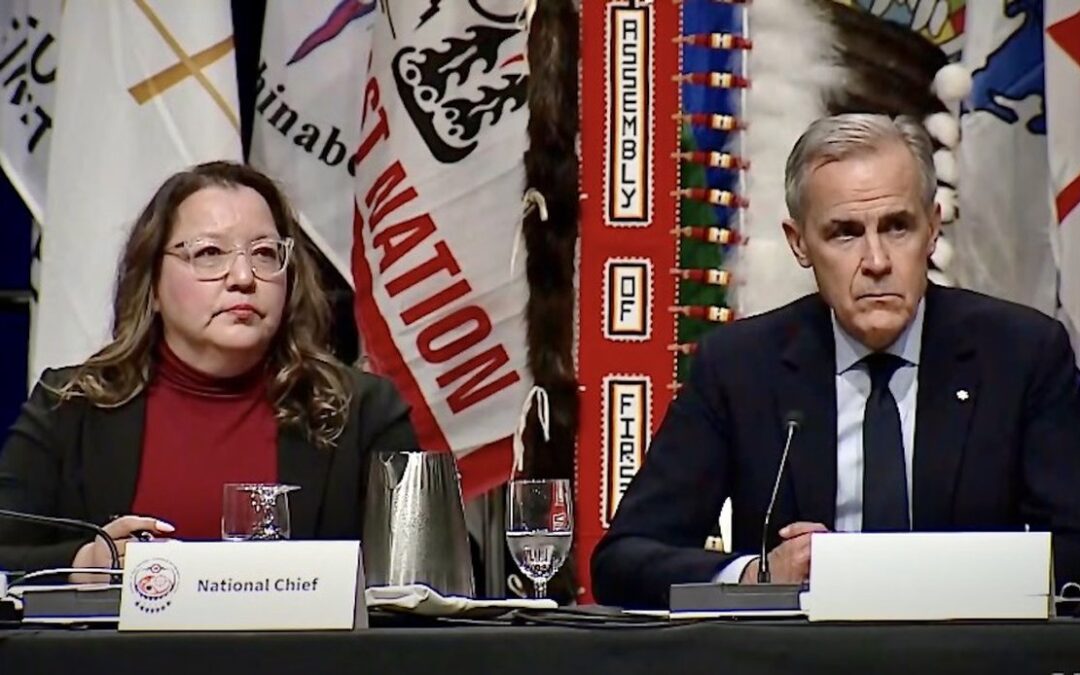
Photo: National Chief Cindy Woodhouse Nepinak and Prime Minister Mark Carney at an AFN assembly Dec. 2 where Indigenous leaders voted unanimously for the withdrawal of the pipeline pact and in support of BC First Nations opposed to lifting the oil tanker ban. / CPAC screen shot
By Rochelle Baker
Local Journalism Initiative Reporter
Canada’s National Observer
Ottawa’s pipeline deal with Alberta poses mounting political risks for the federal Liberals in British Columbia, political experts say.
The federal government’s conventional role is typically to arbitrate when disputes arise between provinces, said Stewart Prest, a political scientist at the University of British Columbia.
By inking an agreement with Alberta Premier Danielle Smith for a proposed oil pipeline across BC, despite its opposition, Prime Minister Mark Carney has undermined provincial authority and raised red flags for other partners in the federation, Prest said.
“It is really unusual for us to see a federal government so decisively weighing in on one side of the debate and to actually conclude an agreement with one province about what should happen in another province without involving them in the conversation,” he said.
“That really goes against the spirit and the principles of federal government.”
The move sends the message that the federal government can make significant decisions about a province’s territory without consultation — an approach that is bound to have ongoing ripple effects, especially in Quebec which is zealous about maintaining jurisdictional integrity, Prest said.
On Tuesday, Bloc Québécois Leader Yves-François Blanchet repeated his early criticism of the deal as “undemocratic,” saying it’s a precedent for the imposition of pipelines anywhere in the country. Blanchet said his party intends to oppose the project in Parliament to defend BC’s right to refuse and support First Nations demanding Carney maintain the oil tanker ban on the northwest coast.
Eby left holding the bag
Though it’s a federal decision, the deal leaves Eby holding the bag — putting him in a “defensive” position, Prest said. The premier must walk a difficult line, presenting himself as someone who can get economic projects built, while not betraying coastal First Nations’ rights or sacrificing environmental protections — particularly in the Great Bear Rainforest region.
By fighting for BC’s provincial autonomy, Eby must take up an “uncomfortable obstructionist stance” which could ramp up the province’s polarized politics and benefit the BC Conservatives, Prest added.
Eby has repeatedly said the pipeline pact endangers the deals and compromises BC has negotiated with First Nations on various provincial resource development projects, such as LNG projects, mining of critical minerals and the North Coast Transmission Line.
“[Carney’s] seemingly high-handed approach to decision-making tends to throw all those working relationships into abeyance,” Prest said. “The BC government also has to be really concerned with that.”
The deal also is stressing the federal government’s already fragile relationships with Indigenous Peoples across Canada, already on edge after the passage of Bill C-5 to “fast-track” projects of national importance and could undermine Indigenous sovereignty and decision-making in their territories.
On Tuesday, the first order of business for the Assembly of First Nations chiefs was to vote unanimously for Ottawa and Alberta to scrap the pipeline deal. They also called for respect for Indigenous rights and offered unqualified support for First Nations opposed to pipelines in their territory and Coastal First Nations fighting to protect the oil tanker ban.
Resurgence of pipeline protests
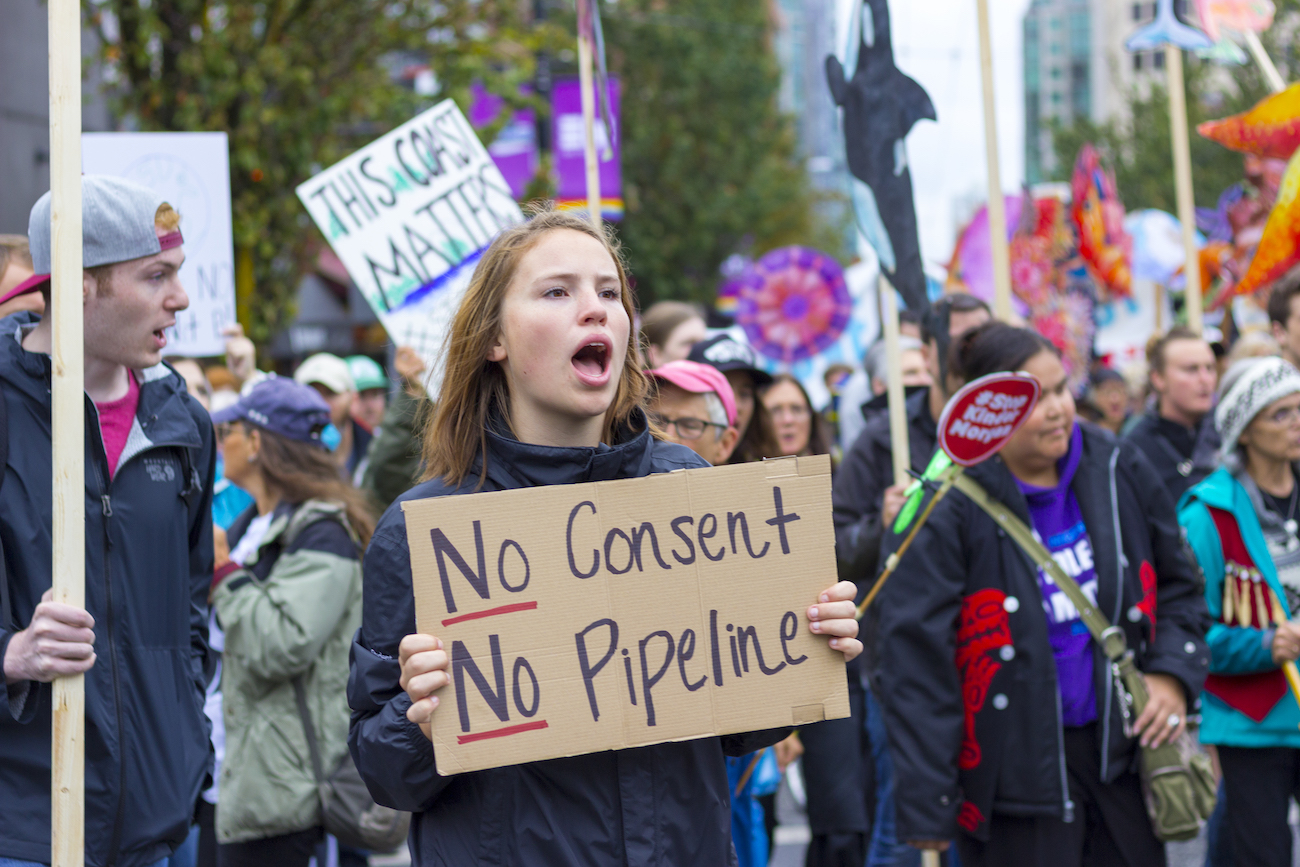
Protests that dogged the Northern Gateway Proposal and the Trans Mountain Pipeline expansion project will resurface, say political experts.
There’s likely to be a “political tsunami” and serious pushback from environmental groups and First Nations that could echo the widespread protests and legal battles that ultimately derailed the Northern Gateway project — a similar pipeline proposal fought over a decade ago, aimed at transporting Alberta crude to BC’s tidewater, said UBC sociologist David Tindall.
Carney, focused on making waves with conservatives in the rest of Canada, likely underestimated how important the oil tanker ban is on the West Coast, Tindall said.
“People in central Canada, in particular, don’t really understand the sort of depth of feeling on this issue, and people’s perspectives in BC,” Tindall said.
The more recent Trans Mountain Pipeline project to BC’s south coast was only completed after long delays, legal battles and protests that spooked private sector investor Kinder Morgan into abandoning the project and forced the federal government into buying it.
The environmental movement and Coastal First Nations are already sending strong precautionary signals to private backers about the latest Alberta pipeline proposal, he said.
“If [they] can tell the corporate sector, ‘If you thought Trans Mountain was a headache, wait till you see this new proposal,” Tindall said, “that will make investors think twice or three times about this.”
Liberal MPs bear brunt of decision
Carney’s decision will also have significant ripple effects for the 20 Liberal BC MPs largely concentrated in more environmentally conscious urban and coastal ridings, Tindall said. Recent polls suggest there is strong general support in BC for a pipeline, but that doesn’t mean it’s concentrated where Liberal MPs were elected, he explained.
Political support for the Liberals that bled from the federal NDP or the Green Party in the last election in tight three-way races may well fall away, Tindall said, giving an opportunity for more Conservative candidates under leader Pierre Poilievre.
“There were centre-left voters willing to prop up a Carney government in order to keep Poilievre out of power — with climate and the environment being strong motivations,” he said.
“Going ahead with this gives them permission to pull back from the Liberals,”
BC Liberal MPs flagged concerns before the pipeline deal was done.
Once it was unveiled, former environment minister Steven Guilbeault resigned as minister of Canadian identity and culture. While many BC Liberal MPs have gone quiet in the days since the deal was signed, Victoria MP Will Grieves continues to express deep concerns, repeating the need to include BC and Coastal First Nations.
Carney in his objective to “neutralize the federal Conservative party” may have misjudged the political risks and rewards of pursuing a pact with Alberta, Prest said.
“The federal Liberals are the dominant party in the Legislature, but they don’t have a majority, and polling suggests that the Conservatives are still very much neck and neck,” he said.
However, there’s the risk the federal government will find itself financially and politically attached to an increasingly divisive project that will leave “the Liberal coalition in shambles,” Prest said.
“I think, ultimately, this is an electoral gamble, and I think it’s a bigger one than they seem to think.”