
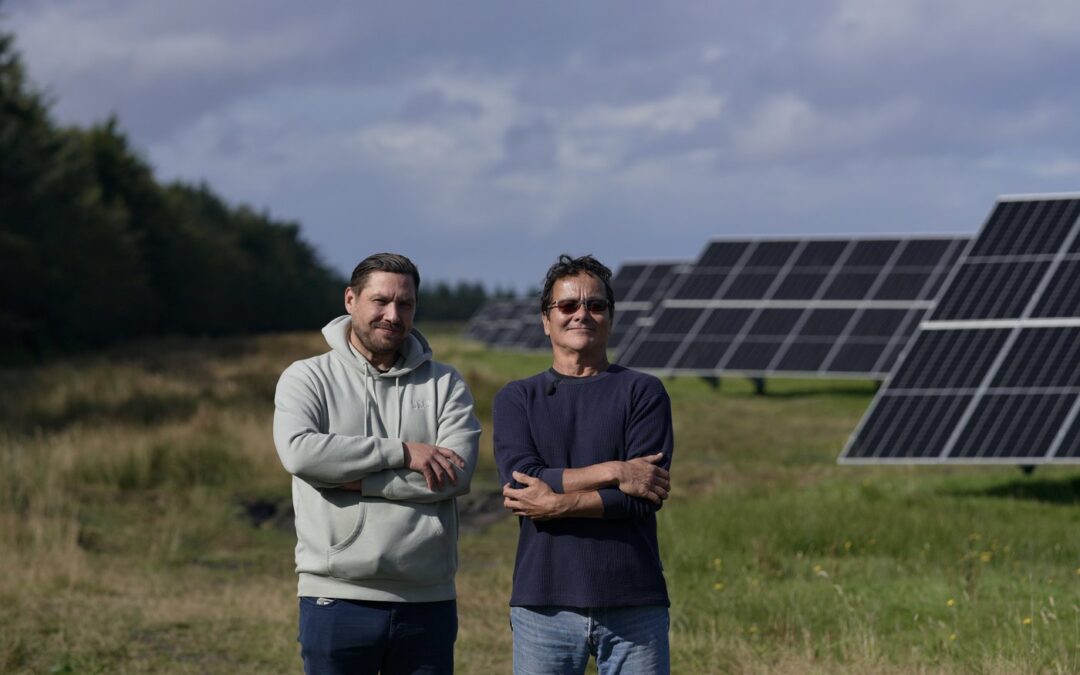
Photo: Sean Brennan (left) and Kevin Brown at Solar North, the Haida-owned solar farm beside Haida Gwaii’s Masset airport. / Photo by: Sonal Gupta / Canada’s National Observer
By Sonal Gupta
Local Journalism Initiative Reporter
Canada’s National Observer
Growing up on Haida Gwaii, an archipelago off central British Columbia, Sean Brennan gave little thought to the diesel generators that kept his community’s lights on.
Heavy diesel dependence is common across remote Canada, with off-grid locations like those on Haida Gwaii relying on fuel shipped by barge or truck. But the Haida Nation was building a global reputation for a vastly different legacy. Decades of fierce resistance to old-growth logging, the creation of the Gwaii Haanas National Park Reserve and the pioneering Haida Gwaii Watchmen program set an example for responsible environmental stewardship.
Then in 2018, when a group of Haida youth pieced together records of the islands’ diesel dependence, Brennan realized the scale of their reliance on the climate change-enabling fossil fuel. That year, the sustainability group Swiilawiid showed that Haida Gwaii was burning roughly 10 million litres of diesel each year to generate electricity for the islands’ 4,500 people, businesses and public services like the hospital.
“Haida Gwaii is seen as this environmentally friendly shining star, so it’s a bit of a black mark to have so much diesel coming through the back door without people realizing that’s how we get our energy,” Brennan says.
Now, the Haida Nation is working hard to live up to its image. Over the next two years, Brennan and his colleagues at Tll Yahda Energy, an Indigenous-owned power company established in 2021, are building what is set to become Canada’s largest off-grid solar installation.
Youtube Video: https://www.youtube.com/watch?v=UhvLOGuyNR4 Caption: Before pursuing Solar North, the Haida partners had to prove they could build it. Brennan recalls the decision to focus on solar and points out where the next rows of panels will go. Video by: Sonal Gupta / Canada’s National Observer
Walking the perimeter of the Masset airport, Brennan notes the rows of solar panels already covering 11 acres of cleared land. In the distance, more land sits waiting for more panels to help power Masset and neighbouring communities. The team plans to begin construction in 2027 and finish by the end of 2028. Over that period, Solar North, as this installation is known, will quadruple in size, growing from two megawatts of generating capacity to eight.
Though grid-connected solar farms are larger — Alberta’s Travers solar project, for instance, clocks in at 465-megawatts— the Haida’s efforts set a new scale for solar on an isolated Canadian grid.
Tll Yahda also plans to build a two-megawatt solar farm at Sandspit airport in southern Haida Gwaii by 2030. Taken together, the Tll Yahda team estimates the expanded Solar North and planned Solar South installations could replace roughly 2.9 million litres of diesel annually — nearly 30 per cent Haida Gwaii’s reported consumption. Already, Solar North’s operation since December 2025 has displaced an estimated 168,000 litres of diesel, as of Nov. 3, 2026.
If the Haida can somehow eliminate all of their diesel-generated electricity, that would knock out more than half of the emissions from diesel used to generate electricity from all of BC’s remote communities, according to the team.
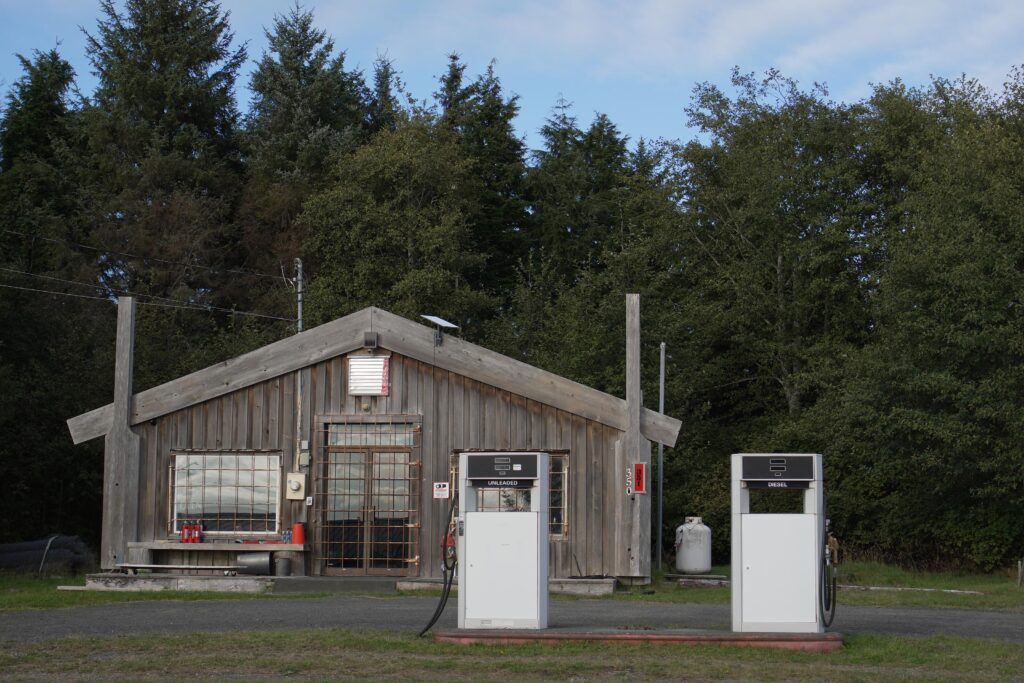
Gasoline and diesel pumps in Old Massett.
To cut diesel use further, the Haida partners are exploring wind, expanded hydroelectric power and a local tidal project. But getting these projects off the ground could prove more challenging.
As of Nov. 4, 2026, BC Hydro stopped accepting new proposals under its remote community renewable energy program to focus on nine projects that are already underway, including Solar North and Solar South. Without BC Hydro buy-in, any new projects would be dead on arrival — legal requirements mandate that the utility must buy and then sell electricity to residents.
BC Hydro’s pause hampers the province’s goal of cutting diesel generation by 80 per cent by 2030. The utility has not said when it will consider new projects. But with wars pushing up diesel prices, the Haida team wants the new Conservative government and BC Hydro to work with First Nations to meet their renewable energy ambitions.
The long road away from diesel
Alfred Adams, a journeyman carpenter who grew up in the 1960s in nearby Old Massett, remembers when the military radio station, church and Indian Day School had electricity, but the homes around them did not.
When Brennan discussed Haida Gwaii’s energy history at a community meeting, Haida elders recounted life before the grid. They lived by oil lamps and kerosene, and lost family members to sudden house fires. Diesel-generated electricity was not an environmental burden — it was a lifeline.
Across the street from his childhood house, Adams remembers a neighbour running a small generator to keep the lights on past dark. But most of Old Massett didn’t get electricity at home until around 1965. “We didn’t really have much choice,” Adams says.
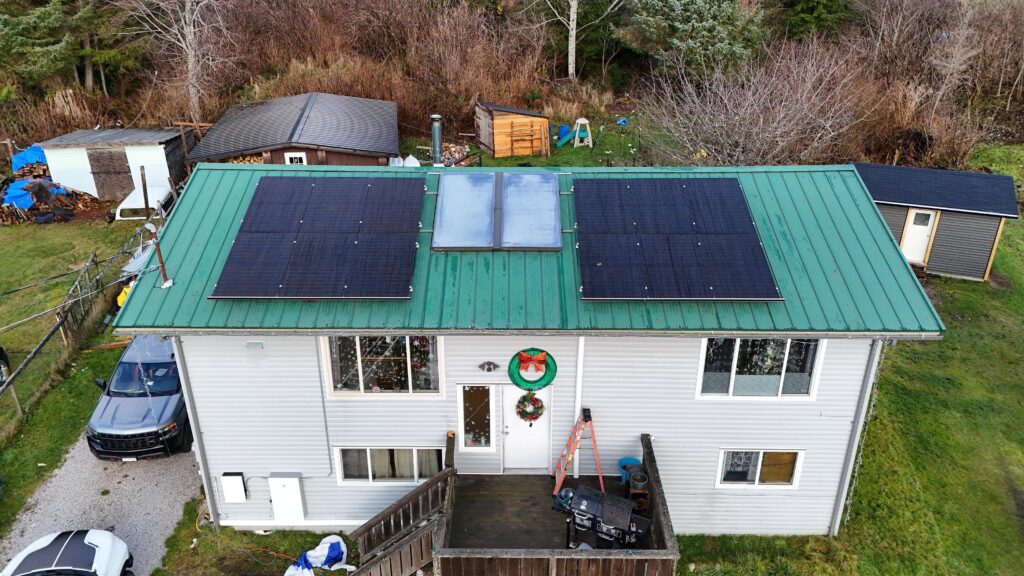
Solar panels on a home in Skidegate.
Unlike the hilly slopes of the mainland, Haida Gwaii’s flat terrain – especially on the archipelago’s northern island – offers limited potential for hydroelectric power. Diesel, meanwhile, is dependable, and generators now supply power to homes as far south as Port Clements, 35 kilometres from Masset.
Over time, Haida Gwaii developed two isolated electrical grids. On the archipelago’s northern island, the grid relied entirely on diesel. On Moresby Island to the south, power primarily flows from a hydroelectric plant that began operating in 1990 near Moresby Lake – with diesel generators to fill the gaps.
Yet, the risk inherent in shipping millions of litres of diesel along British Columbia’s sensitive coastline became impossible to ignore after 2016, when the Nathan E. Stewart ran aground near Bella Bella, spilling around 110,000 litres of diesel — enough to generate electricity for 44 average BC households for a year — into the waters of the Heiltsuk Nation. Brennan feared what would happen if a similar accident happened near Haida Gwaii.
“We realized we needed to get off of diesel faster than we thought,” he says.
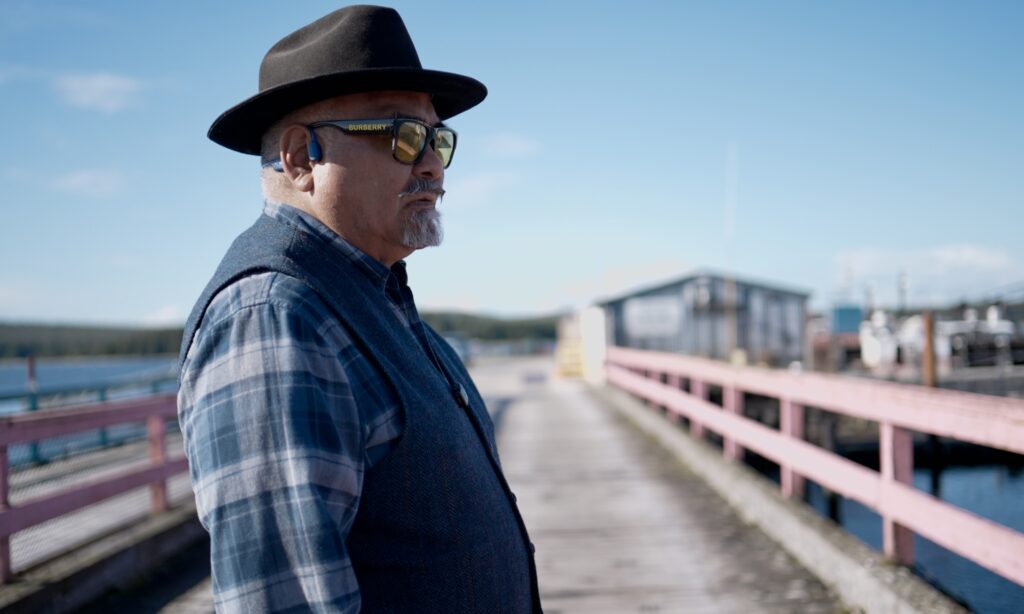
Alfred Adams, at the Masset waterfront, where fuel arrives by barge.
So, in 2018, when Swiilawiid and the Council of the Haida Nation brought people together in Old Massett for a renewable energy symposium, the gathering committed to working toward energy sovereignty, prioritizing local ownership and control of power production and distribution.
Kevin Brown, the climate action and energy coordinator for the Old Massett Village Band Council, spent several years working to solve what he calls the “dirty little secret” of Haida Gwaii’s diesel dependence. In the past, he says, decisions about the Haida’s energy supply were made in Victoria, Ottawa, and the regional hub in Prince Rupert. Now, though, the Haida are choosing what they want to build. “Instead of being dictated to, now we get to make decisions for ourselves,” Brown says.
Across remote Canada, Indigenous governments are increasingly becoming power producers in their own right. A recent report from the Pembina Institute, an environmental think tank, found clean electricity projects grew 20 times faster over the past decade than the decade before, with roughly three-quarters wholly or majority Indigenous-owned.
Old Massett teamed up with people from the nearby Skidegate Band Council and the Council of the Haida Nation to create Tll Yahda Energy and began brainstorming the path to the archipelago’s clean energy future.
Initially, they considered using wood left behind by logging as a fuel source. After all, Haida Gwaii has forestry workers and a supply of material that might otherwise go unused. But studies suggested they’d eventually need to start importing wood from elsewhere. The community worried going down this path would create pressure to cut more trees. “It felt more like it would end up becoming logging just to feed the machine,” Brennan says.
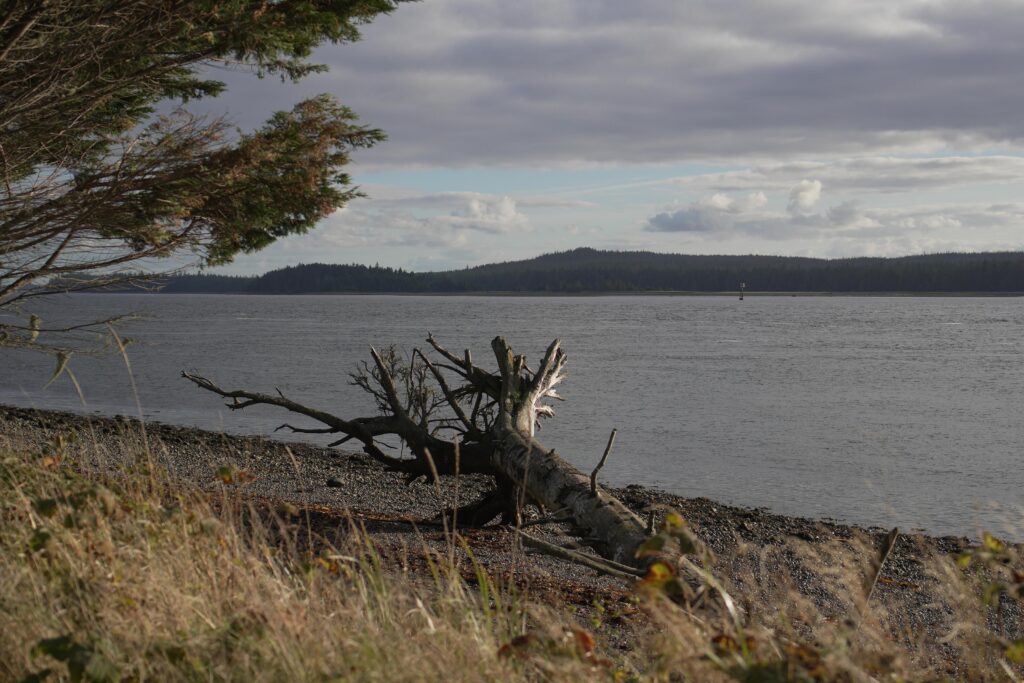
Driftwood rests along the Old Massett shoreline in late September.
Building a hydropower dam was too expensive relative to the number of users, Brennan says, while tidal power lacks proof of long-term reliability. Offshore wind seemed tempting, but leftover baggage from a failed project in nearby Hecate Strait — which won environmental approval in 2009 but failed to secure BC Hydro as a buyer — made the community reluctant. After all, they wanted to actually get their project built.
The community’s alternative-fuel survey eventually led them to solar, which has been growing increasingly cheap and productive in recent years. Combined with solar’s relative ease of use — solar panels need neither a reservoir nor regular fuel deliveries — the community calculated that solar would be their best bet, even with Haida Gwaii’s cloudy, rainy environment and sunlight-depriving northern latitude. The team carefully vetted five separate locations, rejecting each in turn out of concern for disturbing important salmon habitat, old-growth cedar forest and sensitive archaeological sites.
The breakthrough came unexpectedly, when Brennan was dropping an engineer off at the Masset airport. Looking out across the wide, already-cleared safety buffer surrounding the tarmac, he thought: “Why don’t we do it here?”
About 18 months later, 4,250 panels are up, and the Tll Yahda team has plans to install 12,000 more. Brennan couldn’t be prouder of what his community has pulled off.
“We’re always just wet and in the dark over here, but we’re producing energy out of these panels,” Brennan says.
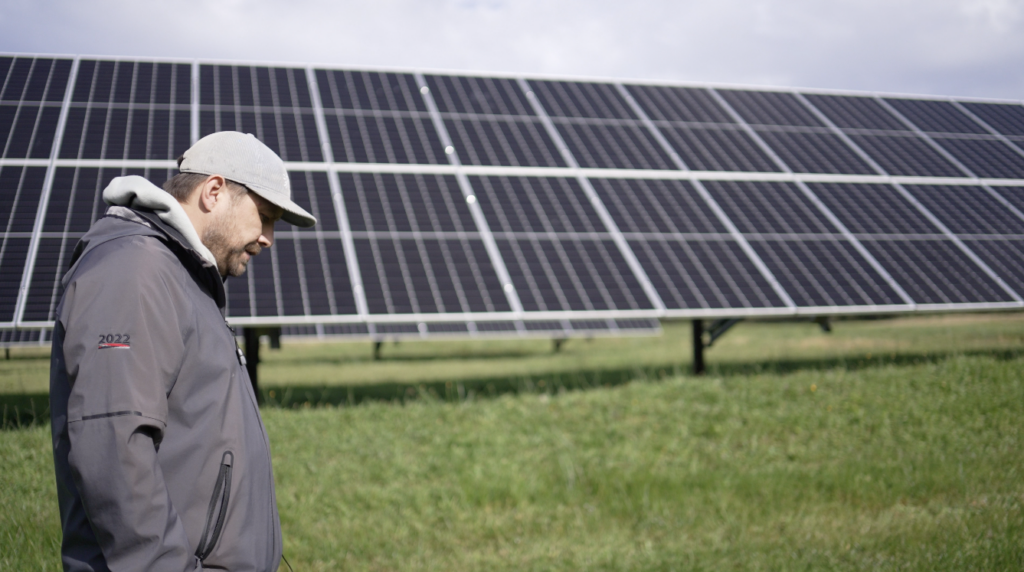
Sean Brennan, manager of Tll Yahda Energy, walks beside a solar farm known as Solar North.
The author thanks Patrika McEvoy, Garrett Russ and Haana Edenshaw, who were not directly quoted but whose time and insights informed this reporting.
This is the first story of a series Canada’s National Observer is producing on climate adaptation in rural BC – in collaboration with I-SEA and The Donner Canadian Foundation.
Sonal Gupta / Local Journalism Initiative / Canada’s National Observer.