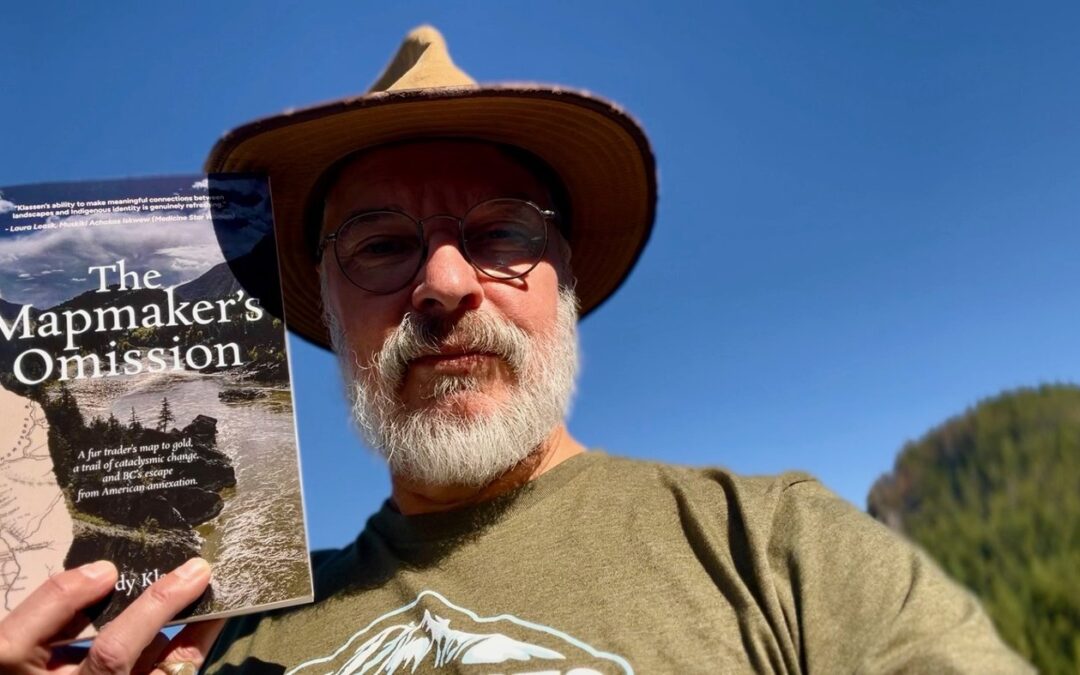
Photo: Author Randy Klassen launched his new book on Oct. 7 at the BAG, which documents a human history between 1846 and 1860 that he said he had never been taught.
By: Ina Pace
Local Journalism Initiative Reporter
The Squamish Chief
Randy Klassen’s ‘The Mapmaker’s Omission’ re-examines gold rush history and Indigenous knowledge across the Sea to Sky Corridor. Hear more in three upcoming Squamish presentations.
“I am not equipped to tell the stories of the First Nations, but what I can do is tell the story of my encounter, and what it meant to me.”
Squamish author and ultrarunner Randy Klassen has spent much of his life discovering trails, in fact it’s why he said he made the move to Squamish full-time in 2021.
His first book was Perhaps Joy Is The Reward, self-published by Cliffrose Ventures Inc. in 2023 about ultrarunning.
His second publication The Mapmaker’s Omission, also from Cliffrose Ventures Inc., was launched at the Brackendale Art Gallery (the BAG) on Oct. 7. It chronicles his two-year research journey about how B.C avoided American annexation.
Having originally set out to decipher the mid-1800s fur trader routes with his friend on an ATV, Klassen said an alternate journey emerged that he didn’t expect: a human history between 1846 and 1860 that he had never been taught. So, he took a subsequent year to write “the book that was really trying to break through.”
What is it about?
As the book’s description relates, “in the year British Columbia stood on the brink of falling to the Americans, a fur trader’s map to BC’s gold was published in San Francisco with a glaring omission.
The book Klassen’s search for answers as to why the mapmaker omitted what he did.
“If you’ve ever wondered about the genesis of the First Nations unceded land claims in B.C. or been curious about how a chunk of Canada got wedged between the states of Washington and Alaska, read this book,” the description reads.
The fur-trader map in question, Klassen said, was drawn up by explorer and fur-trader Alexander Caulfield Anderson in 1858 for gold miners, only Anderson made no mention of the road he was building.
“He dismissed the Fraser River as a way to get to the gold … I started investigating why (Anderson omitted) what became known for five years as the Douglas Road from his original map.”
Klassen said he set out to physically re-trace this map, making a journey over 7,000 km, starting from Portland, Oregon, up through Washington State, and then B.C.
Klassen was schooled with a “prairie education” in Saskatchewan, and came to B.C. for university, his only knowledge on the topic then being that B.C. began with a gold rush.
“(The Mapmaker’s Omission) is about me mining for answers about a fur trader’s map to gold in the year British Columbia began, and how that effort exposed (an uncharted) past that now helps me better understand the present,” he wrote in an emailed statement.
“Real gold is mined when we dig down to, and challenge, our foundational beliefs,” Klassen’s website reads.
The first 55 pages of his book, Klassen said, delve into stories leading up to the Fraser Canyon War; of the 1846 fur traders who were “being graciously led” through both Sḵwx̱wú7mesh and St’át’imc territories, north from Átl’ka7tsem (Howe Sound) and Harrison Lake, up to Lillooet. Also of American miners invading via the Douglas Road, and reconciliatory acts made as a result of First Nation people standing their ground.
Klassen said he used primary journals of explorers and cartographers, such as Simon Fraser and David Thompson, and first-hand oral histories from First Nations people in his research.
One particular lesson he said he learned is how boundaries of Nation land are defined by topography, or “the height of the land,” rather than by longitude and latitude lines on a map.
“I started to see how the way things really work in B.C. was lost in the face of other conventions. The book goes into that in some detail,” Klassen said.
“For the Squamish and the St’át’imc people, by omitting them from the maps we lose them from the maps of future economic development.”
The Mapmaker’s Omission is now available to buy on Amazon, and from the Gather Books and Lovely Things bookstore in Squamish.
Catch Klassen talking about his book at three upcoming local events.
- Presentation at Squamish Public Library
Tuesday, Nov. 3 from 6:30 to 8:30 p.m. (Register here.)
- Book signing at Gather Bookshop
Saturday, Oct. 24 from 11am to 2 p.m.
- Book signing at Sea to Sky Gondola, upper lodge
Sunday, Nov. 29 from 11am to 3 p.m.
Ina Pace is The Squamish Chief’s Local Journalism Initiative (LJI) reporter.
This reporting was produced through the LJI, which supports original civic journalism across Canada.