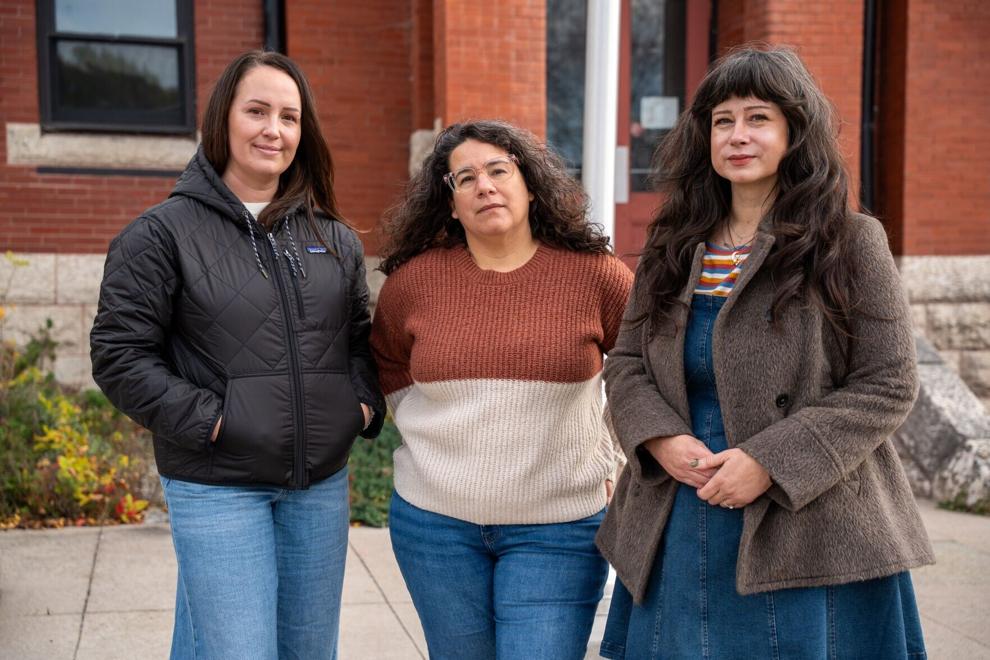
Photo: Ashley Trent, Kim Loranger and Leah Nilson are adamant that a candidate running for Kenora’s City Council — as well as a voting bloc she is a part of — must answer for past comments made on several different podcasts.
By Pam Fedack
Local Journalism Initiative Reporter
Kenora Miner & News
Leah Nilson, Kim Loranger and Ashley Trent are questioning how statements made by a candidate running for Kenora’s City Council might affect their ability to represent the municipality if elected.
The three say they are concerned with public statements made by Karla Treadway about residential schools, reconciliation and cultural differences, along with a range of other statements that pertain to the evidence behind claims about nearby First Nations, gender ideology and social service salaries.
The majority of the comments made took place on Treadway’s podcast, The Sovereign Sphere, where she says listeners can “expect truth and light conversations about culture, politics and living free.”
“I think it’s difficult, if not impossible, for the Indigenous community to trust a councillor who has said these kinds of things,” Nilson told the Miner and News, in reference to several things Treadway has said herself, or invited guests to share on the podcast.
Loranger, who was born and raised in Kenora, began looking through Treadway’s public content after questions arose about her campaign platform, which have more or less come to dominate the online discourse on social media ahead of the Oct. 26 election.
According to Loranger, many of the people discussed already face discrimination and should not always have to be the ones speaking out.
“And when they do fight back, they’re deemed kind of loud, aggressive, or problematic,” Loranger said, adding that she wants voters to know more about the candidate seeking to represent them.
“I think people need to make informed decisions when it comes to picking who they want to put their vote behind,” she said.
Nilson says she has followed Treadway’s social media output since the pandemic. When Treadway entered the municipal race, she wanted voters to know the kinds of things she had heard.
Among the statements Nilson highlighted were two from Episode 227 of Treadway’s podcast, titled “Canada’s Suicidal Empathy: The Paradox That’s Killing a Nation,” dated July 27, 2026.
Treadway’s guest in the episode, Phillip Milan, eventually went on to say that “some cultures are just better than others, but you’re not allowed to say that.” Later on the episode, Treadway herself says, “I’m going to get lambasted for this, but certain cultures don’t mix.”
Nilson said the episode discussed immigration, including people coming from countries where Islam is practised. She questioned how those views would affect Treadway’s representation of newcomers and said her concerns also extend to members of the 2SLGBTQIA+ community.
Loranger said Treadway’s podcast appearances, as well as her Instagram posts, raised similar concerns for her about statements involving immigrants, First Nations and transgender people.
Both women highlighted Episode 186 of The Sovereign Sphere, dated Dec. 10, 2025, in which Treadway discussed a documentary questioning the residential school system and reconciliation efforts.
“Being the devil’s advocate, I don’t know how you’d actually determine whether abuse actually happened other than hearsay,” Treadway said in an excerpt reproduced in one of Loranger’s Facebook posts.
Loranger’s post also includes passages describing allegations made in the documentary about residential school nutrition, death counts and the financial interests of organizations involved in reconciliation.
She said questioning survivors’ experiences was particularly troubling because survivors and their families live in Kenora and the surrounding communities that comprise Treaty #3 territory.
In other podcast appearances, Treadway has also called the First Nations surrounding Kenora “dangerous” and “corrupt inside and out,” but she has since retracted and clarified these statements to our newsroom.
Tania Cameron, another local advocate, has responded to Treadway’s statements by starting her own local “Rock the Indigenous Vote” campaign, which she is running as a third party advertiser for the stated intent of preventing Treadway from getting elected.
“I think it’s retraumatizing in a lot of aspects,” Loranger said.
Nilson described the statements as minimizing residential school harms and repeatedly questioning established history. She believes that could make it harder to work with Indigenous residents and Treaty 3 partners if Treadway is elected.
In her Facebook post, Loranger compared the podcast excerpts with the City of Kenora’s stated commitment to Indigenous relations and reconciliation, which none other than Mayor Andrew Poirier reiterated as recently as Sept. 30 during the Orange Shirt Day ceremonies held at the Harbourfront.
“How can this work if a current candidate that actively speaks against Truth and Reconciliation is voted into Council?” Loranger asked.
Trent, a registered social worker with 20 years of experience in Kenora and surrounding communities, began paying closer attention to the election when Treadway, Tyler Johnson and Chris McCaffrey announced they were campaigning together as a bloc, titled “A New Vision for Kenora.”
Treadway’s candidate profile invited voters to listen to her podcast, so Trent did.
As a holder of an honours bachelor of Indigenous social work degree, Trent said her career has included corrections, child welfare, justice and community mental health.
She said she does not speak on behalf of First Nations. But after years of working in surrounding communities and building relationships, she felt a responsibility to check the claims and share what she found, which included suggestions by Treadway about how much money social service workers earn.
Trent said she consulted Ontario’s Sunshine List, municipal documents, community safety and well-being information and the MNP municipal policing feasibility study undertaken by the City of Kenora last year.
Trent is still questioning Treadway’s description of nearby First Nations as “dangerous,” as well as her perspectives on deaths from non-health-related causes on reserves, as well as references to social service workers earning around $300,000 annually.
Trent told the Miner she could not find support for the 80 percent mortality figure Treadway has cited, and that she has asked Treadway for its source.
On salaries, she said there is an important difference between frontline workers and senior executives or physicians working in Kenora. Some executive and physician salaries approach or exceed $300,000, she said, but that does not reflect what frontline social service workers in Kenora earn.
“Many of us are underpaid, stretched completely thin and carrying heavy caseloads,” Trent said.
She said she has lived paycheque to paycheque for much of her career and believes the claim gives a misleading impression of people working directly with families.
She is also concerned about how descriptions of communities affect the people who live there.
“My greatest concern is language like this shapes how people are treated when they walk into an emergency department or a shelter or for a job interview,” Trent said.
“And stigma is one of the biggest reasons people don’t ask for help.”
Trent said she has repeatedly worked with people falling through gaps between systems, including those leaving withdrawal management without a place to go and people leaving custody without housing.
In her view, understanding Kenora’s social and drug crisis requires understanding the effects of residential schools, the Sixties Scoop and other aspects of colonial history.
“We can’t look at our social issues in Kenora without understanding that historical body of information,” she said.
Trent said she emailed Treadway on Sept. 7 with questions, podcast timestamps and an offer to correct anything she had attributed incorrectly. She said she had not received the sources she requested, and her offer to correct the record remains open.
Loranger also sought answers publicly on the candidates’ shared campaign page. She said she asked Treadway for sources and asked Johnson and McCaffrey where they stood on reconciliation and residential schools.
Loranger said she was subsequently blocked on Facebook and believes her comments on the shared campaign page were removed.
“I think all of my content was actually deleted off of the site and then blocked from being able to engage,” she said.
She wants Treadway to explain which statements she believes have been misquoted or misunderstood.
“It’s been direct quotes, it’s been direct posts, it’s been her words, it’s been her information,” Loranger said.
Loranger said she initially had no independent concerns about Johnson or McCaffrey. Their decision to campaign together left her wanting clearer answers about whether they shared Treadway’s views and how they would approach council decisions.
Nilson said she intends to stand in solidarity with Indigenous residents and other affected groups and work through lawful, democratic means to oppose the three candidates’ election.
Trent said McCaffrey was willing to answer her questions and told her he accepts the Truth and Reconciliation Commission’s findings
“I wouldn’t say I agree with him, but I appreciated his ability to engage in respectful discourse back and forth,” she said.
Loranger said she was also concerned about how residents’ questions had been characterized. She said critics have been accused of bullying and compared to a “witch hunt” and a “lynch mob,” with the discussion framed as women attacking another woman.
She said Treadway’s role as a wife, mother or friend does not answer questions about her public statements as a candidate.
“It has been strictly about, like, the voters having that right to know who they’re putting their name behind and who will represent us, and about transparency,” Loranger said.
She does not know Treadway personally.
“I’m sure people who know her one-to-one have a different experience than what I’m experiencing, but what I’m experiencing is just what she has put out into the public,” she said.
Loranger wants voters to consider whether candidates can serve people beyond their own circles and beliefs.
“And when we think of community, we don’t just think of the people who reflect ourselves as our community as a whole,” she said.
Nilson wants candidates who can work with the rest of council and represent all residents with compassion. Trent emphasized experience and strong relationships with Treaty partners.
“We need consistency, experience, and people willing to do the work of reconciliation and fostering good relationships with our treaty partners,” Trent said.
Loranger also wants to highlight people bringing the community together to talk, learn and support one another.
In a follow-up message, she identified Natalie Skead and Raven Crow as organizers of a peaceful protest walk planned for Oct. 15, which will proceed from Anicinabe Park — the site of a current lawsuit against the municipality — to City Hall. She also pointed to Cameron’s work with Rock the Indigenous Vote.
“It’s important to me to amplify their voices,” Loranger wrote.
The Miner and News reached out to Treadway for further comment. She indicated she must first consult with a legal professional and that she will have more to say if and when the time is appropriate.