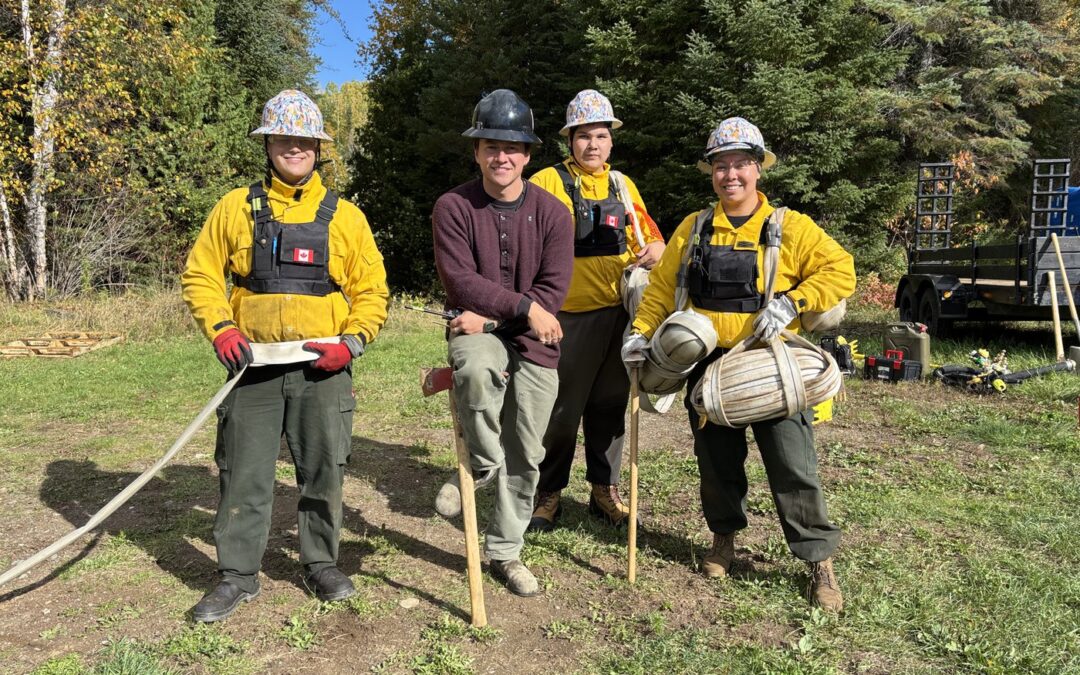
Photo: Recruit Brady Phillips from Saugeen, left, next to lead instructor Simón Bermudez from B.C., and recruits Keaton Soney from Walpole Island and Amalee Jacobs from Six Nations.
By Carrie Ivardi,
Local Journalism Initiative Reporter
SNnewswatch.com
A new wildfire management model in Northern Ontario aims to put First Nations communities in a position to train and support each other, but facilitators of the program say experienced firefighters will be needed to lead the work until the model can become fully Indigenous-led.
“The goal of the model is to provide First Nations with an ability to grow their knowledge in wildfires so that if an emergency comes, they’re better trained than not trained at all, but not to make them instant firefighters,” Simón Bermudez said.
Bermudez is the lead instructor of wildfire training with a company out of B.C. called Carmanah Wildfire, a partner of the International Wildfire Alliance (IWA). He was at Kab Lake Lodge to train a new batch of 25 firefighters between Sept. 28 and Oct. 2.
He said this was his third training session after teaching two in the spring. Recruits are from various communities throughout Northern Ontario and they come from diverse backgrounds.
The parameters are to educate people on wildfire, he said, and translate that to encompass a community.
His example: a mother of three who spent her career working in a company running a program or a business who might look at this course and think, I’m not realistically going to put on a 35-pound backpack and go hike around for eight hours for 14 days straight.
“That’s a really great person to (challenge me) as an instructor to say, if you live in a community that gets affected by wildfire, they’re going to need people who know how to order gear, who know how to organize food, who know how to take attendance, who know how to keep a time schedule.”
This is the person, he said, who can learn the terminology to help support the person swinging the fire axe or spraying the hose.
“So if somebody comes up to me and they say the term jewelry, it means that they have some kind of training because for most people it’s rings and necklaces and bracelets. But in the wildfire world what it means is all the pieces between the hoses and the pumps that you use to redirect water, to put it into another place to slow it down, the jargon for it is jewelry.”
This is terminology, he said, you wouldn’t know unless you have some training.
He said the ministries across Canada that run wildfire programs are composed of many interdisciplinary people coming in and working collectively, and they had years to build that. This new model is one that will take time to develop.
There are no shortcuts, Bermudez said. Before they take on a leadership role on a crew “they just have to go put in the work for 100 days.”
How it works for now, he said, is if you have 10 people going out on a fire it’s going to be nine experienced people with one of the Indigenous recruits. Over time, the number of experienced First Nation firefighters will grow, and “eventually it would be great if one day I came to Ontario to join a 20-person crew and it was me and 19 other First Nations (people).”