

Photo: Celebration and the launch of the Saskatchewan Indigenous Community Foundation took place at One Arrow Cultural Lodge, One Arrow First Nation, near Bellevue, Sask.
By: Nicole Goldsworthy,
Local Journalism Initiative Reporter,
SASKTODAY.ca
A new Indigenous-led foundation is aiming to reshape how philanthropic funding reaches Indigenous communities in Saskatchewan, with a focus on community priorities, language revitalization and greater access to charitable resources.
The Saskatchewan Indigenous Community Foundation (SICF) officially launched this week during a gathering at One Arrow First Nation that brought together Indigenous leaders, organizations and supporters from across the province.
According to founder and board chair Max FineDay, the foundation was established to help direct more philanthropic dollars to Indigenous communities while ensuring Indigenous people lead decisions about how those resources are invested.
FineDay told SaskToday that the organization was created in response to a longstanding gap in philanthropic funding available to First Nations communities, particularly those on reserve.
“First Nations communities are doing extraordinary work with limited resources,” FineDay said. “What has often been missing is consistent access to philanthropic funding and a meaningful role in deciding how those resources are invested.”
FineDay said Indigenous communities have not had equitable access to philanthropy and, in many cases, government funding has been the primary source of support available on reserve.
“We created SICF so Indigenous people can shape philanthropy according to our own priorities, values and aspirations,” he said.
The foundation’s approach is designed to connect donors and philanthropic organizations with Indigenous communities while keeping Indigenous voices at the centre of decision-making.
Rather than requiring communities to fit existing funding models, FineDay said SICF plans to start by listening to communities, understanding their goals and identifying ways to support those priorities.
A key part of the foundation’s mandate will be supporting First Nations communities on reserve, where traditional philanthropic funding has often been limited.
“The fact that most of our granting will take place on reserve is central to our purpose,” FineDay said.
FineDay said SICF differs from traditional charitable funding models because it is Indigenous-led and grounded in Indigenous relationships, responsibilities and ways of knowing.
“Our model is less transactional and more relational,” he said. “Communities are partners, not simply recipients, and First Nations determine their own priorities.”
The foundation expects to support initiatives focused on youth, culture, education, wellness, community development and leadership.
Language revitalization is expected to be a major long-term priority.
“Our languages are connected to our identities, cultures, histories, laws and relationships with the land,” FineDay said. “We want to make sustained investments in language speakers, teachers, learners, families and communities.”
Funding decisions will be shaped through ongoing engagement with communities, he added.
“Communities are not all the same, so our approach must reflect their different priorities and circumstances,” FineDay said.
The foundation also hopes to address barriers faced by northern and remote Indigenous communities, where access to donors and philanthropic networks can be limited.
“Geography should not determine whether a good idea receives support,” FineDay said.
He noted that northern communities often face challenges ranging from administrative requirements to the higher costs associated with delivering programs and services.
SICF plans to build direct relationships with communities to help ensure distance does not prevent worthwhile projects from receiving support.
FineDay said the launch comes at a time when many Indigenous leaders, entrepreneurs and community builders are exploring new ways to create opportunities and strengthen communities.
“Reconciliation requires more than good intentions,” he said. “It requires changing institutions, building new relationships and changing who has access to philanthropic resources.”
Beyond addressing immediate community needs, FineDay said the foundation aims to invest in long-term community strength, identity and culture.
“I want young Indigenous people to know there are institutions built by our own people that believe in their ideas, leadership and potential,” he said.
FineDay said SICF has already helped direct more than $500,000 to Indigenous-led community initiatives across Saskatchewan through funding partnerships.
“That is an important beginning, but our ambition is much larger,” he said.
He said the foundation’s long-term success will be measured by the impact communities create through those investments, including stronger languages, expanded access to philanthropy and greater opportunities for future generations.
“Our ambition is to build an enduring Indigenous institution that can mobilize resources, strengthen communities and create opportunities for generations,” FineDay said.
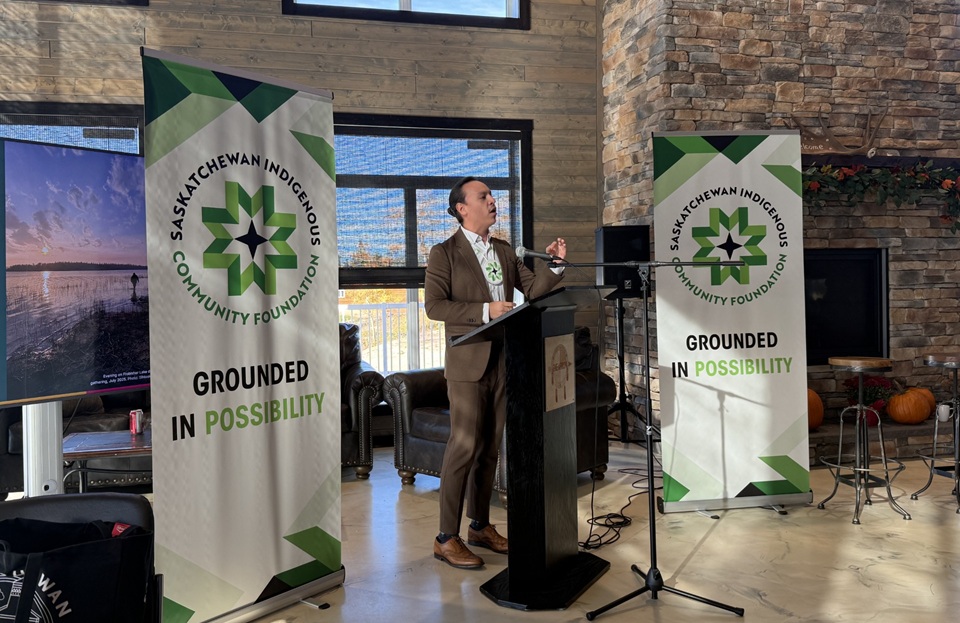
Max FineDay at the Celebration and the launch of the Saskatchewan Indigenous Community Foundation.
