
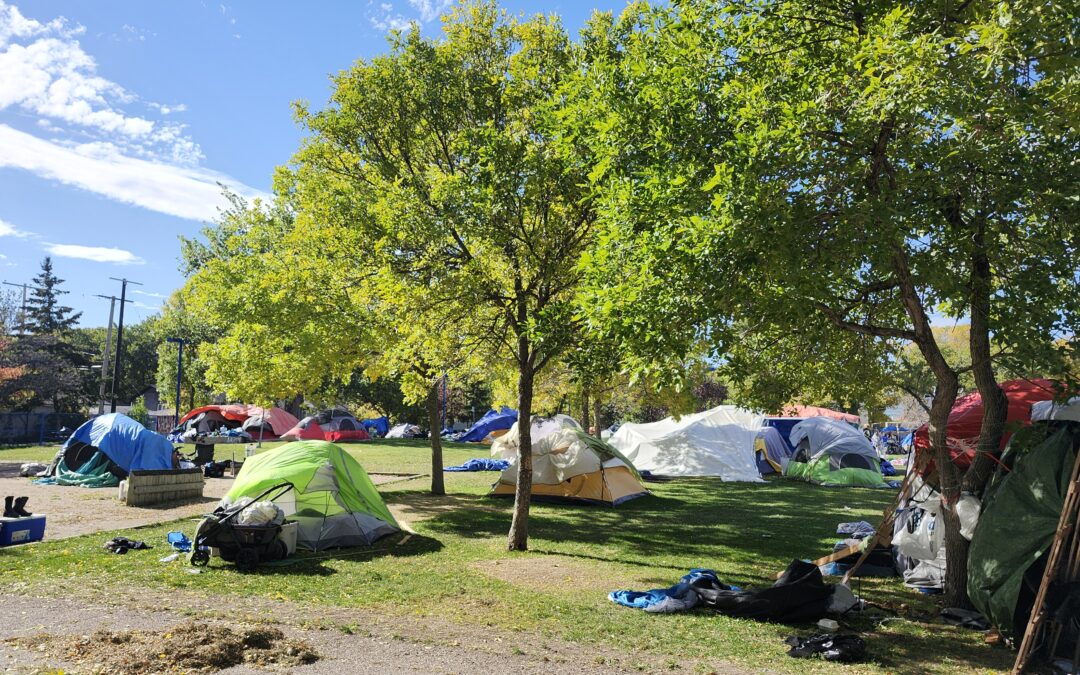
Photo of: Regina Encampment at Pepsi Park
Photo by: Danielle Dufour
After April ChiefCalf, the Shadow Minister of Housing and a Member of the Legislative Assembly (MLA) in Saskatoon, visited the encampment in Pepsi Park, Regina on Truth and Reconciliation Day, she called out the provincial government to address the houselessness issue in Saskatchewan.
“Our current provincial government needs to address the scale of the housing crisis in Saskatchewan and immediately invest in housing, mental health and addictions and adequate income supports,” said ChiefCalf in a Facebook post.
It was the second time she visited the encampment in Regina since August 13 and said, “I would say it’s doubled in size, number of people, number of tents.”
She observed there was a fire hydrant hooked up to a water station, and two porta-potties and a tent sent up with a table where volunteers distribute food.
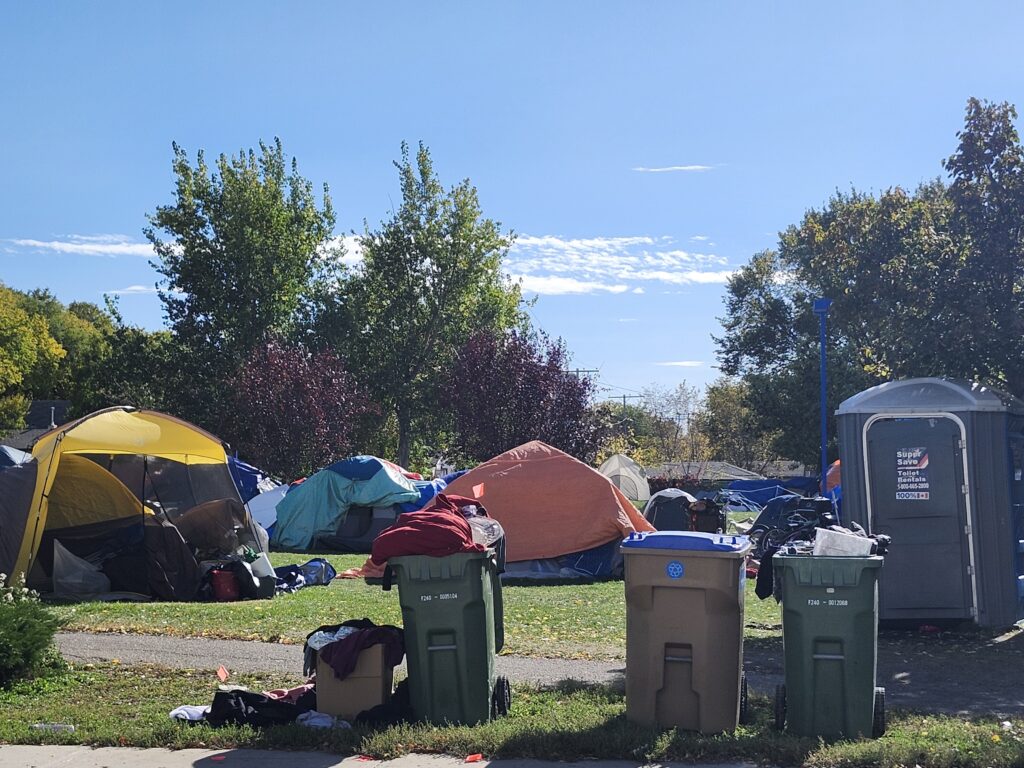
Photo by: Danielle Dufour
“The encampment is run very much by a very dedicated group of volunteers that try to have shifts, teams, where they’re all there at different times to make sure people are taken care of,” said ChiefCalf.
She said the volunteers are worried with the number of people, including seniors, on waiting lists for housing as winter season approaches.
“I just want everybody to come together, find ways to solve this housing crisis in our province, because people are going to die this winter if we can’t get them into adequate shelter,” said ChiefCalf.
The Ministry of Social Services is providing a social worker from September 24 to October 9 on Thursdays and Fridays from 1:00 p.m. to 3:00 p.m. at The John Howard Society, 1801 Toronto Street, to assist individuals seeking income support and Saskatchewan Housing applications.
“When we think about this, 150 people, a few weeks, a few hours, this is not going to address the capacity of the problem right now,” said ChiefCalf.
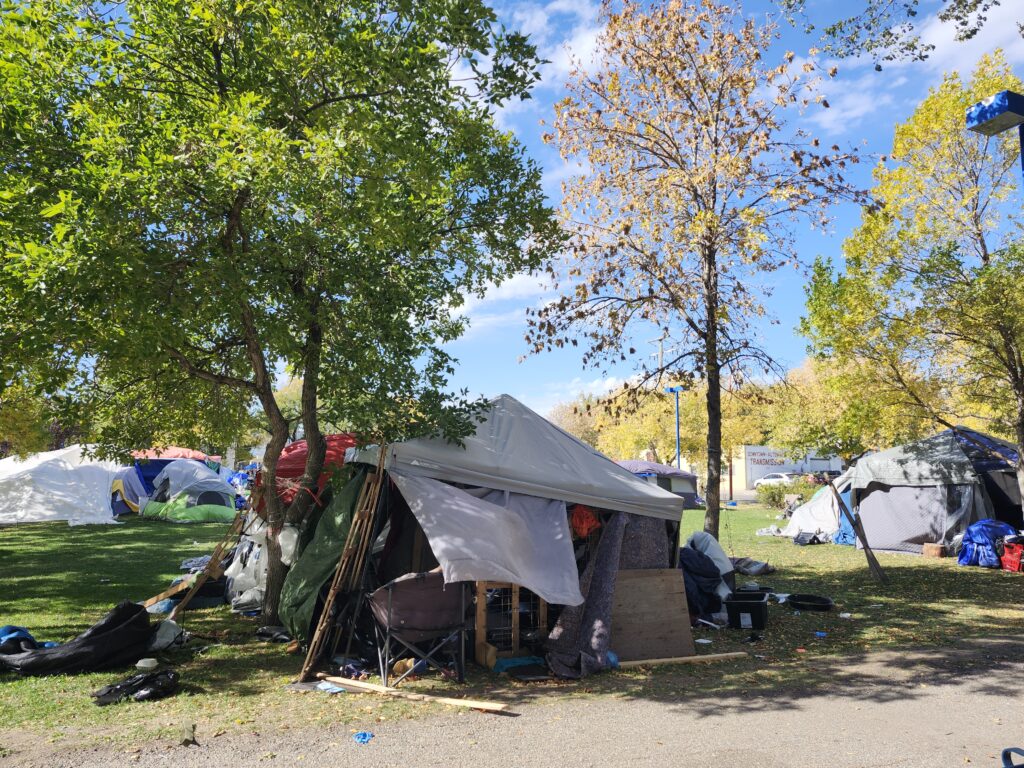
Photo by: Danielle Dufour
Namerind Housing Corporation manages and maintains the Regina Homelessness Data Dashboard and reported in August that 1106 people were experiencing homelessness in Regina, which is 44 per cent higher than last year. Of those people, 77 per cent are Indigenous.
ChiefCalf also noted the issues are not just in Regina, but provincial wide with encampments in Saskatoon and Prince Albert among other locations.
In September, a Judge in the Court of King’s Bench in Saskatoon dismissed an emergency injunction which was a request to prevent the city from clearing the encampment.
Justice Richard Danyliuk stated these systemic challenges must be resolved by elected leaders and officials, those who are directly accountable to the public.
“Looking at the judge’s ruling, I understand where the advocates are coming from, because people are living in an encampment because they have nowhere else to go,” said ChiefCalf. “The city has their concerns about when people gather, and they don’t have all the services they need; it can be problematic. Two things can be true at the same time.”
The City of Saskatoon has not stated a timeline or plan for the removal of the encampment.
“We have elected leaders, and that’s their job to address homelessness,” said ChiefCalf. “They’re not doing that, and it’s being put on the city to solve a problem that municipal governments don’t have the resources or the capacity to solve; the province has the capacity to solve this problem.”
When asked if he would describe the houselessness issue in the province as a crisis, Honorable Terry Jenson, the Minister of Social Services said, “I would describe it as an extremely complex situation, one that isn’t exclusive to just Saskatchewan. This is something happening right across our country.”
He identified affordability challenges resulting from inflation, along with the ongoing drug crisis, as contributing factors to homelessness in the province.
The Minister stated that he has spoken with individuals outside the encampments in Regina and Saskatoon but has not personally entered the encampments.
“We have our mobile outreach workers at the encampments, both in Saskatoon as well as Regina,” said Minister Jenson. “We’ve encouraged individuals who find themselves in one of the encampments to speak to our mobile outreach people.”
Ministry of Social Services requires individuals applying for Saskatchewan Income Support (SIS) to have Identification (ID), such as a social insurance number (SIN), and a valid home address.
“If they don’t have any identification, the ministry works with that individual to get them their identification so that they can get applied,” said Minister Jenson. “We work to get them an address of some sort, whether that be an emergency shelter or some other type of housing arrangement.”
Mister Jenson said the ministry works with various community-based organizations, such as Regina Treaty Status Indian Services (RTSIS), that offer different housing programs and additional supports.
“We want to be there to help these individuals, but these individuals also have to be wanting the help to begin with,” said Minister Jenson. “If there is an individual that needs help, needs to be somewhere where they’re warm, where they’re supported, we will be there for them, but we have to make sure that individual is willing to work with us as well.”