
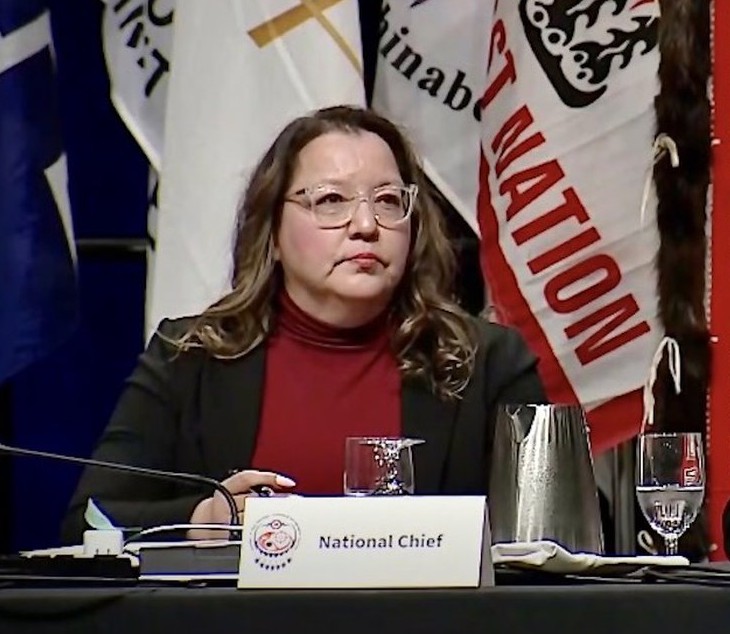
Assembly of First Nations National Chief Cindy Woodhouse Nepinak has hailed the conclusion of a historic two-day First Nations-First Ministers’ Meeting as a successful dialogue resulting in key commitments to move First Nations issues forward.
The discussions brought together First Nations leadership, Provincial Premiers, and the Prime Minister to address critical funding gaps, rights recognition, and long-term economic partnership.
“Over these two days, we saw Canada as its best,” said National Chief Woodhouse Nepinak in a statement. “Dialogue at forums like this is in the national interest. The path to progress, prosperity, and reconciliation is founded on the full recognition of our Treaty, inherent, international and constitutional rights.”
At the conclusion of Monday’s meeting, the Prime Minister announced a comprehensive series of new measures and federal funding packages:
- Economic Autonomy: Development of new revenue-sharing mechanisms, including the potential creation of a new First Nations Sovereign Wealth Fund.
- Emergency Management: $2.5 billion in funding over five years, alongside nearly $450 million in ongoing funding to better equip First Nations communities to conduct evacuations, provide emergency assistance, and rebuild homes and critical infrastructure.
- First Nations Policing: $630 million over four years, with $250 million in ongoing annual funding, to renew and expand First Nations Policing Program agreements.
- Community Safety: $140 million over four years to fund crime prevention and culturally sensitive community safety initiatives in Indigenous communities across the country.
- Workforce Readiness: $260 million over four years to establish the new Partnerships for Indigenous Workforce Readiness Fund.
National Chief Woodhouse Nepinak expressed gratitude to the leadership in attendance following the announcements.
“We want to thank all the Chiefs for their thoughtful and passionate presentations,” said the National Chief. “Each delegation brought forward concrete objectives and pathways for nation-building. We heard firsthand the determination and creativity of First Nations working hard to make a better tomorrow for our children. All are clear that Canada cannot nation-build without First Nations at the table. We look forward to following up with Premiers and the Prime Minister over the coming year.”
In addition to funding announcements, discussions touched on the future of governance and legislation. During the Monday meeting, Manitoba Premier Wab Kinew tabled a proposal to examine ways to move beyond the Indian Act, which the Prime Minister accepted.
National Chief Woodhouse Nepinak clarified that the proposal did not originate from the AFN or the attending delegation, reaffirming that self-determination remains firmly in the hands of First Nations communities themselves.
“It is important to recognize that this proposal did not come from the AFN or Chiefs from our delegation,” said National Chief Woodhouse Nepinak. “As we said yesterday in response, this is a question for Chiefs to decide. First Nations must be able to determine for themselves how they want to develop their own laws. Because our rights are our rights and this land is our land.”
National Chief comments draw ire from MN-S
The Métis Nation–Saskatchewan, however, is rejecting some of the comments made by National Chief Nepinak at the First Ministers’ Meeting in Ottawa.
The AFN Chief suggested some people identifying as Métis fit the definition of “pretendians.”
In a statement, MN-S President Glen McCallum raised concerns over this comment saying that Métis people are distinct Section 35 rights holders whose identity is rooted in their own history and culture.
“Métis people are rights holders under Section 35 of the Constitution, alongside First Nations and Inuit,” said McCallum in the statement. “No government or national organization defines who we are
MN-S is now calling for their own discussions with Prime Minister Carney and the federal government.