
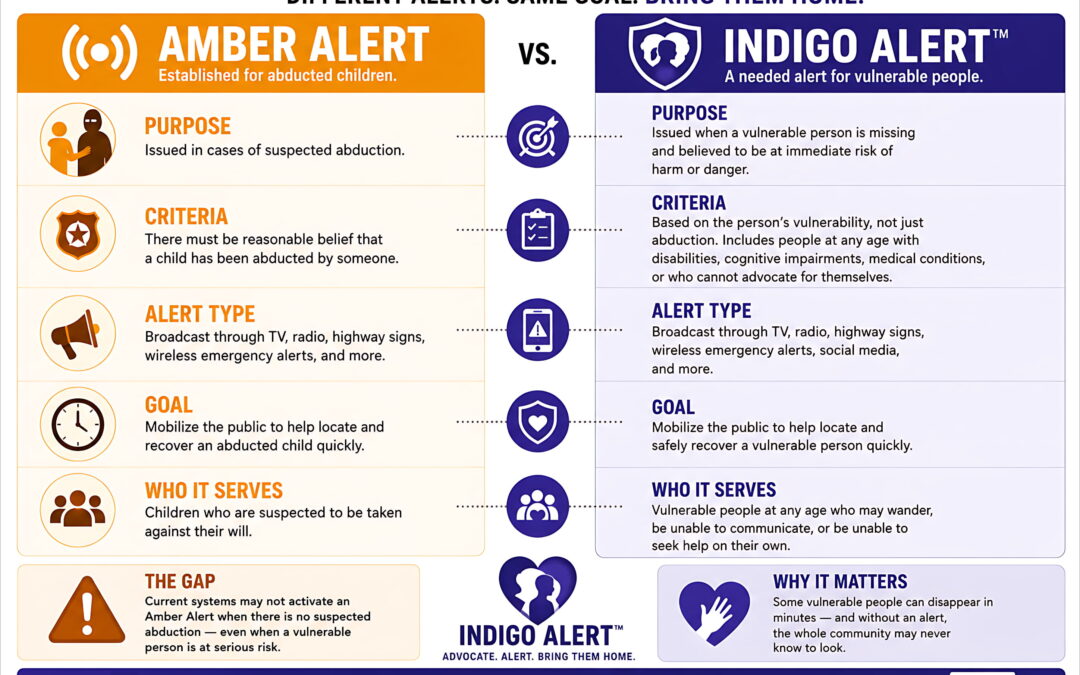
Photo: amber-vs-indigo comparison / Photo from indigoalertcanada.com
By Carol Baldwin
Local Journalism Initiative Reporter
Wakaw Recorder
On Saturday, September 12, proponents for a new classification in Canada’s alerting system gathered at the Saskatchewan Legislature.
“The point of having rallies is to not only bring awareness, but [to] bring people together so they are able to connect with each other, educate and share their stories,” said Katie Emde, national director of advocacy and operations for Indigo Alert Canada. “Because without their stories, we have no idea what’s happening in our communities.”
An Indigo Alert would be distinct from an Amber Alert, she says. “Amber Alerts’ perimeters are … around abduction. This [Indigo Alert] would be for vulnerable individuals in the spectrum of disabilities, dementia, Alzheimer’s, and there’s no age cap,” Emde said.
A province-wide alert is not triggered when a vulnerable person, who relies on caregiver support, cannot self-rescue, wanders off with no one able to explain where they went, leaving them alone near roads, rivers, or in dangerous weather. An Indigo Alert, if instituted, would be issued when a vulnerable person is missing and believed to be at immediate risk of harm or danger. Some vulnerable people can disappear in minutes, and without an alert system, the whole community may never know to look. The goal is to mobilize the public to help locate and safely recover a vulnerable person quickly.
Jennifer Ball, a mother of a non-verbal autistic child, spearheaded the campaign, which gained urgency after an 11-year-old non-verbal autistic boy, Parker Wells, went missing from a Calgary day home in July 2026. No Amber Alert was issued in the first two days of the search because Parker had not been abducted. An exception was ultimately made to send one out on July 18, but “the time it took to reach the community was detrimental,” said Ball in an interview.
Ball started a petition on Change.org asking Canadian authorities, provincial and federal, to formally recognize that a child who cannot explain where they are, or recognize danger, faces a completely different kind of risk than the one Amber Alert was built to address, and create a new alert category for medically or developmentally vulnerable missing children. The original Change.org petition has since passed 41,000 signatures, but Change.org signatures are not tabled in Parliament or officially recognized by the House of Commons. A petition being linked on Indigo Alert Canada’s site, built on that same petition and the same momentum, has a broader ask than the original: for an Indigo Alert covering vulnerable people of any age, including older adults with dementia. The e-7703 petition, linked on indigoalertcanada.com, is recognized by the House of Commons, so it is that petition that will carry formal weight with government, and the one the creators are asking Canadians to sign now.
Over 9000 signatures have been added to the e-7703 petition, first created on August 24, and sponsored by Mike Lake, MP for Leduc-Wetaskiwin, who will present it to Parliament. It remains open for signatures until December 22, 2026, at 3:13 p.m. (EDT)
Some statistics that highlight the danger:
- 49 percent of autistic individuals have attempted to elope (run away or wander off) after age four.
- More than 33 percent of autistic individuals who elope cannot communicate their name, address, or phone number.
The Office of the Honourable Michael Weger, Minister of Community Safety, offered the following statement. “SaskAlert operates within Canada’s National Public Alerting System (NPAS) and follows the Canadian Alerting Protocol-Canadian Profile (CAP-CP), which establishes the alert categories authorized for use across the country. …SPSA believes there remains a gap for vulnerable missing persons and supports the development of a nationally consistent Indigo Alert, At-Risk Alert, or Missing Vulnerable Person category to address these situations.”