
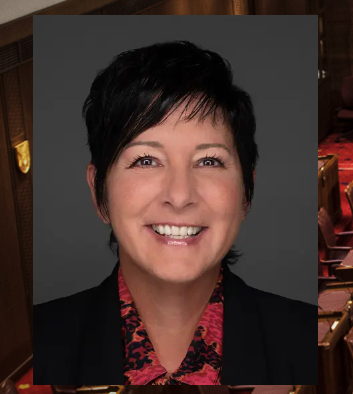
Photo: Senator Tracy Muggli, Progressive Senate Group / Parliament of Canada
By Carol Baldwin
Local Journalism Initiative Reporter
Wakaw Recorder
The Senate Committee on Agriculture and Forestry visited Saskatoon and other areas of Saskatchewan this week, as part of its study on the role of the agriculture and agri-food sector in Canada’s food security. The Senators met with stakeholders from across the food supply chain, including food access organizations, agri-food innovators and researchers, and participated in facility tours to gain first-hand insight into challenges and opportunities related to food security, resilience and innovation.
Saskatchewan’s Senator Tracy Muggli, who sits on the committee, grew up on a Saskatchewan grain farm and is a registered social worker, senior executive, and former provincial public servant with over 35 years of experience in the health and social services sectors. We spoke with her about the committee and its focus.
The committee, which launched this study in fall 2025, seeks to better understand the state of food security in Canada. Senator Muggli explained, “We’re taking a pretty deep dive into some aspects of food security. It’s complicated because we’re trying to look at food security, food insecurity, and food sovereignty, and it’s a big continuum that starts with a seed in the ground and ends on a grocery shelf.”
Committee members are examining barriers to food access in Canadian communities, how the environment and agriculture affect food security, and how federal policies and programs can be strengthened to support a secure and sustainable food supply.
In 2023, approximately 25.5 percent of the population in Canada’s 10 provinces, roughly 10 million people, lived in households that reported experiencing some form of food insecurity, according to Statistics Canada. In the territories, that figure rose to 37.4 percent of the population… and this was all before the recent unprecedented jump in grocery prices.
For obvious reasons, Muggli said, the committee feels it’s important to pursue food sovereignty because so much of our fruits and vegetables, for example, are transported through the United States before they ever get to us, regardless of where they come from. Ships from around the world dock at American ports where cargo is offloaded onto trucks that then make their way to Canada.
During the committee’s visit to Saskatoon, they heard of many aspects of research, while also hearing “a lot” about the gap between research and processing, sometimes referred to in the industry as ‘Death Valley.’ Canadian scientists complete amazing crop science research and create new varieties that perform better in our climate, Muggli noted, but once that crop is harvested, the raw commodity is sent elsewhere for processing. She was pleased and excited about the Prime Minister’s announcement of the $1 billion funding commitment for the Agri-Food Project Finance Fund, delivered by Farm Credit Canada, to boost domestic food processing and manufacturing.
Tyler McCann, managing director of the Canadian Agri-Food Policy Institute, said that in Canada ‘we don’t do big well’ and ‘we don’t do ambitious well’ when it comes to agriculture or agri-food either. When asked about this comment and if she thought there needs to be a shift in Saskatchewan’s collective mindset to make agri-food processing a more major player, here in the province, she acknowledged the psychological ‘comfort zone’ of remaining an exporter of raw materials.
“We grow comfortable in a certain way of existing, so how can we create synergies in industry and get people more excited and develop a level of confidence that somebody’s got your back if you decide to step out of a comfort zone and take a risk in some aspect of food processing? There has to be some support from government to help give people confidence, especially if someone is a smaller producer. To leverage part of your operation to invest in that production side is a tough call. Once people do start taking some of those risks, others will see that it is possible, and momentum will build.”
Some information that the committee has gathered has already been examined by other members of the government, and Senator Muggli is optimistic that the fact-finding mission will yield further positive results.