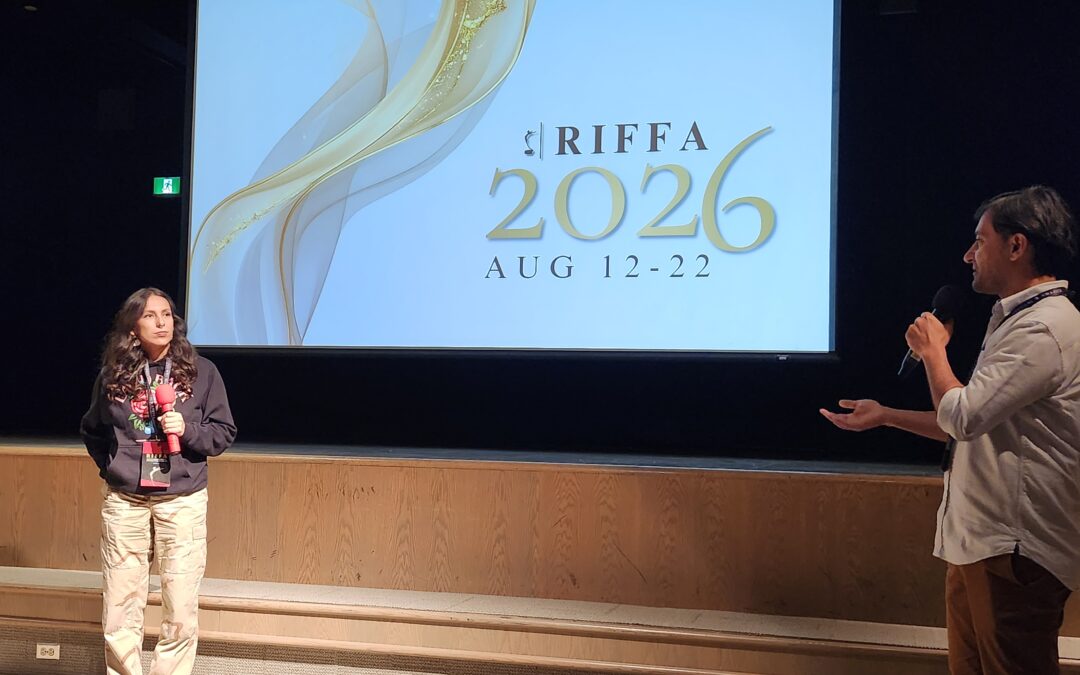
Photo of: Tristin Greyeyes at the Saskatchewan premiere of A Cree Approach
Photo by: Danielle Dufour
Filmmaker Tristin Greyeyes of Muskeg Lake Cree Nation brought her feature documentary A Cree Approach home to Saskatchewan with a Regina screening at the MacKenzie Art Gallery Shumiatcher Theatre on Aug. 21, following its March 7 premiere at the VIFF Centre in Vancouver.
In A Cree Approach, Greyeyes explores why Cree was not her first language. The documentary is a portrait of her late Nokom, grandmother in Cree, Freda Ahenakew who was a Cree educator, and draws on archival material, photographs and interviews to tell her story and examine her legacy.
“We get to learn her life story, and how she became this important person in our Indigenous Cree and Canadian history, of saving and helping to retain Cree language and revitalization,” said Greyeyes.
Freda Ahenakew was born in 1932 on Ahtahkakoop Cree Nation in Saskatchewan. She died in 2011.
During her life, she dedicated much of her time trying to save the Cree language, while providing for her 12 children and others who came into her care.
Ahenakew went on to study at the University of Saskatchewan, where she earned her Bachelor of Education in 1979. She later completed a master’s degree at the University of Manitoba.
She was also awarded honorary Doctor of Laws degrees from the University of Saskatchewan in 1997 and the University of Manitoba in 2009. In 1998, she was appointed to the Order of Canada.
Ahenakew’s master’s thesis, originally completed in 1984, was later published in 1987 as the book titled Cree Language Structures: A Cree Approach.
Greyeyes said the goal of the film is to inspire people to want to learn their Indigenous language or to retain it.
During the making of this film, when she first saw archival footage of her grandmother in a documentary called Mother Tongue, Greyeyes felt overwhelmed and shocked and said, “She was so young, younger than I knew her. She was a teacher by then. She was speaking English fluently, because Cree is her first language, and when she had strokes, she only really spoke Cree and just very little English. It was like a totally different person.”
Although Greyeyes isn’t fluent in Cree, she remembers living with her grandmother and asking her Nokom to teach her the Lord’s Prayer in Cree. “We did that every night,” she recalls.
Greyeyes has made several short films, but A Cree Approach marks her debut as a feature-length documentary filmmaker.
She has received several accolades for the film, including the GEMFest Award for Best Feature Film and won Best British Columbia Feature Film at the 2026 Sundar Prize Film Festival for A Cree Approach.
A Cree Approach was also nominated for Best Documentary Feature Film at the 2026 Regina International Film Festival and Awards (RIFFA).
Greyeyes said the film is set to be screened at an Indigenous film festival in Colorado at the end of September.
She plans to join the International Cinematographers Guild (ICG) camera union as a camera trainee and travel to India in November to work with Photographers Without Borders.