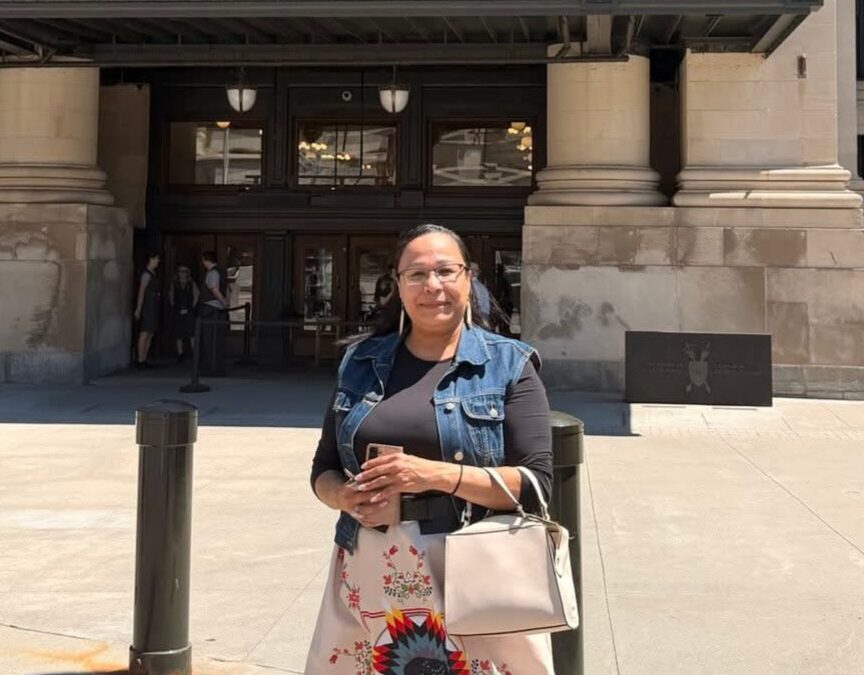
Photo: supplied by Silvia Mckay
The House of Commons passed an amendment to the Canadian Criminal Code to criminalize forced or coerced sterilization. Bill S-228 received Royal Assent on June 15. The law states that sterilization without legal consent constitutes aggravated assault which carries a maximum penalty of 14 years in prison.
Silvia Mckay, one of the first survivors to come forward with her story in 2015, was there when the Bill passed and said, “It was very emotional and overwhelming. All these years I’ve advocated, I’ve always wanted accountability and justice. The sadness only comes because of what happened to me.”
“I was sterilized against my will in 2001. I was 29 years old,” said Mckay. “I signed no consent, I said no many times, and nobody listened.”
This occurred at the Royal University Hospital in Saskatoon.
After giving birth to her sixth child, her son, Mckay said she was put in a wheelchair and moved to another location in the hospital where the hospital staff forced her to stay.
“And finally, this man says, there, you’re tied cut and burnt. Nothing will get through that,” said Mckay.
She was not given any explanation as to why they were doing this to her. There were no health concerns that would prompt the medical team to perform this sterilization.
Mckay believes this was a result of discrimination and racism towards Indigenous people and said, “Saskatchewan is like the epicenter of it all.”
The Survivors Circle for Reproductive Justice estimates 15,000 Indigenous people have been sterilized without their consent from the 1890’s to 2025.
Now the organization is working with the federal government around the guidance of implementing this law while continuing to support survivors.
Mckay is a survivor’s support worker with the Survivors Circle for Reproductive Justice and manages over 100 cases from people across the country, but mostly in Saskatchewan.
“I think it’s important for people to know that this isn’t historical and that this is still happening as recent as 2025,” said Mckay.
An “R” symbol indicating a “Registered Indian” declaration was automatically printed on health services cards in Saskatchewan when individuals applied for a card and self-declared.
One of the first things Mckay’s team worked on was the removal of the “R” from health cards in Saskatchewan. Mckay said, “Right away, as soon as you go to the hospital, you’re already listed.”
The Saskatchewan governments decision to remove the identifier took effect March 1, 2022.
Mckay’s experience has left her terrified of doctors and hospitals and she avoids seeking medical treatment.
She received backlash and racists comments for sharing her story.
As a plaintiff in a class action lawsuit in Saskatchewan against the provincial and federal governments with some named doctors, she is awaiting the decision from the appeal hearing that took place May 6th.
“You are not alone,” said Mckay. “I’ve been advocating since 2015 and before this, I always thought it was just me, but it’s not. We aren’t alone.”
She would like more people to be aware of the history of forced and coerced sterilization and the newly amended law to protect the generations to come.
While the Society of Obstetricians and Gynaecologists of Canada (SOGC) condemn the practise of coerced or forced sterilization without consent, SOGC raised concerns over Bill S-228 that the legislation could have unintended consequences for patient care in Canada, where fear of criminal liability could delay urgent life-saving decisions in emergency situations.
“I believe that if you’re doing everything that you’re supposed to as a doctor there wouldn’t be any backlash,” said Mckay.