
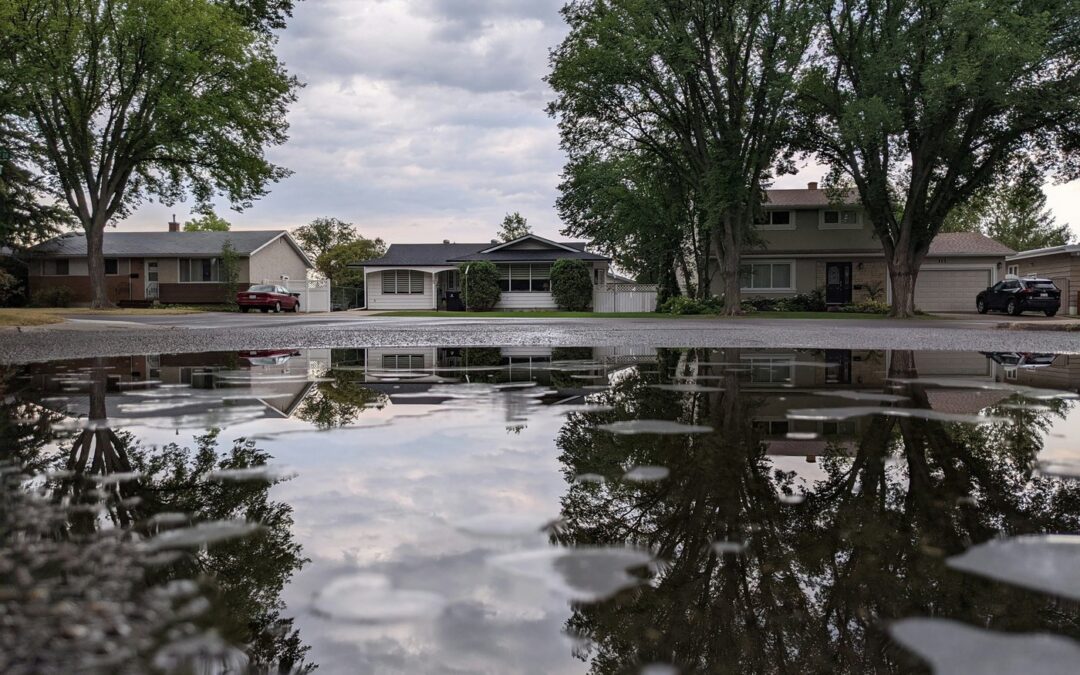
Photo: Trees beside standing water near Salisbury Drive in Saskatoon, Sask.
By Sonal Gupta
Local Journalism Initiative Reporter
Canada’s National Observer
Saskatoon is planning to keep a retrofit loan program running after its federal-backed support ends to help homeowners continue to cut emissions from buildings.
The city’s updated climate strategy, headed to council later this month, is meant to guide Saskatoon toward its 2050 net-zero target. Homes, apartments, businesses and other buildings account for about 61 per cent of local emissions, mostly from electricity and natural gas, said Amber Weckworth, the city’s climate manager.
Saskatoon has many older homes: 79 per cent were built before the mid-2000s real estate boom, meaning many need energy-efficiency upgrades.
That makes retrofits one of the most important parts of the plan as Saskatoon looks for ways to cut energy use.
Saskatoon’s Home Energy Loan Program lets homeowners borrow money for upgrades such as insulation, windows or more efficient heating, and repay it through their property taxes, Weckworth said. Saskatoon started the program with city money in 2021 and expanded it in 2022 with support from the Green Municipal Fund, a federal program administered by the Federation of Canadian Municipalities.
The federal portion of the program is expected to end within one to two years, but the city has committed to continue funding the program, Weckworth said.
“The Home Energy Loan Program has been a really great program,” Weckworth said. “We do find that residents are really interested in these programs. They want to retrofit their home.”
An FCM spokesperson said its Green Municipal Fund invested nearly $11 million through its Community Efficiency Financing initiative to help Saskatoon expand financing for residents who want to make their homes more energy efficient. As of June 2026, 358 homeowners had been approved and 289 had completed upgrades, including deep energy retrofits, the spokesperson said.
The program also offers $1,000 rebates for energy audits, which help homeowners understand where their home is losing energy and which upgrades should come first, Weckworth said.
A Green Municipal Fund case study found Saskatoon’s program had supported upgrades such as windows, furnaces and attic insulation and that only four per cent of surveyed participants said they would have done the same work without the financing.
“Without a loan program, some of the more challenging retrofits might not happen,” Weckworth said.
Heat pumps are one example of a tougher upgrade. They can replace or reduce fossil-fuel heating, but Weckworth said they can be a difficult first step in Saskatoon. Cold winters mean homes need a lot of heat and many houses may need insulation or window upgrades or other efficiency work for a heat pump to make financial or climate sense.
Installing a heat pump in a home that has not first been made more efficient could cost more to run and may even increase emissions, she said.
Retrofits are especially challenging in Saskatoon because homes have to handle both deep winter and hotter summers, said Greg Poelzer, a professor at the University of Saskatchewan’s School of Environment and Sustainability.
“When we get our -30s, so many days per year, that’s a massive heating load,” Poelzer said. “The same retrofits on things like insulation also matter for cooling loads and that’s going to be increasingly important as climate change continues.”
Saskatoon plans to continue offering the audit rebate and to keep applying for federal funding so it can offer additional rebates through the program and make it more attractive to residents.
The FCM spokesperson said the federal money behind this type of home-upgrade financing is nearly fully allocated, but cities such as Saskatoon will still have access to technical support and peer networks. The goal was not only to pay for individual renovations, but to help cities build loan programs that can keep helping homeowners over time. Federal support has helped grow similar programs from a handful of pilots to more than 40 across Canada, they said.
Some cities are now putting their own money into local home-upgrade programs or bringing in private financing. Ottawa, for example, has used private capital to help support its program and extend the reach of the original federal investment, the spokesperson added.
The federal government is also rolling out the Canada Greener Homes Affordability Program with provinces to cover retrofits for low- and median-income households at no upfront cost. Saskatchewan has not yet joined, but SaskPower has applied.
Climate change is still accelerating, but for many people it now competes with problems that feel immediate. Programs that make homes more comfortable, lower energy use, support local work and save money over time are easier to explain and more likely to get buy-in from residents than lofty emission targets, he said.
The path to net zero
Saskatoon does not yet have all the pieces needed to reach net zero, the city’s climate strategy shows. Even if Saskatchewan’s grid becomes much cleaner, its current plan is expected to cut community emissions 69 per cent below 2014 levels by 2050.
The city’s current focus is on actions it can take over the next decade, Weckworth said. The longer-term path is harder to pin down because it depends on issues outside city hall, including future technology, funding and decisions from other governments.
Poelzer said Saskatoon’s strategy gets important pieces right, including retrofits, city fleets and energy literacy. But the city could be more ambitious in areas it controls, especially new construction, he said.
As Saskatoon grows, he said, new subdivisions could be designed so rooftops are better positioned for solar panels. Building rules could also require relatively inexpensive drain-water heat recovery pipes, which capture heat from used water from showers, laundry and dishwashing. Those measures are not central to the current strategy, he said.
Saskatoon could also move faster on city fleets and invest more in active transportation, such as infrastructure that makes it easier to walk or bike, Poelzer said. Those are areas where municipalities have more direct control than they do over the provincial power grid or private household spending.
Still, Poelzer said the city’s climate strategy is moving in the right direction. “I’ll take 70 per cent of something over 100 per cent of nothing every day of the week,” he said.
Weckworth said the city is treating climate action as an economic issue, pointing to rising home insurance costs, basement flooding and wind damage as examples of climate-related costs residents are already facing. Residents who took part in city engagement linked climate action to affordability, housing, health and infrastructure and said the city should focus on the biggest sources of emissions rather than expect too much from individual behaviour.
“Where both residents and city council are making decisions to invest money is where they know they can have a payback,” she said, “And they know that there’s going to be long-term financial benefits.”
Sonal Gupta / Local Journalism Initiative / Canada’s National Observer.