
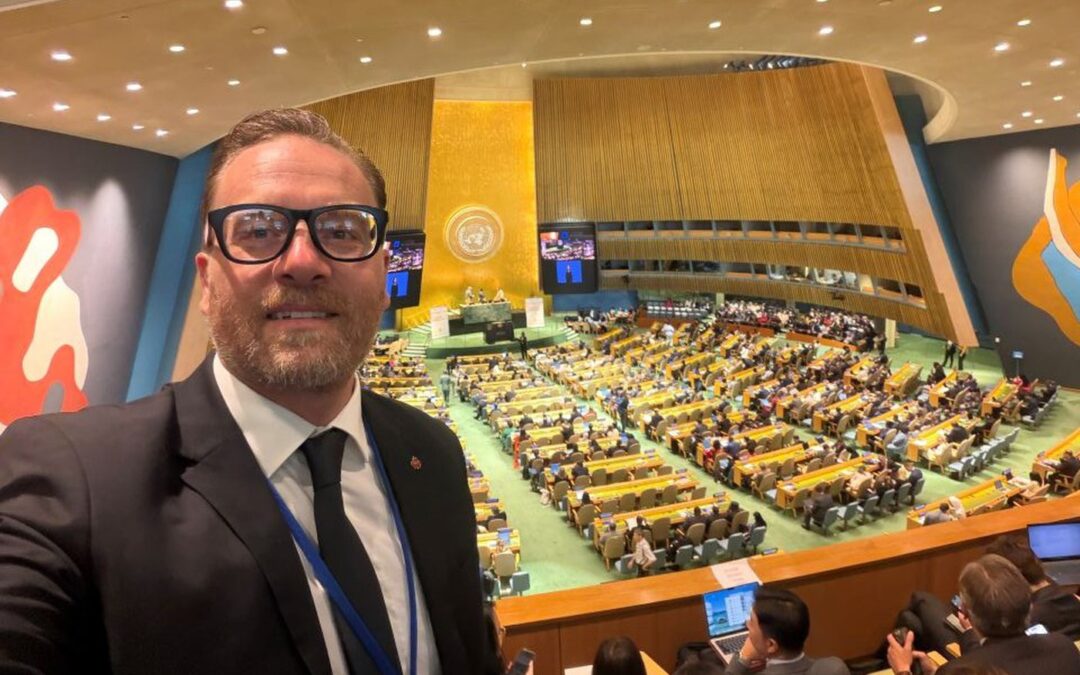
Photo: Mayor Kienle at United Nations Forum in New York City. / Photo courtesy of Mayor Kienle
By: Andrea Moss
Local Journalism Initiative Reporter
SASKTODAY.ca
Yorkton Mayor Aaron Kienle and Métis Nation–Saskatchewan regional representative Darcy Lepowick recently took part in discussions at a United Nations forum in New York City, bringing perspectives from rural Saskatchewan to an international stage. The focus was on sustainable development, infrastructure and community resilience.
Kienle participated as a panellist at the United Nations High-Level Political Forum, appearing at Canada’s official side event titled Cities that Work for People: Connecting Social Policy and Infrastructure for Resilient Communities.
The event explored how communities can better connect social policy with housing, infrastructure and community design to create more inclusive and resilient cities.
Kienle said his involvement stemmed from work Yorkton has been doing around the United Nations Sustainable Development Goals, a framework of 17 objectives adopted by UN member states that address issues including poverty, healthcare, clean water and sustainable communities.
“These goals are all, for lack of a better term, no-brainers,” Kienle said. “We’re talking about clean water and better health care and zero poverty and no hunger.”
He said Coun. Stephanie Ortinsky first introduced him to the initiative through Local Futures, prompting him to become involved in discussions and research around sustainable development. That work eventually led to an invitation to join a Canadian delegation attending the annual forum.
Kienle said he was one of only two mayors on the delegation and was later asked to join a panel discussion representing municipalities of Yorkton’s size.
“I just try to represent the city really well, and opportunities and doors open,” he said. “Most of the time on the other side is good opportunity and good value for the City of Yorkton.”
During the panel, Kienle highlighted Yorkton’s long-standing need for a new wastewater treatment plant, describing it as a critical piece of infrastructure needed to support future growth.
He told delegates that solving the issue would allow for additional housing, industrial development, commercial growth and support major projects such as a new regional hospital.
“All those things can only happen if this problem is solved,” Kienle said.
However, he noted the scale of the project makes it difficult for the city to address alone.
“The cost is so great and our tax base is so small. Partnership with the provincial government and the federal government is absolutely crucial.”
The timing of the forum proved particularly beneficial, Kienle said. This year’s discussions focused on issues including clean water, sanitation, sustainable communities and infrastructure, topics directly connected to Yorkton’s priorities.
As a result, the Canadian delegation was led by federal Housing and Infrastructure Minister Gregor Robertson, giving Kienle opportunities to share Yorkton’s challenges directly with senior decision-makers.
Beyond the formal panel discussion, Kienle said he spent additional time speaking with Robertson, ministry officials and Deputy Minister Paul Hoka, advocating for federal support for infrastructure projects in Yorkton.
“As we’re seeking in excess of $100 million of funding from the federal government, and also the third portion from the provincial government as well, I’m going to do whatever it takes to put myself in the best places,” he said.
Kienle also described the forum as an opportunity to learn from communities facing similar challenges around the world.
One presentation that stood out involved a mayor from a community of 40,000 people celebrating access to clean drinking water for the first time.
“It was such a beautiful thing and also something that really shows perspective on a global front,” he said.
Lepowick also attended the forum on behalf of Métis Nation–Saskatchewan after receiving an invitation through the Canadian Consulate.
Lepowick, who serves as regional representative for Eastern Region 2A and as Minister of Environment, Agriculture, Lands and Resources, said he was struck by the calibre of attendees.
“I was surprised,” he said. “I didn’t expect high-end ambassadors from different countries and leaders of countries from all over the world.”
Despite the global nature of the discussions, Lepowick said many of the themes mirrored issues facing Métis communities in Saskatchewan, including food sovereignty, water security and sustainable development.
“It was still relatable to things that we’re doing here,” he said.
Lepowick said representation was particularly important because many people outside Canada remain unfamiliar with the Métis Nation and its distinct identity.
“A lot of times the Métis Nation or Métis people are known as a forgotten people,” he said. “Especially on the international stage, people don’t know who the Métis people are.”
While viewing an Inuit artifact from Canada, Lepowick said, he learned there were no Métis or First Nations artworks or artifacts on display.
The experience sparked discussions about the possibility of one day contributing a culturally significant Métis item, such as traditional beadwork, to the UN.
“It’ll be very significant for the Métis people to have something at the United Nations building,” he said.
Lepowick said the trip also provided opportunities to build relationships and gather ideas that could be adapted to local communities.
“The idea is just to apply them here,” he said. “It’s similar to other countries where water security and food sovereignty are all issues.”
Both delegates said the experience created valuable connections while ensuring the voices of Yorkton and the Métis Nation were included in conversations about global challenges and local solutions.