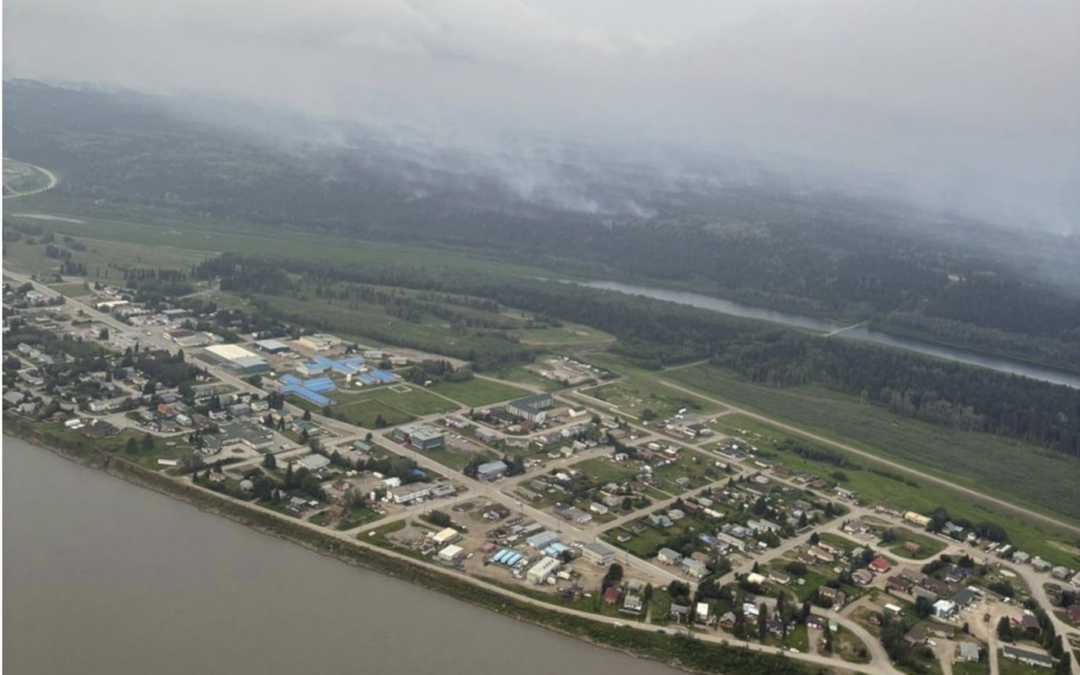
Photo: A photo of Fort Simpson and the encroaching wildfire taken at 8:30 a.m. on July 1. The fire has led to the town’s evacuation and halted investigations from the Transport Safety Board of Canada into a nearby plane crash which killed three people on June 24.
By: Dylan Follett
Local Journalism Initiative Reporter
Yellowknifer
While the lead investigation has been interrupted by wildfires and an evacuation, early findings suggest an “in-flight breakup” caused a Bird Dog firefighting aircraft to crash near Fort Simpson on June 24, says Transport Safety Board (TSB) regional manager Jonathan Lee.
The crash involved a Bird Dog Turbo Commander 690 Bird Dog 104 plane operated by Buffalo Airways as part of the GNWT’s firefighting fleet, which was helping to combat a wildfire east of Fort Simpson. All three of the crew on board were killed.
Lee said the initial investigation of the crash site found the wreckage missing the plane’s left wing and its tail section, including vertical and horizontal stabilizers, suggesting they came off in the air before the crash.
However, it’s unlikely the crash site itself will turn up any more information soon, as investigators “can’t do anything” more on site due to wildfires in the Deh Cho region, which caused the evacuation of Fort Simpson.
What the TSB was able to find before the evacuation is only an incomplete picture: investigators still don’t have the missing parts, and the “areas of interest” for the wreckage they did find are buried feet-deep in the muskeg.
“It’s a mystery right now as to what we’re going to see in terms of fracture surfaces, damage to the structure and all those signs that lead us or help us determine which of these [types of causes] this in-flight failure falls into,” Lee said.
That determination will only come after the TSB is able to get all the wreckage to its lab in Edmonton, which won’t happen until the Fort Simpson evacuation is lifted and the fires are under control.
Lee said in-flight breakups, which are “very rare,” can be caused by how the plane was flown, by conditions like extreme turbulence or through improper maintenance that compromises the aircraft. It could also be caused by a mid-air collision with something, though Lee said the TSB didn’t find evidence of that.
The TSB is an independent agency that investigates transport incidents in Canada. Its investigation is not the only one into a crash like this — the NWT Coroner’s office, Buffalo Airways and other groups also carry out their own probes. However, Lee says the TSB tends to get priority and be on the “leading edge” of investigations.
TSB investigations generate a written report, and do not assign blame or punishments. An RCMP investigation was also triggered by the plane crash, as is required, and officers attended the crash scene. That investigation was concluded on July 1 after no evidence of criminality was found, according to an RCMP spokesperson.
Investigations at the wreckage site are only about five per cent of the greater TSB inquiry, Lee explained. The rest involves obtaining and sorting through a “fire house of information.” They investigate the aircraft, its history, maintenance and any ongoing issues or previous accidents the plane had.
They also look into the people involved, from pilots to maintenance crews to management, and the environment, including weather. As well, they review the aircraft’s mission and the expectations and organizational management of its final flight.
While these are less hindered by the fires, Lee said the “process of elimination” from this data is also a lengthy task, and has only just begun in recent days.
He noted that even in the best conditions, TSB investigations consume time that the anxious public may find frustrating. He urges patience as fires slow the investigation further.
“The whole [investigation and report] process takes time because we don’t have the luxury of speculation,” he said. “What can happen is people who have a megaphone or a platform, like a YouTube channel, will get in there, and nature hates a vacuum, so they’ll fill the vacuum with their own speculation based on very little information.”
The fire keeping Fort Simpson evacuated and the TSB at bay continues to grow. It’s now more than 15,000 hectares and burning actively “adjacent” to the community, and presents a threat of even further growth, according to a July 2 GNWT news release.