Photo: PPT
By: Patrick Quinn
Local Journalism Initiative Reporter
The Nation
Following a week of testimony, Canada was judged guilty of genocide by the Rome-based Permanent Peoples’ Tribunal, an international court of opinion that convened in Montreal May 25-29 to investigate the country’s residential school impacts.
“In international law, genocide need not involve mass killings,” said PPT co-chair Frances Webber. “It can be a slow and continual process taking place over centuries. The genocidal intent behind the forced removal of children was explicit.”
This is the preliminary verdict from seven judges of the 57th PPT, a legally non-binding forum that has examined human rights violations on a global stage since 1979. A final decision and report will follow on September 30, the National Day for Truth and Reconciliation, after the judges have pored through nearly 900 pages of evidence.
The Native Women’s Shelter of Montreal (NWSM) requested the tribunal in 2024 to demand accountability for crimes against Indigenous children in Canada’s residential schools. Ten years after the federal Truth and Reconciliation Commission, NWSM executive director Na’kuset said its 94 calls to action have been largely ignored.
“Canada gets all these reports and they just sit on the shelf,” asserted Na’kuset. “When you bring in a European body, it has a different tone – it’s not a Canadian thing they’re funding. I felt we needed to do something stronger.”
Na’kuset highlighted that Mohawk activist Mary Two-Axe Earley fought against Indian Act gender discrimination for almost 10 years, but Canada didn’t change its law until she brought her case to the United Nations.
“What’s funny with the government is they cut the funding to do radar searches [on former school sites] and a week before the PPT they’re saying now we’re going to give you some money,” said Na’kuset. “It’s not an accident. You put the pressure on and they’re like, ‘Oh yeah, you caught us, we’ll do it.’”
Organizing for the hearings began with monthly meetings between survivors, Elders and sometimes the legal team, led by tribunal lead prosecutor Christa Big Canoe. Co-hosted by Amnesty International, local universities and organizations like Know History, Future Generations and the David Suzuki Foundation provided support.
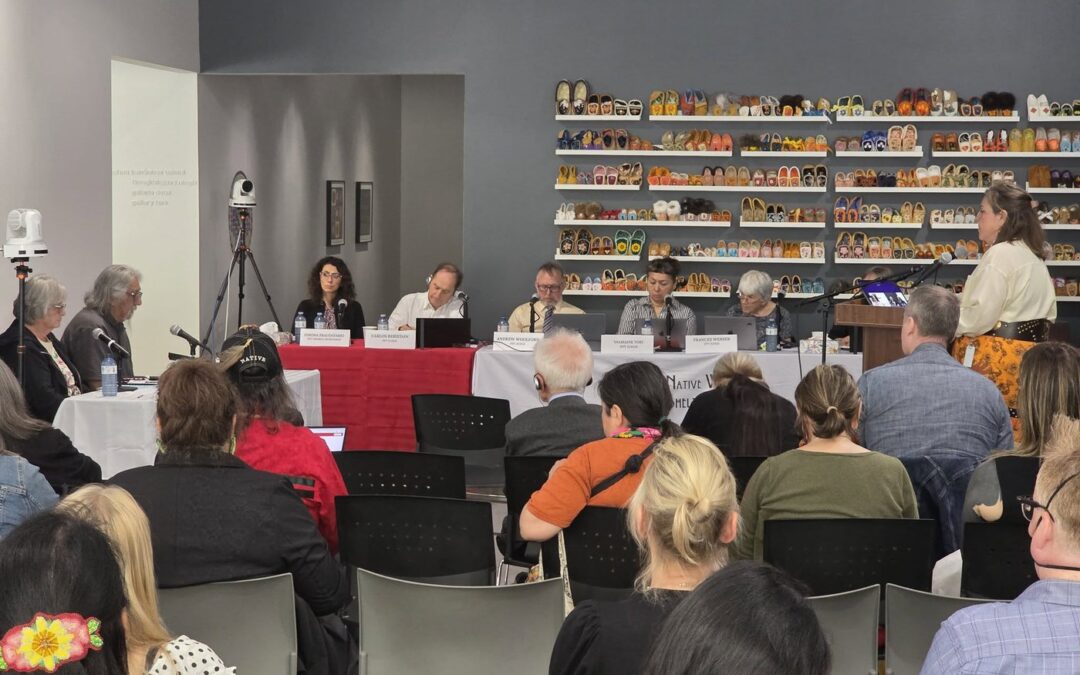
Public hearings were held at Montreal’s Indigenous-run Daphne Art Centre. A moccasin display borrowed from Jessica Hernandez’s Kahnawà:ke craft shop provided a focal point. The Survivors’ Secretariat, established in 2021 to support investigations at the Mohawk Institute, found speakers who wouldn’t be traumatized by the process.
“I didn’t necessarily want survivors because I was afraid for their well-being,” explained Na’kuset. “Everyone felt really supported, between the judges and the community. We had firekeepers for the sacred fire running for the whole five days.”
Cree survivor George Diamond shared his story of being taken from Waskaganish to Moose Factory at age four, before being transferred in Grade 6 to the Mohawk Institute in Brantford, Ontario. Diamond recalled frequent strappings, shaming and other punishments, spending 85% of his time in the basement.
“Now I call it a prison,” Diamond told the Nation. “It was devastating to live in those conditions. They’d strap us seven times on each hand. We told each other not to cry, no matter how much it hurt.”
When Diamond toured the former school in 1993, he was shocked to discover the room where they were punished. The floor, walls and ceiling were painted black in this “press room” that supervisors threw kids into and turned out the lights.
“It wasn’t time out – it was torture,” said Diamond. “We were just kids. That kind of punishment stays with you a long time. After residential school, many people couldn’t deal with it. I had a very good support system that made me stronger.”
When the plane left his community’s beach at the end of each summer, mothers would ensure their children’s footprints in the sand were left undisturbed so they could return and think of them. Diamond said his mother’s crying could be heard across the street after her five children were taken.
Numerous witnesses described the system’s numbing physical, emotional and sexual abuse, as well as the multi-generational impacts of family separation and cultural destruction. Eleanor Hegland said she couldn’t be a good parent because she didn’t know how to trust or show love. Evelyn Wolfe said the loneliness “almost made you ill.”
“Every single First Nations person I know has people in their family missing, either in residential schools, child welfare or ‘Indian hospitals’,” said Anishinaabe author Tanya Talaga, who testified as an expert witness. “When I was in Kamloops as a reporter, survivors said, ‘We always knew there were people who didn’t come home from this school – we call this The Knowing.’’”
A book and four-part CBC documentary series of the same name (available in Swampy Cree) explore Talaga’s search for the truth about her great-great-grandmother Annie Carpenter from Fort Albany First Nation. An “army of researchers” helped find Carpenter’s grave, learning she had six children who disappeared into the residential school system. The sixth child, Liz, raised Talaga’s mother.
“She never spoke about which residential school she attended, about her family,” said Talaga. “She wouldn’t speak her language. All the women in my family lived through the mouth of genocide. We need the Canadian government and churches to do more than apologize; to stand up to denialism and educate people that this is actually truth.”
Talaga noted that none of the recommendations made by Kimberly Murray, the Independent Special Interlocutor for Missing Children and Unmarked Graves and Burial Sites associated with Indian Residential Schools, have been fulfilled. She also highlighted Connie Walker’s plea to save TRC testimonies from being destroyed in September 2027, which she said is tantamount to “protecting pedophiles.”
An empty chair at the tribunal represented the Canadian government, which declined to participate. “The government thinks that just because they apologized, they can wash their hands of it and say all is good now,” said Diamond. “It isn’t. The residential school system is a big factor in the present state of many communities.”
Co-chair Valmaine Toki, a Māori barrister from New Zealand, expressed shock that the Canadian state appeared “indifferent to the exposure of its crimes.” She noted that “all the survivors, witnesses and experts stressed Canada’s lack of genuine engagement, sense of urgency or even interest in remedying the violation.”
After “as perfect a week as it could be,” Na’kuset hopes to keep the pressure on government by sharing PPT highlights on social media. At the request of Elders, a gathering at Six Nations reserve in October will support everyone involved with the tribunal.
“It’s not going to be a conference,” Na’kuset said. “We’re recovering from residential school and its effects – where do we go now? It’s going to be outside on the land – healing, ceremony and direction about how to move forward.”