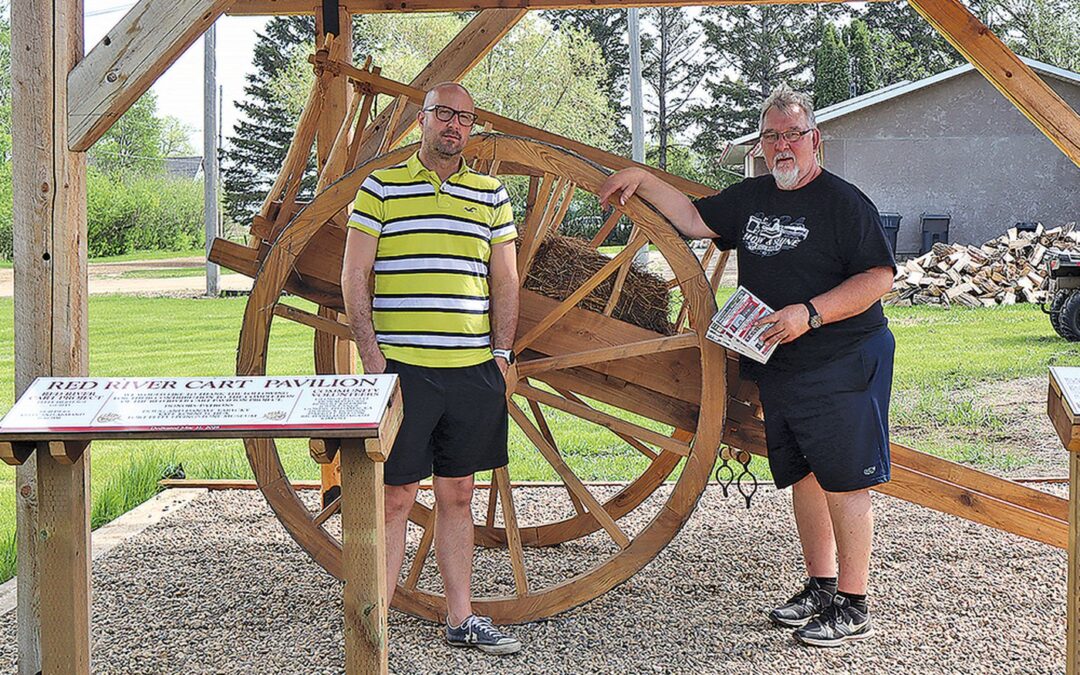
Photo: A model Red River cart is now on permanent display at the Fort Pelly-Livingstone Museum. At the unvieling were Canora-Pelly MLA Sean Wilson, left, with Donald Budz, President of the Fort Pelly-Livingstone Museum board. Photo by Bastien MacLean
By: Bastien MacLean
Local Journalism Initiative Reporter
Kamsack Times
A model Red River cart built by Kelly and Armand Jerome of St. Northbert, Man. is now on permanent display at the museum.
“The Red River Cart was a simple conveyance developed by the Métis people for use in their settlement of [the] Red River area”, per an informative signboard at the display.
“The Red River cart was constructed using basic materials, oversized wheels, [it was] small but could carry heavy loads” said Donald Budz, president of the Fort Pelly-Livingstone Museum board. The settlers followed several trails, some which dipped south “into Pembina, North Dakota, then onto St. Paul, Minnesota”, while others followed a northern trail that went to Fort Pelly through Fort Qu’Appelle.
This is “how the settlers moved around the area” said Budz. “The cart was constructed on site, it could be easily repaired, there are no nails, it’s all made out of wood.” Horses or oxen were used to pull the cart, at a pace of 25 to 60 miles a day.
Canora-Pelly MLA Sean Wilson was at the event.
“Places like this matter because they help tell the story of how Saskatchewan was built,” said Wilson. “Long before there were highways, trucks, or modern equipment, people moved across the land by Red River Cart. Those carts carried families, supplies, and opportunities, and they played an important role in shaping the communities we know today.”
He acknowledged the “dedicated volunteers, board members, and community supporters” who made it so that “these stories continue to be preserved and shared with future generations.”
The museum, which now occupies the former police detachment building in Pelly after the old building burnt down in 2015, has “five pillars,” per Budz. These pillars – the RCMP/Northwest Mounted Police, First Nations, Veterans, the Village of Pelly and surrounding district, and Fort Pelly and Fort Livingstone – represent five different histories that the museum provides historical information on.
Alexandria Irwin is working as a museum assistant at Fort Pelly-Livingstone this summer. Originally from Windsor, Ont. and currently pursuing a history major at the University of Saskatchewan, she’s looking forward to “being able to work with the community and learn.” Of special interest to her is “the Anglican church that was recently taken over by the museum.”