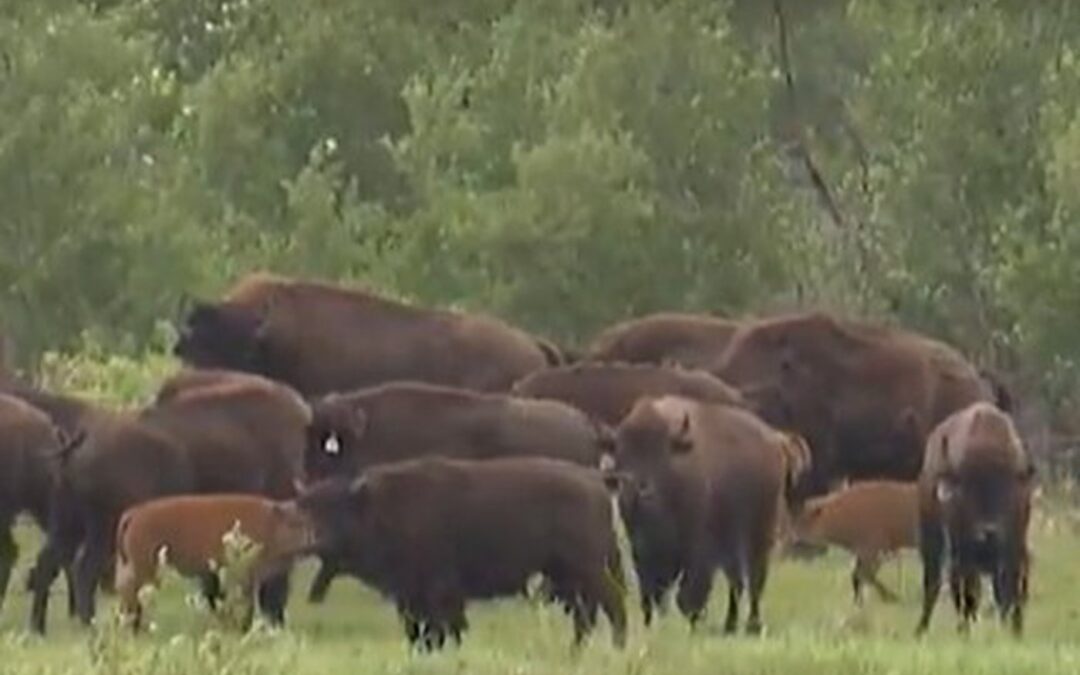
Photo: MN-S bison herd at Batoche
By: Carol Baldwin
Local Journalism Initiative Reporter
Wakaw Recorder
In December 2023, MN–S received 25 young plains bison from Parks Canada. Two years later, 50 more were delivered, growing the adult herd. This year, in anticipation of births in the bison herd, Métis Nation–Saskatchewan (MN–S) invited students in Michif language programs across the province to submit suggestions for names to be given to 16 new calves, and on Monday, June 22, at 11 am, a special naming ceremony took place. School children from the surrounding Michif language schools in Duck Lake, Bellevue, and St. Louis attended a special naming ceremony at the bison paddock. After meeting at Dumont Lodge, students, media, and special guests proceeded to the paddock, where the ceremony proceeded with Elders offering prayers and songs for the health of the bison and all who gathered to welcome the young bison born on the traditional lands.
In November 2022, Métis Nation-Saskatchewan signed a memorandum of understanding with Parks Canada to transfer 25 bison from Grasslands National Park, in southwestern Saskatchewan, to MN–S’s Back to Batoche festival grounds near the Batoche National Historic Site north of Saskatoon, to establish a new herd. The Grasslands bison herd, which was established in 2005, is now used to found new herds, according to Parks Canada. Phase one of the Memorandum of Understanding between Parks Canada and MN-S involved the reintroduction of bison, the first step in MN–S’s long-term vision to grow the herd and explore the economic development potential it could bring to the region. At some point, Darcy Lepowick, MN-S minister of environment, agriculture, lands and resources, said, the herd will grow too big, and then some bison will be moved to start new herds.
Bison are significant in Métis culture, representing strength, resilience, and a deep connection to the land. Through this naming ceremony and ongoing initiatives, the MN–S strives to cultivate stewardship among the younger generation and ensure they grow up with a strong sense of their cultural identity. Angela Rancourt, who teaches the Michif language class at St. Louis Public School and coordinates the Michif early learning program for pre-K and kindergarten students, said that having the kids engaged in the naming process allows them to see themselves represented in this space.
“This is our homeland,” Rancourt said. “My ancestors were here. Our high school students can identify their families’ river lots. So being able to be on this land, celebrating something like this together, it’s really moving.”
Names were chosen equally from the three different forms of the Michif language. From the French Michif came the names: Pchit pwelleu (Little Furry One), Chiraan (Northern Light), Toneur (Thunder), Groos tet (Big Head), Rouille (Rusty), and Boo (Beautiful). From Heritage Michif came the names: Li noovoo (Newcomer), Li braav (The Brave one), Shakwala (Chocolate), Li pchi (The Little One), and Paywapun (Sunrise), while the Northern Michif names included: Yôtin (Windy), Ci boy (Tiny Boy), Kôna (Snow), Âyimisô (Rascal), and Okimâsis (Little Boss).
Batoche Homeland Métis Local #51 said of the bison’s return in 2023, “Their return represents a restoration of our heritage and a renewed relationship with the land. It’s a powerful symbol of MN-S’s ongoing connection to our Métis roots and the commitment that MN-S and all of us have for preserving our traditions.”