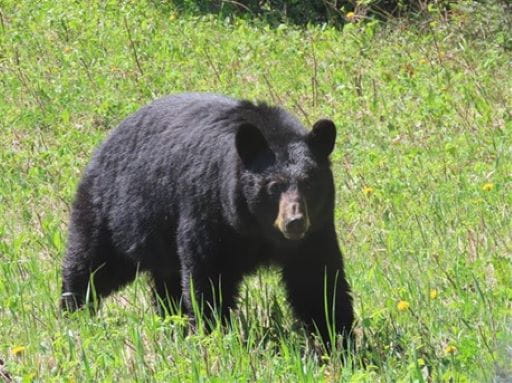
Photo: Photo of black bear from Ministry of Environment
By: Danielle Dufour
According to the Government of Saskatchewan the bear attack on May 8th west of Wollaston Lake that led to the death of a 27-year-old man, is in the early stages of an investigation by the Conservation Officer Service’s Wildlife Human Attack Response Team, RCMP and the Coroner’s Service.
This is the fourth fatal bear attack in Saskatchewan history.
“I wouldn’t say black bears are really aggressive,” said Elizabeth O’Hara, an Ecologist and black bear Biologist with the Ministry of Environment. “They’re typically afraid of humans, so having any aggressive interactions with black bears is very uncommon.”
O’Hara’s job is to guide the management of black bears in the province, using the best available scientific, social and economic information.
“You might see aggressiveness happening when bears have become habituated to human food sources and lost some of that fear to humans,” said O’Hara. “The best way to sort of manage those potential aggressive interactions is if we manage attractants and human food sources that are bringing bears into where people are.”
Bears are found widely across the province but the highest densities of bears are along the transition zone between the boreal forest and the Aspen Parkland region.
“Black bears are typically found in the northern forested regions of the province, but they’re also found throughout southern and central regions of the province as well,” said O’Hara.
Black bear movement and home range size vary depending on their age, their sex and food availability.
“For female black bears their typical home range is only about 15 to 50 kilometers squared, whereas males will travel much farther at about 100 kilometers squared or more,” said O’Hara.
“They tend to be pretty solitary animals, only seeing groups when you have a mother with her cubs or short-term congregations where there’s really abundant food sources.”
O’Hara noted the black bear population in Saskatchewan is very health and stable.
“Bears spend a lot of the year in hibernation,” said O’Hara. “They’re typically entering their dens in about mid October and they’re emerging in late March, early April. They’re mating between late May and late August and the cubs are born while the mother is hibernating in January or February.”
The cubs will stay with their mothers for about 16 to 18 months before going off on their own.
Some signs of bear activity in the area are visible bear tracks or scat, or if there’s a bear den in the area you might see claw marks or rubs on trees or overturned big stones.
With the long weekend ahead, O’Hara suggests campers and hikers try to manage attractants to be safe.
“Try hiking in groups and let bears know that you’re in the area by talking loudly or singing.”
“If you’re camping, don’t eat, cook or store any type of food within your tent or tent trailer, store all food in airtight containers in your vehicle,” said O’Hara.
If you do encounter a bear, O’Hara suggests you to stay calm.
“Don’t run away. Back away, make a wide detour, speak calmly in a deep firm voice and don’t make direct eye contact with the bear,” said O’Hara.
She suggests carrying bear spray as a tool that can be used to deter unwanted advances by bears.
“It’s been proven to be over 90 per cent effective at deterring advances from bears,” said O’Hara.
O’Hara recommends reading the directions on the canister before the first time you take it out as each brand slightly differs with the time and range of the sprays. Also to check the expiration date as bear spray does expire.
“If you’re out in the back country hiking, it’s important that you have that bear spray easily accessible, not in the bottom of a backpack.”
Bear sprays will only act as an irritant and will not have permanent effects on the bear.
“We never want to spray people with bear spray,” said O’Hara. “When storing bear spray, it’s important that it’s in a secure container, in a cold, dry location.”