
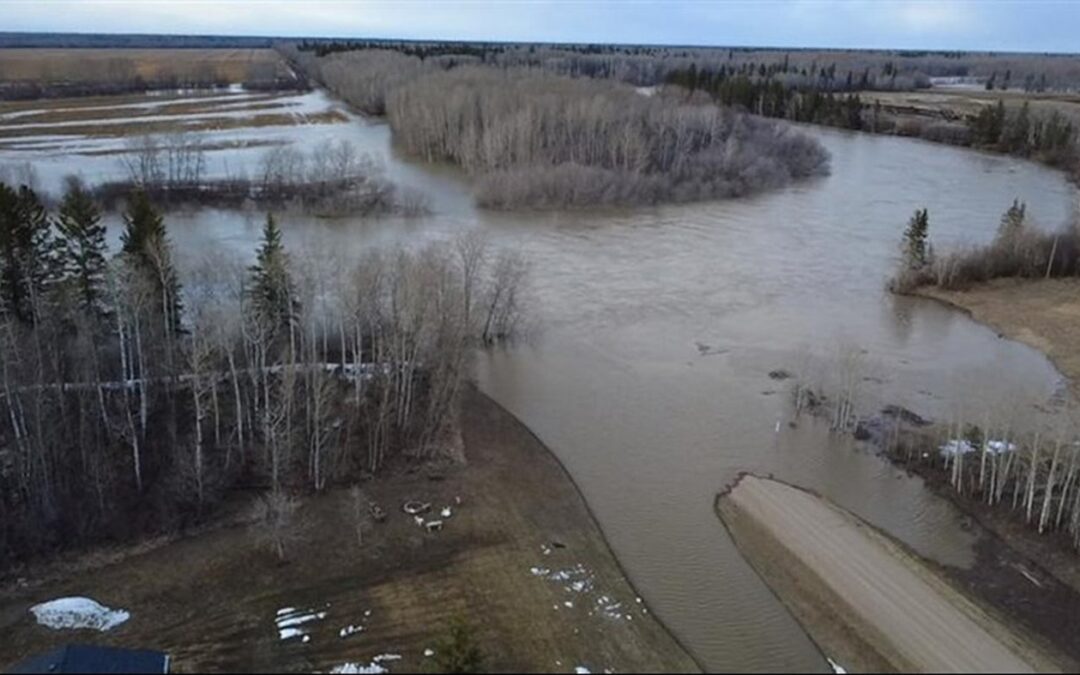
Photo: Floodwaters from the Carrot River cover low-lying land near Smoky Burn, Sask., as flows reached record levels this week. / Courtesy of Shayne MacDonald / Water Security Agency
By Nicole Goldsworthy
Local Journalism Initiative Reporter
SaskToday.ca
Record flooding along the Shell and Carrot rivers has forced evacuations in northern Saskatchewan First Nations and prompted the Prince Albert Grand Council (PAGC) to activate its emergency operations centre (EOC).
Members of Red Earth Cree Nation and Shoal Lake Cree Nation were evacuated late Monday. Priority 1 individuals — those requiring immediate medical support or considered vulnerable — along with Elders and prenatal and postnatal members, were relocated from both communities by Tuesday.
PAGC activated its EOC on Tuesday in co-ordination with Saskatchewan First Nations Emergency Management and the Saskatchewan Public Safety Agency to support response efforts and monitor rapidly changing conditions.
Officials are also working with the Canadian Red Cross to assist evacuees as they register for emergency support.
Grand Chief Brian Hardlotte said PAGC is closely tracking flooding along both river systems while maintaining communication between First Nations leadership, emergency partners and government agencies.
“Water has its own way of returning to the land. That is nature’s way,” Hardlotte said. “But when it comes back like this, it creates serious problems for our communities, our roads, our homes and our families. Our priority right now is safety, communication and making sure our First Nations have the support they need.”
According to the Water Security Agency, the Carrot River near Smoky Burn has exceeded all previous records at that monitoring station. Flows on Monday surpassed the gauge’s measurement capacity, briefly forcing it offline.
A reading taken Monday measured 900 cubic metres per second, with flows rising to about 980 cubic metres per second by Tuesday morning — the highest ever recorded on the river. Water levels are now 2.9 metres higher than on April 29.
Officials estimate peak flow could reach 1,050 cubic metres per second, which would classify as a one-in-100-year event. The previous record of 816 cubic metres per second was set in 1972. The peak is expected around May 9, though monitoring continues.
Vice-Chief Christopher Jobb said the EOC is focused on communication, co-ordination and public safety as communities brace for several more days of high water.
“We are doing our best and opening lines of communication with our communities and emergency partners,” Jobb said. “We are asking everyone to be safe. Please listen to your local leadership, avoid flooded areas and give emergency crews the space they need to do their work.”
Sturgeon Lake First Nation is also responding to rising water levels. PAGC Vice-Chief Joseph Tsannie is meeting with local leadership to assess impacts and determine further emergency response needs.
Officials warn that high water, strong currents, unstable banks and damaged roads can quickly become hazardous.
PAGC said it will continue to monitor conditions and provide updates. Residents are urged to follow official notices from their chief and council, local emergency management teams and PAGC communications channels.