Photo: Ecuador exchange / Patrick Quinn, Local Journalism Initiative Reporter
By Patrick Quinn
Local Journalism Initiative Reporter
The Nation
The Cree Nation was well represented in a North-South knowledge exchange that brought together 22 Indigenous peoples from eight countries to the Ecuadorian Amazon for one week in March.
The gathering was hosted by Conserva Aves (Conserve Birds), an initiative of several international conservation groups. They aim to protect areas across Latin America where migratory bird habitats overlap with some of the world’s greatest biodiversity.
“It’s based on the idea that conservation works when we can trust communities who know their land to care for it in the way they know how,” said Fel Castañeda of Birds Canada. “So, it allows flexibility in defining what a protected area means.”
Since designating areas as protected has sometimes resulted in communities being barred from certain traditional lands, the gathering was an opportunity to discuss diverse approaches to conservation across Turtle Island and Abya Yala (North America and South America). The borderless nature of birds emphasized the shared responsibility of this mission.
“The Canada warbler spends most of its time in Colombia,” Castañeda pointed out. “I think these things bind us together, highlighting the importance of local action but thinking of the challenges we face on a global scale.”
This exchange funded by the Canadian government reinforced the growing recognition that traditional knowledge is critical to advancing biodiversity. Reflecting on connections between distant territories, participants shared community-based practices that sustain their local ecosystems.
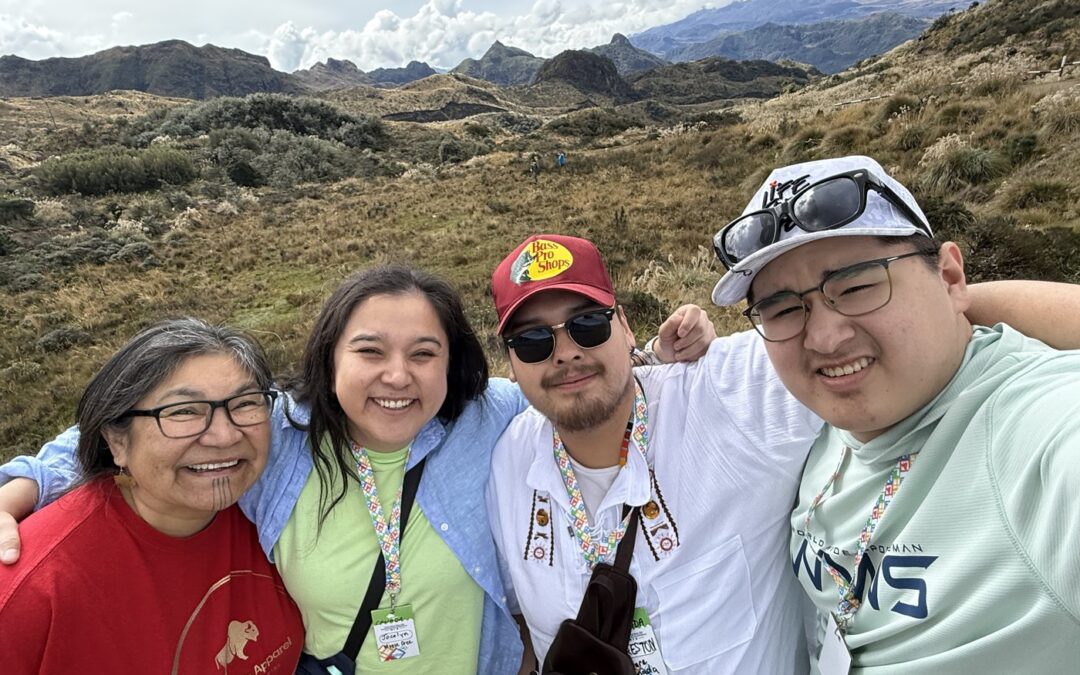
Four Cree people joined representatives from Indigenous communities in British Columbia, Ecuador, Peru, Colombia, Panamá, El Salvador, Costa Rica and México. Along with Lillian Trapper and Jocelyn Cheechoo from Moose Cree, Nature Canada invited Evander Cheezo from Eastmain and Preston Sam from Chisasibi.
“It’s difficult to explain how amazing it was,” Sam told the Nation. “It was my first time travelling abroad. We saw waterfalls and so many mountains. The untouched land in the forest – I’d never seen trees so massive.”
As a research assistant for the Chisasibi Eeyou Resource and Research Institute (CERRI), Sam often collaborates with Nature Canada on projects such as bringing secondary students on field trips to do activities like bird banding, which is used to identify and study individual birds.
Arriving in Quito, the group left Ecuador’s capital the following day for Puerto Misahuallí on the jungle’s edge. The trip was less direct for some participants – it took about a week for the Peruvian contingent paddling from deep in the Amazon to reach the destination.
“We were welcomed by children who shared cacao and did a ceremonial dance,” said Sam. “There was a sense of joy and openness that didn’t need translation at all. They welcomed us with stories, traditions and respect. It made me realize that our identities are rooted in the same principles even if they look different on the surface.”
Trapper has worked with Nature Canada’s Ted Cheskey on shorebird protection since 2002, introducing him to contacts in Chisasibi and Waskaganish to monitor at-risk red knots on both sides of James Bay. Currently a board member for Nature Canada, Trapper requested a welcoming ceremony after her experience at the 2024 UN Biodiversity Conference in Colombia.
“There were no other Indigenous people, so I felt off with no welcoming to the territory,” Trapper recalled. “I said, ‘I’m a stranger here – the trees and birds don’t know me.’”
Before departing, Canadian participants met to prepare presentations about their cultures and conservation work. As water protection was a unifying theme, their story flowed from pre-contact to the present day through their relation with water.
“I had Preston draw four raindrops for the four water spirits,” said Trapper. “Before contact, our way of life was ceremonial, very spiritual. We drew animals and dwellings we used to have. Then a big wooden ship of Henry Hudson coming into the Bay. It was good for us to tell our story because it’s the same story in a different place.”
Drawing exercises leveraging the river’s symbolism helped overcome communication barriers and encouraged storytelling. People from the north and the south worked together on a wider mural that followed the river of their people’s story to the ocean, imagining a shared vision of the future.
Participants also listened to bird sounds together, identifying whether they sounded familiar. This led to dialogue between knowledge systems, revealing cross-cultural similarities in bird observations and relationships with natural cycles.
“The design of the activities was always open so people could define the priorities of what they wanted to share,” explained Castañeda. “There were touching moments with that spark of recognition of ‘That could work where I’m from’ or ‘What you’re saying makes a lot of sense.’ The participants formed very strong bonds with each other.”
Sam said they spent their days connecting with the land and their evenings sharing stories, ceremonies and knowledge around the fire. He shared CERRI’s work building food sovereignty and enhancing eelgrass. Cultural teachings like doing a goose call inspired conversations about hunting, natural law and relationships with the land.
The week inspired insights for improving consultations with Indigenous communities. While Conserva Aves is organizing another exchange focused on communities in South America, there was strong interest for another North-South meeting to be held in Canada.
For Sam, the unforgettable experience gave him a deeper appreciation for Cree culture and a desire to build relationships in different parts of the world. Gifting a Cree Nation flag to a Quijos Pachakutik member represented a gesture of connection. He plans to return to visit his new friends and take a more immersive journey.
“No matter how far we travel, we carry our communities with us,” said Sam. “Even across continents, there are people who understand that connection to land and identity in the same way. It reminded me that the work we do is connected to something much bigger.”