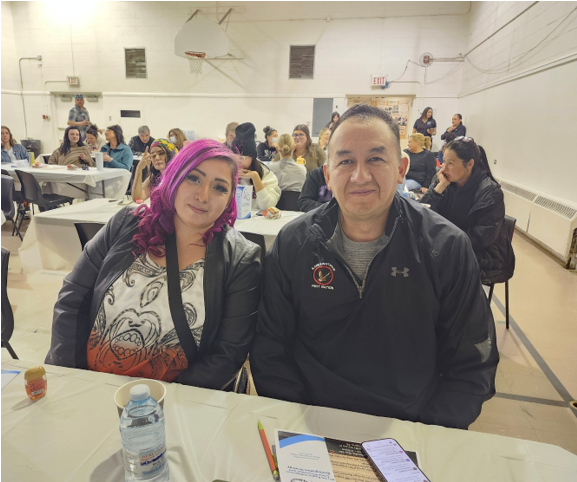
Photo of: Tabitha Bobb a Justice committee member and first responder and Cory Alexson a Councillor for Kahkewistahaw First Nation attended the event. Photo by: Danielle Dufour
By: Danielle Dufour
The Regina Treaty/Status Indian Services (RT/SIS) held an event to bring communities together to have a conversation about the issues of human and drug trafficking.
“We are always having to react,” said Natasha Kennedy Executive Director of RT/SIS. “Any great movement starts with community.”
Kennedy said the goal is to have a community-based conversation addressing human trafficking, drug trafficking and exploitation that is rising in communities; raising awareness and encouraging collaboration that supports healing this generation, so the next generation doesn’t need to do the hard work.
“I’m at the event on behalf of the Justice committee as a member, first responder, a search and rescue, a mechanic, a mother and a concerned community member,” said Tabitha Bobb from the Kahkewistahaw First Nations.
Bobb hopes to bring more awareness to her community as they experience issues around these areas.
“Including the drugs and the trafficking, because our first nation is on a highway, we have a lot of traffic coming through so those are concerns for our First Nation,” said Bobb.
More than 75 per cent of people working in the Canadian sex trade were exploited as a child.
“We did have an incident where somebody actually picked up one of our young girls,” said Bobb. “With our peacekeeper force, we are looking at getting them trained … so that stuff like that doesn’t happen again.”
Some major risk factors for youth include a history of child abuse, poverty, mental health, runaways, living in foster care, involvement in the youth justice system, social and cultural isolation and persons with disabilities.
The exploiter’s main purpose is financial gain. They lure individuals by offering relationships that feel like love and trust.
Over 30 per cent of trafficked persons are recruited by men they considered to be their boyfriends.
“It looks different in every province, in every country, and so we just don’t want people to have an idea of what they think it looks like because it’s not like the movies,” said Saskatchewan Trafficking Response Team member Sgt. Cornelia Seiferling.
Sgt. Seiferling suggests communities look at it with a “different lens” to see and uncover things they thought were not there before.
“As a community, we are responsible to each other, to take care of each other, and to report things to the police and to other organizations that can help these people,” said Sgt. Seiferling.
If you suspect someone is in danger of exploitation and immediate danger, call 911.
You can also reach out to the local police service and ask to be put through to the human trafficking unit.
“No one wants to be told that their a victim,” said Sgt. Seiferling. “Not everybody is in a place to realize that either they are a victim or to admit it, that they are being taken advantage of or exploited. It’s meeting people where they are.”