By Carol Baldwin
Local Journalism Initiative Reporter
Wakaw Recorder
Every year, National Organ and Tissue Donation Awareness Month (NOTDAM) takes place during the month of April.
Registering a decision indicates one’s willingness to donate. However, this is only an intent to donate, not a consent. Consent is obtained through the next of kin, which is why it is so important to talk to one’s family members about the decision to donate.
On April 6, 2018, Canadians were devastated by the Humboldt Broncos bus crash, which claimed 16 lives out of 29 passengers, leaving 13 others with lifelong scars. The following day, defenceman Logan Boulet succumbed to his injuries, and his parents honoured his wishes by donating his organs. This act inspired nearly 150,000 people to register as organ donors in the weeks that followed, marking the largest surge in organ donor registrations in Canadian history due to a single person or event.
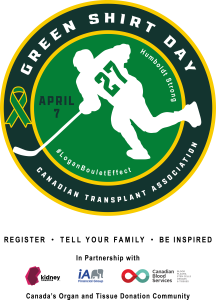
Green Shirt Day was created to honour, remember, and recognize all the victims and families of that fatal crash and to continue Logan’s legacy by inspiring Canadians to talk to their families and register as organ donors. In 2019, the first-ever Green Shirt Day contributed to another hundred thousand registering their decisions about donation.
The 2026 Green Shirt Day theme— “One Decision Can Create a Lasting Ripple Effect”—highlights the extraordinary reach of a single choice. The campaign emphasizes how choosing to register as an organ donor—and sharing that decision with loved ones—can extend far beyond one life, touching families, communities, and the broader health-care system. Logan Boulet’s decision remains a powerful example of how one act can inspire a nation and transform countless futures.
Green Shirt Day is led by the Boulet family and the Canadian Transplant Association in partnership with organizations including Canadian Blood Services and the Kidney Foundation of Canada.
According to the Canadian Transplant Association, more than 4,000 Canadians are currently waiting for an organ transplant, and one registered donor has the potential to save multiple lives. According to the president of the Canadian Transplant Association, Brenda Brown, Green Shirt Day “honours Logan’s legacy and reminds us how much impact one person can have.”
Toby and Bernadine Boulet are retired schoolteachers and have dedicated much time to delivering their message. They visit schools and other venues across the world to tell anyone who will listen about their son, Logan, and the importance of organ donation.
“Organ donor registration is important, but unless you have that conversation in any province,” Toby Boulet explains. “The family can say no, and if they say no, then the transplant recovery of the organ stops.”
“When Green Shirt Day started in 2019, a year after the crash, it was going really strong, then COVID hit. That slowed everything down. Transplant recipients were immunocompromised, and they couldn’t go outside. They couldn’t meet or gather. They couldn’t do lots of things,” Boulet said. “But now we’re back, and we’re flying again, and it’s really exciting.”
Tissue donations from one individual alone can help up to 75 lives, and tissue donation is possible for nearly everyone. In fact, tissue donation may be an option even when organ donation is not possible, and age is not necessarily a determining factor in eligibility. Canada’s oldest organ donor was 93 years old.
We can all be an inspiration by registering as organ & tissue donors and telling our family.