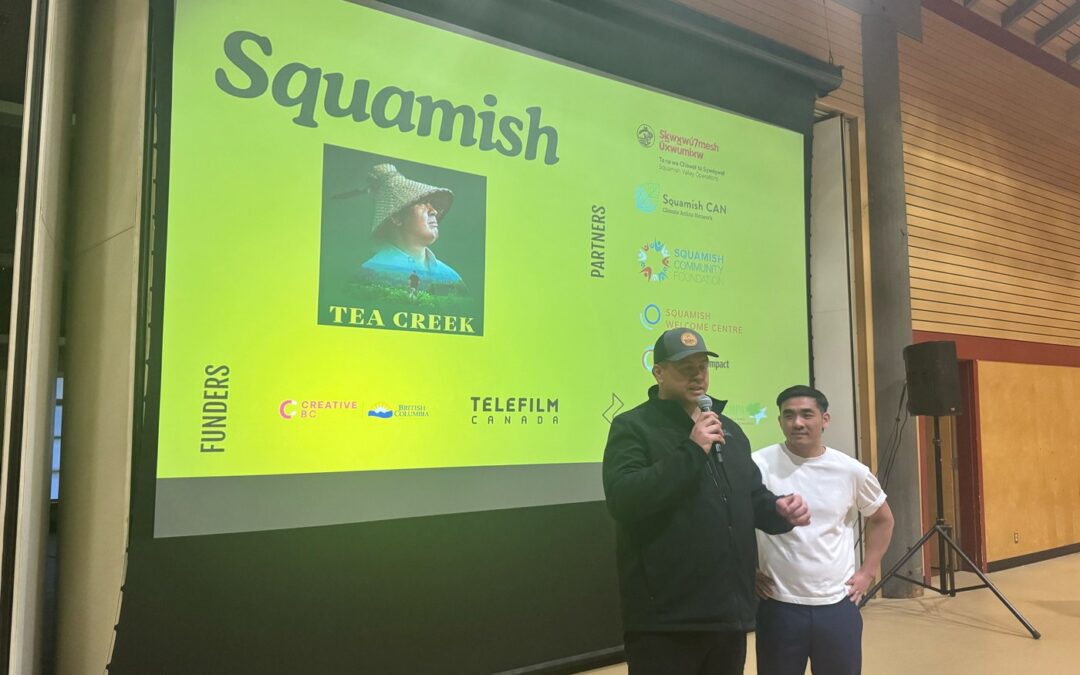
Photo: Jacob Beaton and Anthony Truong Swan welcome attendees at the screening of Tea Creek at Totem Hall on March 19. / Ina Pace
By Ina Pace
Local Journalism Initiative Reporter
The Squamish Chief
Indigenous agriculture documentary Tea Creek screened at Squamish’s Totem Hall, revealing the cracks in a lesser-known oppressive system, according to its protagonist.
Truth and reconciliation are merely words without action, redundant even, if they are not believed.
When federal law usurps what existed before it, truths can get buried and ultimately misinformed, according to farmer Dzap’l Gye’a̱win Skiik Jacob Beaton.
These include truths about the workings of everyday business; your shopping at the grocery store, for example.
Indigenous food sovereignty (Indigenous people having control over their own food sources) is one of these buried truths, he said.
Beaton is the co-owner of farm turned Indigenous agricultural training institute Tea Creek, which he founded in 2020 with his family. Tea Creek is located in Gitxsan Territory where Beaton grew up, in Northern B.C.
Beaton is the protagonist of the documentary of the same name, screened at Totem Hall on March 19. Tea Creek reveals barriers faced by Indigenous Canadians in reclaiming food sovereignty.
It also explores the farm’s progression as a “healing place,” where Indigenous peoples are valued and accepted, according to its trainees.
The turnout for the screening proved popular, so much so that extra chairs were pulled up.
Indigenous voices may be being listened to, but to believe, folks often need knowledge and further context to accept “truth” as truth, he said.
Beaton spoke with The Squamish Chief about some things not elaborated on in the documentary, and discussed ways in which Canada’s “popular political exercise” is to discredit the integrity of Indigenous voices.
What follows is a version of that conversation edited for length and clarity.
The Squamish Chief:Tea Creek touches on cultivation in Canada happening tens of thousands of years before European settlers arrived. Can you please elaborate on this, and why it is not well-known?
Jacob Beaton: Mainstream Canadians need to listen and need to believe because it’s true. It’s such a disgusting, horrible part of our history that’s really not being talked about: how Indigenous people went from being stewards of incredibly complicated, dedicated food systems—what we now call agriculture—who fed the settlers of this country, and were very economically successful doing that, and how that was systemically undermined over a number of decades [with] progressively more oppressive laws and regulations.
Food crops we grow today were domesticated by Indigenous people and we were not taught that in schools in Canada. Built-in racism in this country sees Indigenous people as primitive hunter gatherers.
The European approach to [Indigenous] crops has been to narrow the selection. Cornused to be very diverse. Now corn is just yellow, and it’s all around the same size, and that’s just for marketability.
The first step when we’re delivering training [at Tea Creek] is this grief and anger period where we’re learning this for the first time.
Q: What else do you know that settlers did to discredit the achievements of Indigenous Canadian food systems?
A: Layered policies [under The Indian Act] destroyed Indigenous food systems.
The Peasant Farm Policy [meant seizing] modern tools or equipment, and you were only allowed to use hand tools. The Pass and Permit policy forbade First Nations people from purchasing seeds or supplies, as well as selling food.
Q: Can you explain your interpretation of “stolen land,” and how this further disenfranchised Indigenous farmers?
A: People think “stolen land” [is] some remote construct. In reality, there’s a lot of land in a lot of cities that is literally stolen. The Indian Act empowered many institutions; including municipalities, churches, universities, logging companies, and mining companies, to dispossess First Nations people of their property. It wasn’t an army of government agents going around stealing everything.
[Under the Indian Act], it was illegal to own land off reserve. First Nations land owners [were taxed] at rates many times higher than non-First Nations, so they could seize their houses. We need to start acknowledging it.
Q: In the documentary, you mention taking out another mortgage to cover funding for Tea Creek. How are you ensuring funds for the farm, at least short-term?
A: If we’re going to shame the Canadian government, I’m happy to announce that most of our funding is private, and it’s mostly American.
Q: What are your observations about how the U.S. regards their Indigenous population?
A: The battle [in Canada] is still on the truth part of truth and reconciliation. [After touring the U.S.], the amount of honesty [I saw] the average American has around genocide committed against Native Americans is incredible compared to here.
Even MAGA [campaigners, I saw] didn’t question when tribes got their rights back and got funds. The Republicans are not going after First Nations rights, like we are in Canada. It’s a popular political exercise to attack the integrity of Indigenous truth in this country.
Q: How do you feel your “mainstream Canadian” allies can help you?
A: I said to the director and producer, ‘I can’t say this in the film, because no one’s going to believe me. You need to find a white man expert to say all the things I’m saying.’
I’m so happy I found Dr. David Natcher, because he’s a professor of agriculture in Saskatchewan, a [very] agricultural province in the country.
I call [our allies] ‘co-conspirators’; people on our side conspiring to change things for the better, who understand the mission, and see that it’s a win-win-win. Indigenous people can win, while non-Indigenous people are also winning, while the country and the greater society is winning.
Q: What are your thoughts on Canada’s future of agriculture as it stands today?
A: Canada’s very food insecure. We have all this agricultural land, and yet we can’t even grow enough food to feed our own people. We grow export crops.
[The Indigenous population] don’t have the land because we’ve been dispossessed, and residential schools were effective in stripping [our] knowledge and skills. But we have the desire and the distributed population.
Q: I hope we can end on a positive note. What has been the general reaction to your documentary?
A: So far, there’s been zero hate mail. I’m just so heartened by how much support we’re getting from people of all political stripes.
There’s a lot of [non-Indigenous] Canadians who’ve got our backs, we’re not necessarily seeing it so much in the media, but they’re there because this film has real legs. It’s doing really well because of [non-Indigenous] Canadians watching, and pushing the knowledge forward.
Q: What’s your draw to Squamish?
A: I’m a relative of [Sḵwx̱wú7mesh Úxwumixw/ Squamish Nation Elder] Henry Williams, who did the welcoming [at the film screening.] My great grandmother and his mom were sisters. [Squamish] is like another home through that family line.