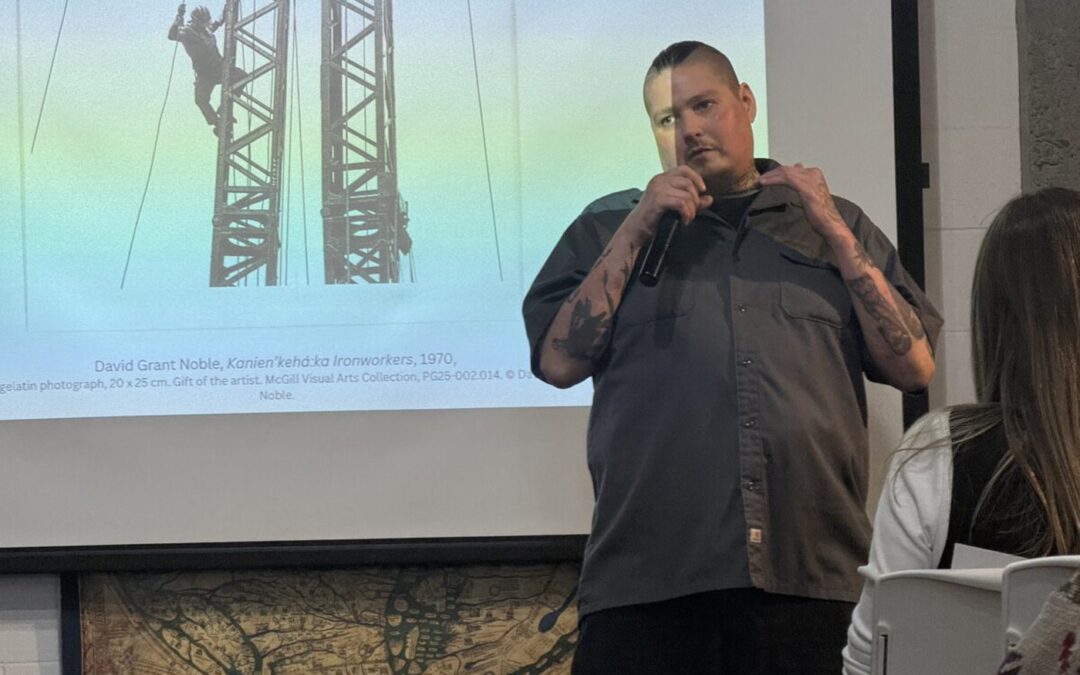
Photo: Jax Robertson, whose father Frank Robertson and grandfather George Robertson were ironworkers before him, had to leave the profession after he suffered an injury 10 years ago.
By Marcus Bankuti
Local Journalism Initiative Reporter
The Eastern Door
Decades ago, Wahiaké:ron George Gilbert was on the job, waiting for the rain to pass, when his superintendent said something that stuck with him.
“Georgie, don’t ever get a gravestone,” he said. “The skyline of New York is your gravestone.”
Many people don’t know the role Kahnawa’kehró:non ironworkers played in building the most famous city in the world. But in Kahnawake, the memory runs deep, and the legacy lives on in stories told by elders and those who followed in their footsteps.
This week, Tiohtià:ke learned a thing or two about this history, with an exhibit called Sky High Trust opening at the McGill University Library. It features images taken by famed photographer David Grant Noble, who photographed the ironworkers in 1970.
“I was lucky to have met every race of men, and I learned something from all of them,” Gilbert told listeners at an event to launch the exhibit on Monday.
Gilbert was joined by younger ironworker Jax Robertson, who worked in Detroit in the 2000s before returning to work in Kahnawake. He had to stop after he fell about a decade ago. The pair shared their experiences with an attentive audience.
Kahnawa’kehró:non faces were among those who came out to see the exhibit and hear the presenters’ words for themselves.
“It’s great,” said Barbara Diabo, who herself paid homage to local ironworkers with her theatre production, Sky Dancers, which was focused on the men lost when the Quebec bridge fell in 1907.
“I think it needs to even get out there more because I find in the mainstream population, a lot of people don’t know about this fascinating side of us.”
She’s now working on an exhibit about local ironworkers.
“Come out to these events,” she said. “Come, see, learn more about the ironworkers. They’re our superheroes.”
Kahnawa’kehró:non professor Wahéhshon Shiann Whitebean brought her Indigenous Oral History and Storytelling class to hear Gilbert and Robertson speak about their experiences in the profession.
“I love being able to get out of the classroom,” said George Tucker-Pieczonka, a student in Whitebean’s class. “I think it’s so much more productive or engaging a lot of the time than lectures.”
The class is currently working on their final projects, and Whitebean thought this event would serve as valuable food for thought for her students.
“I thought this was an excellent opportunity for them to come and hear some stories about our community from an elder,” she said, adding that both the speakers were engaging.
As the talk unfolded, she found herself reflecting on what it was like for the men and the community when Kahnawa’kehró:non relied on this kind of work to make ends meet.
“I think I had this moment of realization, sitting and listening about how we normalize our men getting hurt, having to be tough and carry on,” she said. She thought of her uncle, who fell as an ironworker.
“Our men had to go out and risk their lives because there was nothing for us here, and so it’s something they had to do.”
Helen Kanaieson Nolan and Kahentiióhstha’ (Roberta) Duhaime attended with thoughts of their uncle Tom Paul, who died on the job 70 years ago in New Jersey.
Duhaime recalled seeing headlines decades ago about the Mohawk ironworkers who had no fear. “It took a lot away from those men. ‘They have naturally no fear.’ Well, obviously they do, and they did it anyways,” she said.
“I like that it’s progressed from what we saw about Natives in the 1960s. It’s progressed more to reality,” she said.
Gilbert told an anecdote that reflected the degree of choice the young generation has now. He recalled a couple days when he was teaching the language at Kahnawake Survival School (KSS), and one student said he didn’t have to learn anything – he was going to become an ironworker. Gilbert told him he couldn’t cut it.
“I said I’m not going to argue with you. Ask your father if you’re going to be an ironworker,” he remembered.
When class convened the next day, he reported back to Gilbert. “My father said I can’t cut it.”
It doesn’t mean he can never do it. But the father went on to tell his son to go to school, to learn something. “Stay away from this,” the father said.
“We didn’t have the opportunity, us,” said Gilbert. “There was no work, zero. So you went either to Vietnam – joined the service – or went to work.”
The curator of the McGill Visual Arts Collection, Michelle Macleod, first made contact with Noble, the photographer, when her department was given the task to participate in the redesign of the old Chancellor Day Hall building on campus with a New York theme.
“I knew right away I wanted to honour the Kanien’kehá:ka ironworkers with this project,” Macleod said.
The department purchased four of Noble’s photographs in 2023, and then he donated two more.
“He loved that they were on view so close to Kahnawake,” said Macleod. Ultimately, Noble decided to donate the entire collection.
“I felt like it was our responsibility as an institution, as a public art collection, to make them accessible and create inroads for, especially, our student body, to engage with these artworks. This event was just like cream on top, to have some ironworkers tell stories and really make the photographs come alive, and really connect them to the community.”
Reproductions of the images will soon be featured at the Kanatahkwèn:ke cultural arts building.