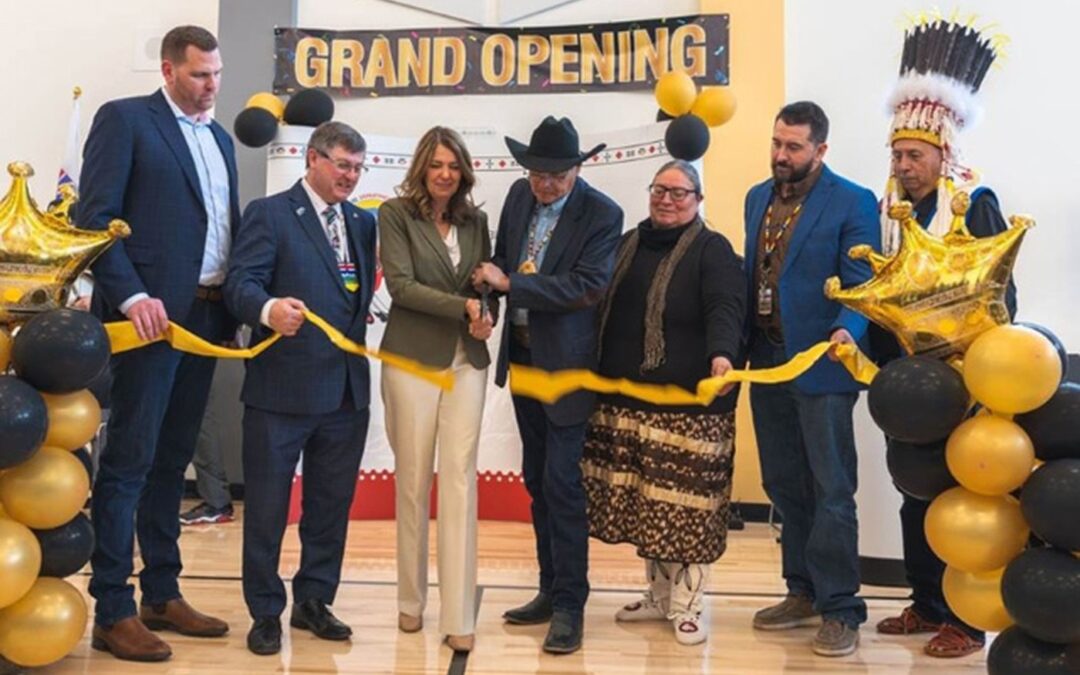
Photo: Blood Tribe Department of Health Communications Photo From left, Joseph Schow, MLA for Cardston-Siksika; Rick Wilson, Minister of Mental Health and Addiction; Danielle Smith, Premier; Chief Traveller Plaited Hair, Crystal Day Chief, Blood Tribe Department of Health; Kash Shade, CEO, Blood Tribe Department of Health and Councillor Marcel Weasel Head, board chair, Blood Tribe Department of Health.
The Blood Tribe has opened the first of five Indigenous-led recovery communities, with the opening of the newly built Iitakamotsiipiohsopi (a place to recover) Recovery Community, a 75-bed recovery community.
This recovery community centre will provide land-based treatment at no cost, to those struggling with addiction.
Premier Danielle Smith says this recovery community, along with others opening across the province, will allow more Albertans to break the cycle of addiction and rebuild their lives.
“This first-of-its-kind recovery community, led by the Blood Tribe, creates a space where people can heal, rebuild their lives and reconnect with their community.”
The Government of Alberta provided the capital funding for the recovery community, but the building is owned and managed by the Blood Tribe.
The recovery community is something Joseph Schow, MLA for Cardston-Siksika, says reflects a partnership between the Blood Tribe/Kainaiwa and the Government of Alberta that is rooted in respect and true reconciliation.
“Funded by Alberta’s government and operated by the Blood Tribe Department of Health, this recovery community signifies partnership and collaboration in solving a problem that takes a devastating toll on families and communities.”
Clients of Iitakamotsiipiohsopi Recovery Community will have access to comprehensive services which embody the Nation’s culture, ceremony, identity, family and community to meet the needs of Indigenous people and those living in southern Alberta.
The first set of clients will begin treatment this month and will have access to evidence based, holistic treatment for up to one year.
It is anticipated the first intake will only include 15 to 20 clients to allow employees to deal with the learning curve of the new programming and increase to full capacity within four to six months.
The recovery community is the final part of the continuum of care for the people on the reserve, and Kash Shade, chief executive officer of the Blood Tribe Department of Health, says will fill a large gap their clients are dealing with.
He says many clients who detox at either the Blood Tribe wellness shelter and Stabilization Unit in Lethbridge or Bringing the Spirit Home on the Blood Reserve often struggle to transition into residential treatment, due to long wait times for the residential treatment.
“With this program and obviously (having) 75 beds available on the Nation, we are hoping that bottleneck is relieved and clients can transition more seamlessly from detox to long term residential addictions treatment programming.”
He hopes by making the transition more seamless, it will reduce the number of clients getting sucked back into the grasp of addiction due to being discharged before being accepted into a recovery community.
Those who graduate from the recovery community will continue receiving support through the Kainai Transition Centre, a partner with the recovery community Shade says will bring the aftercare clients transitioning from the recovery community will likely need.
“They make sure you have the supports for housing and employment, although we do overlap in that programing aspect in recovery community, it just gives those graduates one more layer of support to reintegrate back into society.”
This new recovery community, along with others being built across the province is giving some much needed hope across the reserve.
Shade says with other Indigenous recovery communities opening across the province, the clients he serves will soon have more options catered to their individual needs.
“It just opens the door for client choice, client preferences, because (we recognize) everyone’s at different stages in their recovery…it’s really a positive outlook moving forward.”
While they know it’s a long road ahead, with the learning curve they are about to take on, the Blood Tribe Department of Health is excited to take on the challenge to provide an imperative resource for their clients.