
Photo: Regina YWCA / Photo by Danielle Dufour
By: Danielle Dufour
The YWCA in Regina launched a new fully digital violence prevention and bystander education program on Mar. 3rd.
Upstander Online represents a significant step forward in addressing Saskatchewan’s gender-based violence crisis. The program equips workplaces, nonprofits, Indigenous-serving organizations, and community Groups with practical tools to recognize red flags, intervene safely, and strengthen accountability.
Saskatchewan continues to report the highest provincial rates of gender-based violence in Canada, making prevention education more critical than ever.
Saskatchewan has the highest rate of intimate partner violence in Canada, more than double the national average. The province also has the second-highest rate of sexual violence among Canadian provinces. Various factors contribute to this, including systemic issues and barriers faced by victims, particularly in rural areas.
https://www150.statcan.gc.ca/n1/pub/85-002-x/2025001/article/00006/sk/tbl/tbl05-eng.htm
“The rates of gender-based violence in Saskatchewan are quite startling,” said Megan Moore, the Senior Director of Community Programs for the YMCA in Regina. “If you start looking at Indigenous communities, it’s an additional two or three times higher … those are only reported cases.”
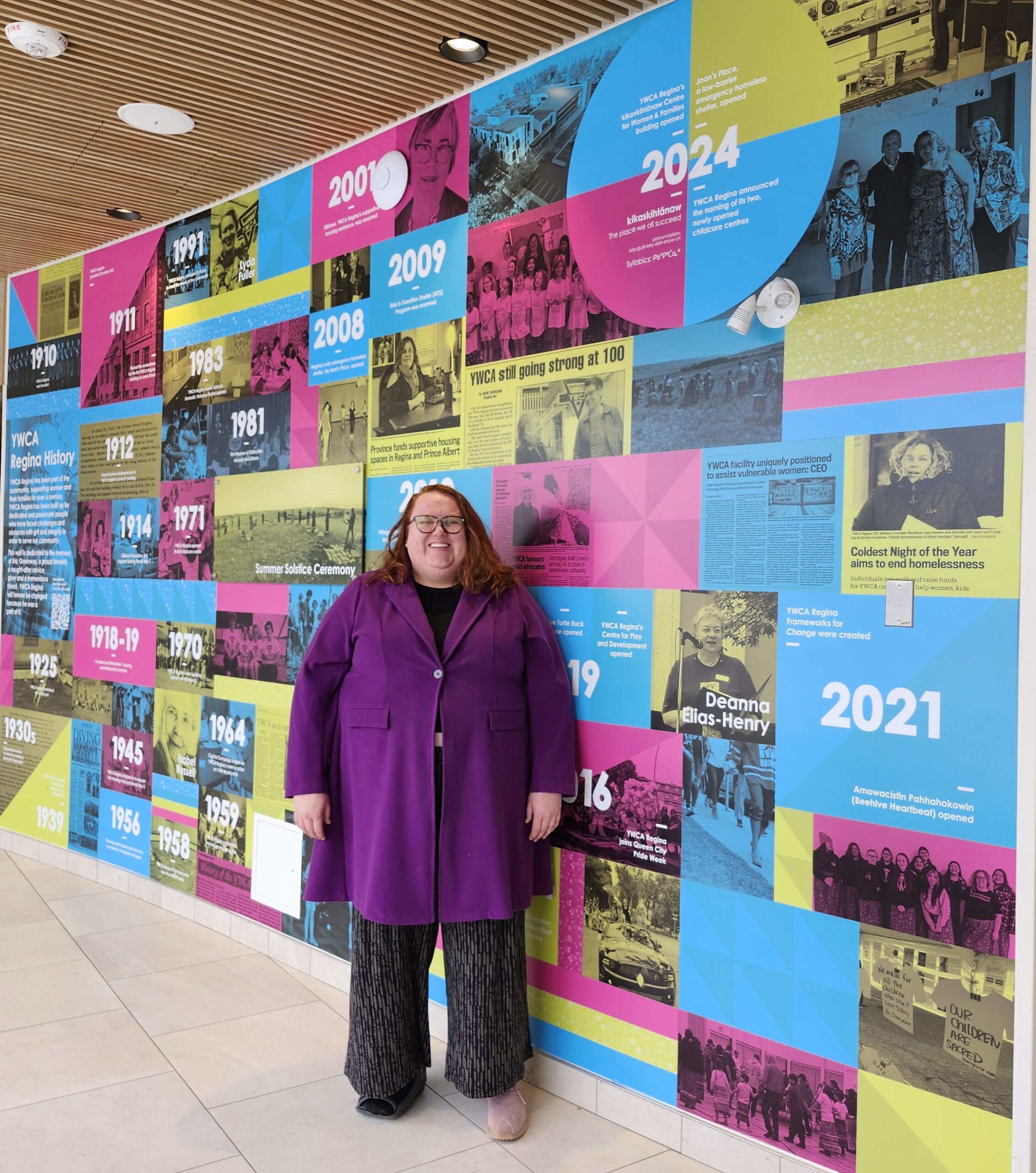
YWCA’s Megan Moore / Photo by Danielle Dufour
The YWCA Regina has been operating the Upstander program for several years.
“The program initially started as workshops where we would work with schools and students and employers, but we’ve realized … by having a workshop model really limits us to the number of people we can reach,” said Moore. “It leaves our northern and our rural communities with less access.”
This last year the YWCA Regina has taken the training content and transitioned into an online learning platform reaching people all over the province.
“The platform itself is easy to use, it breaks down the conflict and breaks down the content into small activities, and the goal was really just to increase accessibility,” said Moore. “The goal was just to serve the province of Saskatchewan.”
Initially the YWCA in Regina is targeting three streams.
“The first stream focuses on for-profit or crown corporations that have a really strict corporate culture where there often is gender-based violence incidents, there’s less women or gender diverse folks in leadership,” said Moore. “How we would approach that would be very different than how we would support something like a community group or a nonprofit in disrupting gender-based violence.”
“The second stream looks at community organizations, nonprofits, where often organizations are left to work a little bit in the grey,” said Moore. “They recognize community work is different, it has to be people first, which means the approach to training and the approach to disrupting gender-based violence in those spaces also has to look different.”
The third stream, in coordination with local Elders in Regina, is focused on Indigenous knowledge and bringing this to the reserves, First Nation schools with a high population of Indigenous students incorporating the Seven Grandfather Teachings.
“We all know the history of colonialism, the impact of gender-based violence on Indigenous communities,” said Moore. “Making sure that the content was relevant and usable for those three communities was really important.”
To get signed up, visit the YWCA Upstander online at: https://ywcaregina.com/upstanderonline/.
“That will put them in touch with our Upstander coordinator,” said Moore. “They can decide how many licences they need, how many people they want to train, then we will set up a classroom just for that designated group.”
Moore noted that they content can be adjusted for each group based on the needs of the community and organization.
“The goal truly is to empower the community from stepping out of being a bystander and becoming an upstander when we see incidence of gender-based violence,” said Moore. “If you stay silent in these moments of gender-based violence, you’re actually complicit, you are now at fault for allowing the behaviour to continue in your community.”
Moore recognizes that people are scared to be victimized or become targeted and afraid of retaliation.
“The purpose of this programming is really to provide people with the tools they need to address gender-based violence safely,” said Moore.
The RCMP report that women have a 20 per cent higher risk of being victimized than men. Indigenous women reportedly experience spousal violence at a rate three times higher than non-Indigenous women. Transgender and gender diverse people are nearly twice as likely as cisgender women to experience intimate partner violence in their lifetimes. Lesbian, gay or bisexual individuals are three times more likely than heterosexual people to report experiencing violence.
https://rcmp.ca/en/relationship-violence/gender-based-violence