
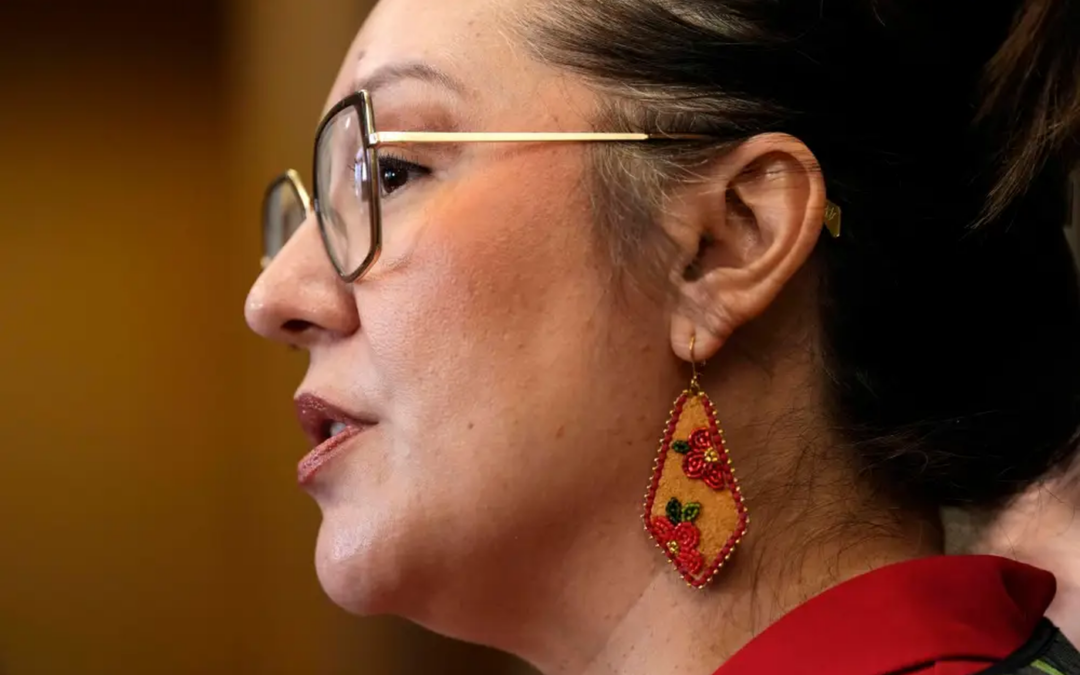
Photo: Indigenous Services Minister Mandy Gull-Masty speaks at a news conference on Jordan’s Principle in Ottawa on Thursday. (The Canadian Press) / Connor McDowell, Local Journalism Initiative Reporter
By Connor McDowell
Local Journalism Initiative Reporter
Brandon Sun
The federal government said it will continue to reform Jordan’s Principle as it announced $1.55 billion in funding on Thursday.
Two western Manitoba First Nation chiefs welcomed the funding announcement, but are opposed to the changes introduced in 2025.
The new funding is meant to provide immediate stability for the Jordan’s Principle program, which underwent reform last year after the federal government complained of misuse.
Indigenous Services Minister Mandy Gull-Masty acknowledged that there has been confusion about what a course-correction will look like.
“I know that the past few months has created much uncertainty for families,” Gull-Masty said during a press conference in Ottawa on Thursday.
“We have had the opportunity to speak with them and collaborate with them in looking at what we are going to be doing with the future of Jordan’s Principle.”
The announcement is the start of a discussion, and more information will be released in the coming weeks, she said.
“We are going to be looking forward to some upcoming announcements on what reform will look like,” she said.
“Today, we started with the announcement of funding, and really creating that stability.”
Ahead of the announcement, Dakota Tipi First Nation Chief Dennis Pashe said he supports the funding, but does not support last year’s reforms. He said a lot of quality service has been lost.
“Jordan’s Principle was one of the most successful programs we had going in our community,” Pashe said. “There was enough flexibility in the program that we were able to address community needs and design our own programs.”
The Jordan’s Principle program was used to create a food security program, to help with dental and physical needs of children, and to manage activities such as hunting, ice fishing, purification ceremonies and language programs, he said.
Those activities were impacted by federal changes in 2025, Pashe said.
“We certainly couldn’t do the activities that we wanted to. And plus, we had to lay off some staff as well, which was unfortunate,” he said. “We sure had to slow down quite a bit.”
He said Dakota Tipi First Nation hopes to bring back those programs if possible.
Cultural programs would also be brought back to Waywayseecappo First Nation if the federal government provided funding for it, chief Murray Clearsky told the Sun ahead of Thursday’s announcement.
Before the reforms, children were taught to snare rabbits and took part in programs to learn how to skin and tan hides from animals, he said. Hunting and fishing programs were discontinued due to changes last year.
“We just have very minimal stuff to get by with right now, and it’s not really feasible for the children,” he said. “We’re running with a skeleton crew, so to speak, due to lack of funding.”
Some of the workers who visited homes and took children on excursions were laid off last year as well, he said.
Thursday’s announcement comes a year after a ruling from the Canadian Human Rights Tribunal, which acknowledged that urgent requests for federal funding under the program included modelling photography head shots, a zipline kit, gaming consoles, a lawn mower, laptops, museum tickets, trampolines and printers. Requests sent as “urgent” grew by more than 900 per cent between 2021-22 and 2022-23, the Government of Canada also showed in its complaint.
Following that ruling, Ottawa released an operational bulletin saying that requests through Jordan’s Principle must show that the First Nations child has distinct needs addressed by the product, service or support being requested, and that the child clearly experienced gaps or delays in accessing government services or had been denied existing government service because of their First Nation identity.
“Jordan’s Principle is supposed to be used when necessary,” Indigenous Services Minister Patty Hajdu said at the time. “(It shouldn’t) be used for requests that are outside of what it is designed for.”
Started in 2007, Jordan’s Principle is a commitment from Canada to ensure First Nation children receive necessary support. It memorializes Jordan River Anderson, a two-year-old disabled child who died after a dispute between governments delayed care prior to his death.
The House of Commons passed Jordan’s Principle as a commitment that “First Nations children would get the products, services and supports they need, when they need them.”
Pashe noted that while it is good to see new funding for Jordan’s Principle, his peers have started to look critically at foreign aid announcements from the Canadian government.
“I think just yesterday, they announced $2 billion for the Ukraine. They (previously) announced money for Haiti, with the gang issues. But we have all those issues in our communities,” Pashe said.
“We’re battling drugs, drug issues, we are trying to create a treatment centre. We need security officers in our community. We need all kinds of supports in those areas. Our housing is bad, our sewer and water is bad, so we’re in a war against poverty,” he said.
“And it’s unfortunate that money is available for other initiatives in the world, but the government’s got to realize you got to take care of your own country, first and foremost.”
The Southern Chiefs Organization issued a news release Thursday welcoming the new funding, but said it should have been for more than a single year and that trust has been strained by recent policy changes.