
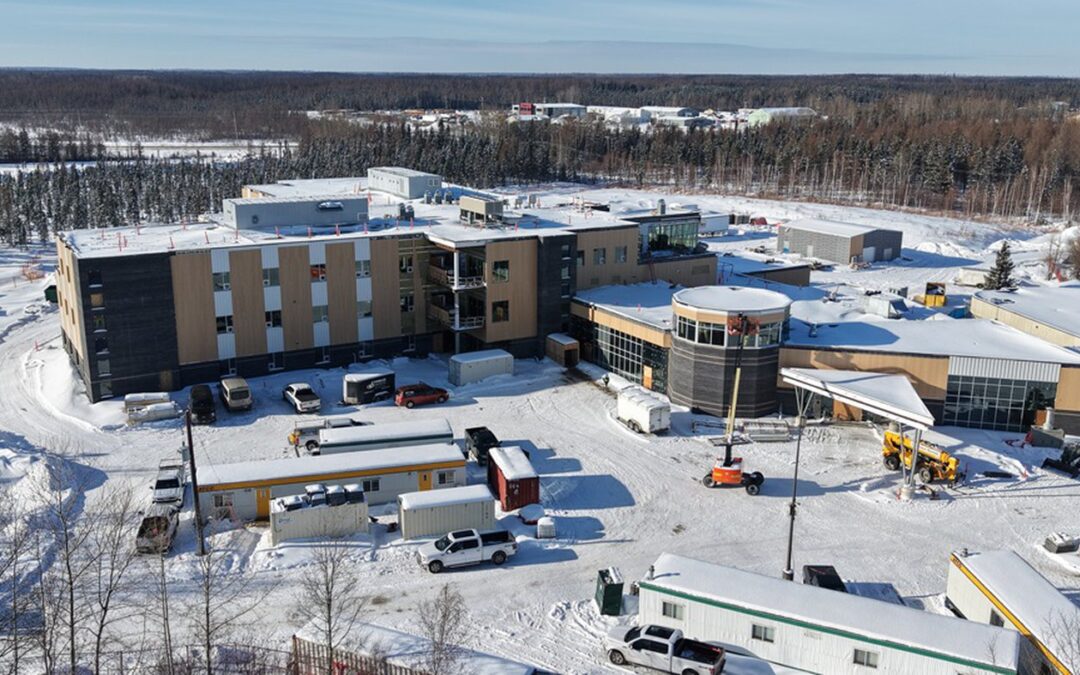
Photo: The new building will include 80 beds across six wings and three floors, with 70 long-term care resident rooms and 10 respite rooms. / Courtesy of the Government of Saskatchewan
By Nicole Goldsworthy
Local Journalism Initiative Reporter
SaskToday.ca
A new long-term care facility under construction in La Ronge is expected to significantly improve access to health care across northern Saskatchewan, including the region’s first dialysis unit and expanded services for patients and families.
The project will include the region’s first dialysis unit, along with expanded long-term care and therapy services designed to support patients and families across northern Saskatchewan.
Since 2023, the Government of Saskatchewan has committed more than $80 million to the La Ronge long-term care project. Completion of the new structure is anticipated in 2027. Once the new addition is finished and residents move into the new building, the existing long-term care space will be renovated to provide additional health services, including the development of a hemodialysis unit, a spokesperson for the Government of Saskatchewan and the Saskatchewan Health Authority told SaskToday.
“The new La Ronge satellite dialysis unit will serve a vast area of northeastern Saskatchewan, supporting several surrounding communities,” said a spokesperson for the Government of Saskatchewan and the Saskatchewan Health Authority (SHA).
Currently, many patients must travel long distances several times a week for dialysis treatment.
“Patients located in the La Ronge catchment area are currently travelling to Prince Albert or Saskatoon to receive treatment. A typical treatment plan for hemodialysis requires four hours per treatment, three days per week. This is a significant time commitment that is compounded for patients and families who need to travel from their home communities.”
Once the new unit opens, patients who meet the clinical criteria will be able to receive treatment much closer to home.
“Patients who meet the clinical criteria to receive dialysis in a satellite site will be able to receive dialysis closer to home, improving access to care, enhancing quality of life and supporting effective chronic disease management,” the SHA told SaskToday.
The facility is expected to serve communities throughout northeastern Saskatchewan. While the primary catchment area includes La Ronge, Air Ronge, Lac La Ronge Indian Band and Stanley Mission, residents from a much larger region could benefit.
“Residents from as far south as Weyakwin and as far north as the Wollaston Lake area could potentially utilize and benefit from the expanded long-term care and dialysis services being made available. This project marks an important step in strengthening essential health services for all of northern Saskatchewan,” the SHA said.
The design of the building has also been developed with northern culture and Indigenous traditions in mind.
“Throughout the planning and design process, the Saskatchewan Health Authority has worked closely with Elders and Knowledge Keepers to ensure the building and surrounding landscape reflect and honour Indigenous culture.”
Alongside government investment, the La Ronge & Area Long Term Care Fundraising Committee Inc. is raising funds to furnish and equip the new facility, expanded therapies area and dialysis unit.
“We are over halfway to our $5 million goal and are continuing to work diligently with donors and potential donors. This includes hosting events, such as our highly successful Chase The Ace fundraiser, to reach our goal,” the committee said.
Community support has played a major role in the fundraising campaign, including a sponsorship program allowing donors to support individual resident suites.
“The community has responded to the 80-suite challenge in an incredible way. Early on, we had the two special care suites ($30,000) sponsored by local businesses. We are proud to say that 50 per cent of the resident suites are now sponsored, with additional suites reserved for individuals, families and businesses who have verbally committed.”
Each resident suite can be sponsored for $12,000, providing families, businesses and organizations with a lasting way to support health care in northern Saskatchewan. To learn more about sponsoring suites, visit the La Ronge Long Term Care Fundraising website.
The new building will include 80 beds across six wings and three floors, with 70 long-term care resident rooms and 10 respite rooms, including five couples’ suites and two special care suites. Ceiling lifts will be installed in every room to assist staff and residents.
Other features include expanded therapy spaces such as physiotherapy, occupational therapy, a gym, access to a dietitian and stroke recovery services, along with a commercial kitchen, expanded cafeteria and outdoor patio that will support hospital meals and the Meals on Wheels program.
Several areas within the facility have also been designed to support visiting families.
The new home will include five community and recreation spaces that can be booked for family gatherings, as well as a third-floor family suite for visitors travelling from outside the area.
“The family suite will give families peace of mind, having a place to rest, visit and lay their head while visiting their loved one who is receiving care. This will be very beneficial for families who may have mobility issues, cannot afford hotels, cannot find a hotel or just need a place close to their loved one while visiting,” the fundraising committee said.
Another unique feature will be a serenity room, a glass-walled balcony space designed for quiet reflection.
The room will offer views of the northern sky, including the aurora, with calming nature sounds and music.
The new facility will connect directly to the existing health centre, creating what organizers describe as a “unified health-care hub for the North.”
Fundraising organizers say the project represents a major step toward improving access to care for northern residents.
“The new facility includes our region’s first and highly needed dialysis unit, which will save countless lives while alleviating the stress of travelling multiple times a week. We are working together to bring accessible health care closer to home.”
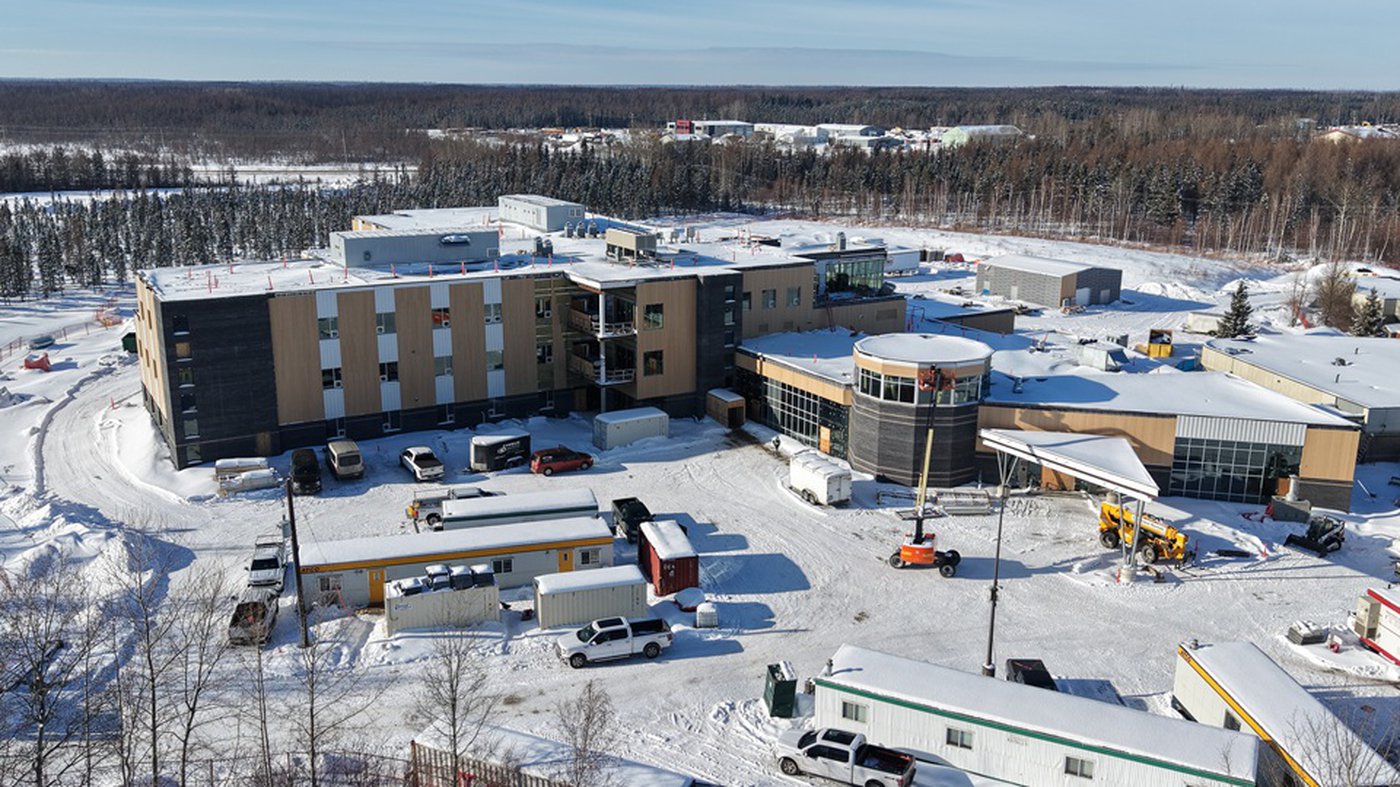
Currently, many patients must travel significant distances for dialysis treatment.