
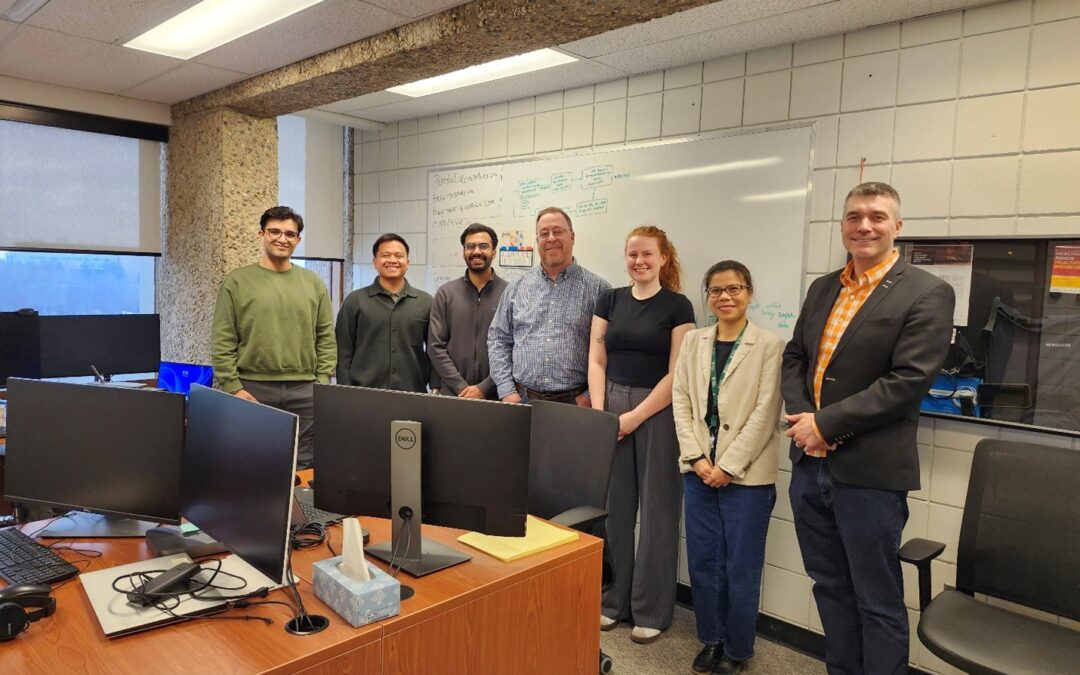
Photo: Dr. Nicholas Carleton (Right) and the PTSS Lab team at the University of Regina / Photo by: Danielle Dufour
By Danielle Dufour
Dr. Nicholas Carleton, a Professor of Clinical Psychology and a registered clinical psychologist in Saskatchewan is the visionary behind the Psychological Trauma and Stress Systems Lab (PTSS) – mental health monitoring application, and leads a team of researchers, clinicians, operational and technological experts.
“Exposure to potentially traumatic events in the workplace is common in public safety personnel,” said Dr. Carleton.
The PTSS lab aims to support and improve the mental health of trauma exposed professionals, including first responders, safety personnel and more by offering a mental health monitoring application. This app provides daily, monthly and yearly check-ins for a variety of trauma-related injuries.
“They’re regularly exposed to potentially psychologically traumatic events at orders of magnitude prevalence and frequency relative to the general population,” said Dr. Carleton. “Most of us will be exposed to five or fewer potentially psychologically traumatic events in our entire lifetime … for most of our public safety personnel and other trauma exposed professionals, they could be exposed to five in a shift.”
Research from the University of Regina and the National Police Federation shows escalating mental health issues among RCMP members.
“We’re asking them to deal with all of our worst days, except for them,” said Dr. Carleton. “We’re asking them to deal with that every single day.”
Dr. Carleton explained while we can not stop our trauma exposed professionals from being exposed to trauma, as that is what we need them to do, these professionals are at risk of injury that needs attention and care.
“If you got a cut on yourself, you wouldn’t wait, I hope, until it was gangrenous before you went to emergency to get it sown up and dealt with, because it takes way less time to deal with,” said Dr. Carleton. “If we get to it early, that’s part of what these tools are doing.”
Daily check-ins are done privately from a personal device and take about 60 seconds to complete on the app for trauma exposed professionals to monitor their mental health and take control.
“The biggest value in our tools is the ability to make sense of the symptoms that we all feel … helping people connect the dots,” said Jonathan Burry, PTSS Program Manager. “Within the app, we provide a curated list of mental wellness resources that could be anything from urgent care items or referral sources for finding help on your own … and if they want to do some independent self-directed learning, we provide resources for that as well.”
Some of these tools were originally designed and pilot tested as part of a world-leading project built by the Royal Canadian Mounted Police (RCMP).
The United Chiefs and Councils of Manitoulin (UCCM) Anishnaabe Police Service in Ontario is launching this mental health app to help officers privately track their well-being and monitor for signs of post traumatic stress disorder or anxiety and provide support recommendations based on their specific needs.
The Regina Police Service will be deploying the system on Monday, March 16th.