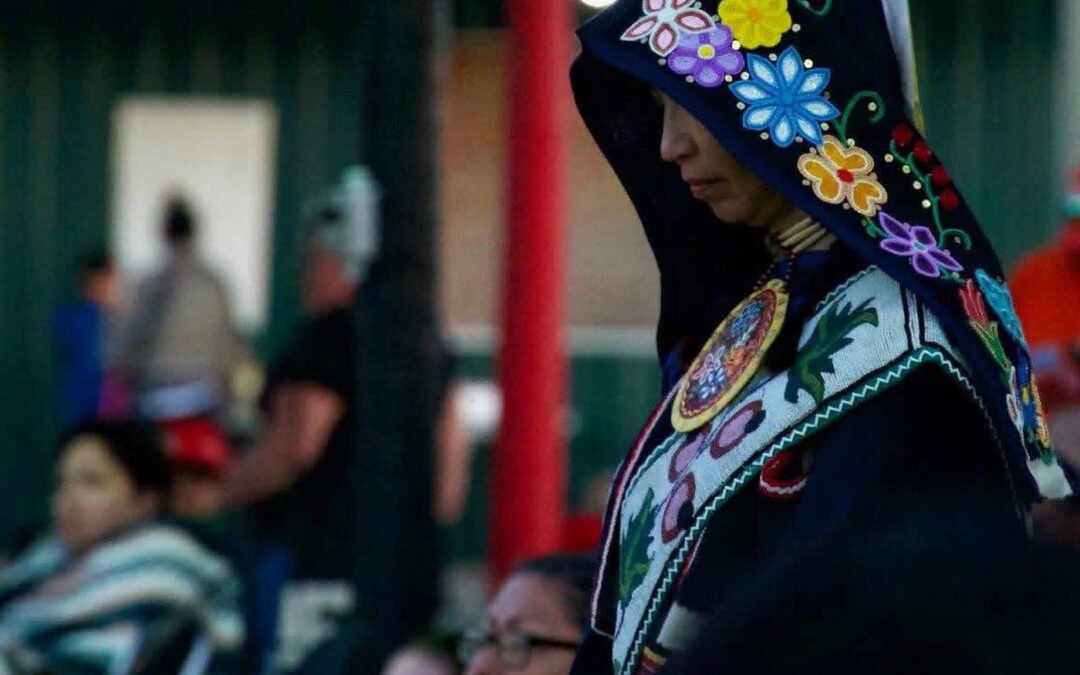
Photo: Joanne Soldier wears strap dress regalia, including a beaded hood and bandolier bag, at the Swan Lake First Nation Pow Wow in July 2017.
IndigiNews
When Starla Redsky sprained her knee and ankle, the lifelong Anishinaabe jingle dress dancer found herself suddenly sidelined from the powwow circuit.
“It was taking me a long time to recover,” the Shoal Lake 40 First Nation member recalled.
“The doctor said I was not going to be able to dance for a couple months.”
But with the vigorous footwork and movements of jingle dress dancing too risky — and the annual powwow season around the corner — she didn’t want to miss out.
She pondered whether another powwow category might be gentler on her injuries.
Then she remembered fellow jingle dress dancer Joanne Soldier, of Swan Lake First Nation, performing in a strap dress at a powwow in Manitoba nearly a decade ago.
“I saw her dancing in the traditional category, and she was wearing a hood and strap dress,” she told IndigiNews.
“And I remember being so mesmerized by her — I was just like, ‘Oh man, she’s so beautiful.’”
‘You’re telling a story about yourself’
Redsky is one of the growing number of women, girls and Two-Spirit people who are reclaiming the woodland strap dress, an ancestral garment she refers to as a nokomis (grandmother) dress.
Traditionally made from two deerhides — and now often made in velveteen or stroud wool — the dress is a long garment held up with two distinct straps. Different variations feature decorations like beadwork and ribbons, sleeves, and dramatic hoods.
Redsky now lives in Minnesota with her son and husband — who is from the Red Lake Band of Chippewa in that state — and they travel to powwows as a family.
All three are woodland dancers, a style that first re-emerged for men’s powwow categories in recent years.
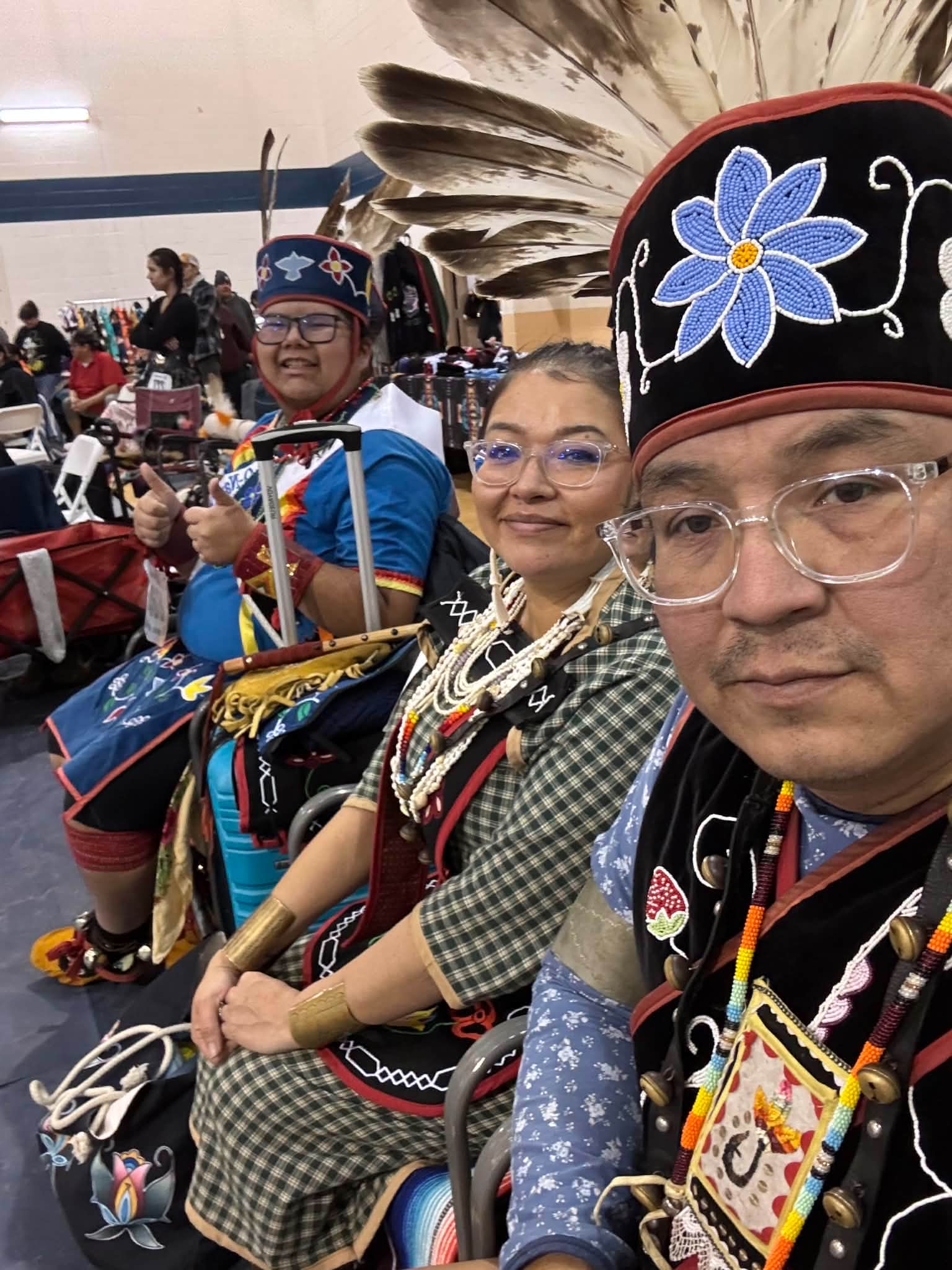
Starla Redsky (centre) attends an event in woodland-style regalia with her son (left) and husband.
The couple worked together to make her first strap dress. But she still didn’t know how to dance in it.
Her husband encouraged her to listen to men’s woodland songs, to get an idea of their distinct rhythm.
“I noticed that the beat was faster,” she remembered.
“I watched some YouTube videos and I saw a strap dress dancer … so I was like, ‘I think that’s the way I’m supposed to dance.’
Watching men perform in the newly revived style, she saw them often imitate the motions of hunting, prayer, holding up a pipe, or using a stick.
“When you’re dancing woodlands, you’re telling a story about yourself,” she said.
“What do I want to tell about myself?”
To her, what seemed important to incorporate were activities she enjoys: scouting out spots for hunting, canoeing, and being on the land.
“That’s what I’ve incorporated in my dance,” she said.
In search of the strap dress
Looking back, Redsky believes the woman she saw dancing in some of the Youtube videos was Zeegwun Noodenese (Siobhan Marks).
Marks, who is part of the Eagle Clan, is a descendant of Lac Courte Oreilles Band of Lake Superior Ojibwe in “Wisconsin.” She has researched the woodland style extensively since around 2009, and sees its growing popularity as a long-overdue cultural revival.
“What were we wearing before the jingle dress?” Marks would ask people as she investigated.
“No one knew. All we would hear is, ‘We heard there [was] some kind of dress.”
Marks recalled powwows she’d attended around the Great Lakes, where she saw an outfit known as a plains-style “t-dress.”
“Usually, [with] the grandmas who were wearing a buckskin dress, it was kind of non-tribally-specific,” she explained.
“I was seeing more western tribal influence than I was seeing woodland.”
Before Marks started dancing as an adult, she often snapped photos as a spectator at powwows with her husband and step-children.
As she continued to research what style preceded jingle dresses, she talked to Anishinaabe elders, who gave her clues as to what previous generations of women wore.
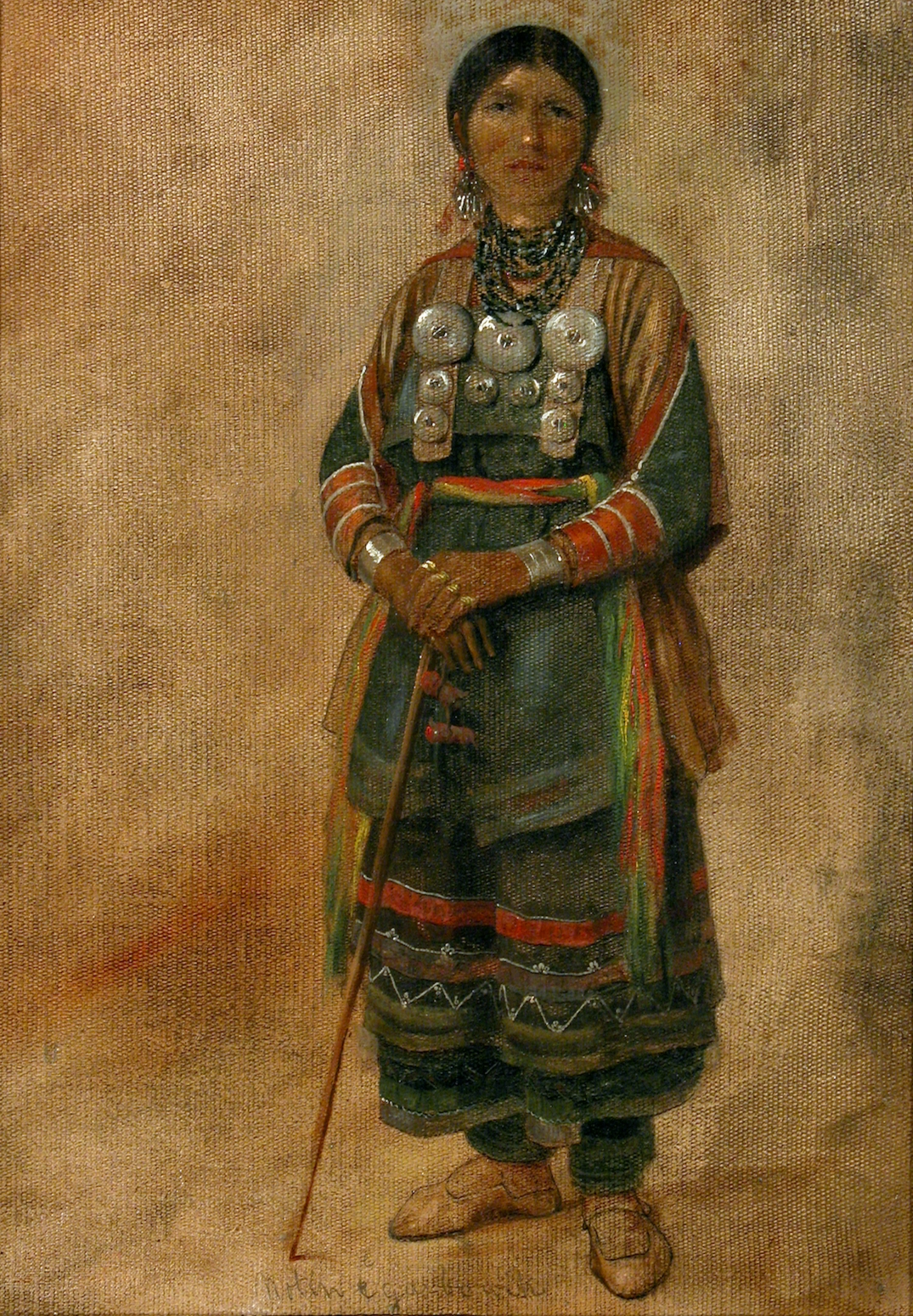
Eastman Johnson’s 1857 painting Notin e Garbowik (Standing Wind Woman) portrays a woman wearing a strap dress in Minnesota, part of the artist’s Paintings of Chippewa Indians collection.
Strap dresses evolved through several historical eras.
After Europeans arrived, the dress adapted during the fur trade, incorporating wool from trade blankets.
The materials used changed further around the time authorities imposed reserves. As relatives and communities were forced apart, strap dress styles also diverged and diversified.
Women began to make them using velveteen and cotton fabrics adorned with copper, brass and beads.
“We were being separated from our families,” Marks said. “That was really creating these communities with specific identities — and allowing the dress to really look different depending where you’re from.
“You could tell where someone was from by what they were wearing.”
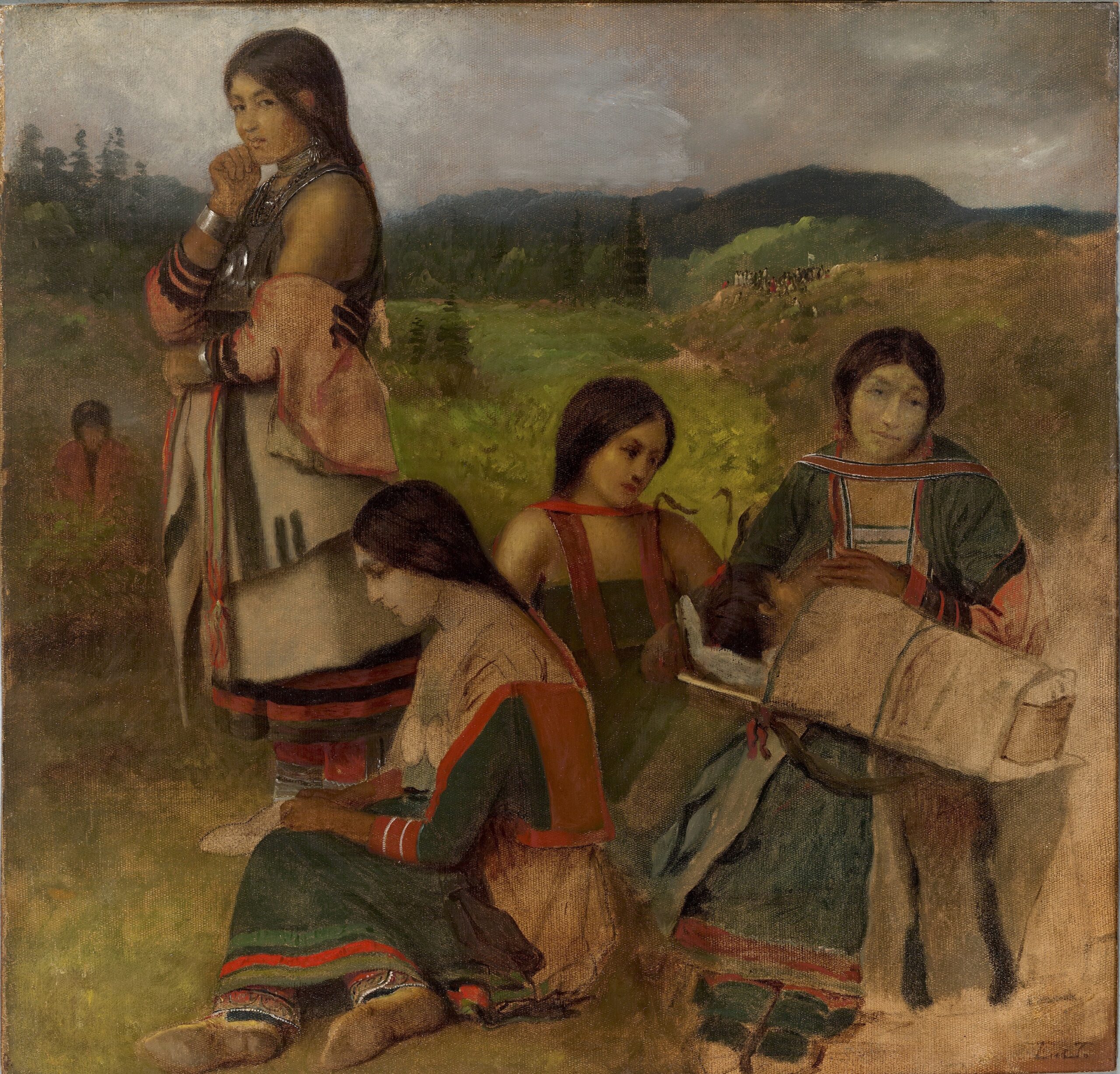
Eastman Johnson’s 1857 oil painting Ojibwe Women depicts women in strap dresses in Minnesota, part of the artist’s Paintings of Chippewa Indians collection. (St. Louis County Historical Society 20051017)
But also with the imposition of colonial institutions in “Canada” and the “United States” came cultural suppression.
Forced assimilation saw children’s long hair cut off, and their traditional clothes seized and replaced with school uniforms.
“Our dress had been taken from us, in the residential boarding school era,” Marks said.
“We weren’t even thought of as human beings … They needed to separate us from our culture.”
In the late-19th century and early-20th century, the “Canadian” and “U.S.” governments enacted policies that restricted Indigenous Peoples from practicing their culture.
But it didn’t completely stop people.
During the Spanish Flu global pandemic of 1918-20, the jingle dress was born at Naotkamigwanning (White Fish Bay First Nation), within Treaty 3 territories in “Ontario.”
According to the outfit’s origin story there, a child named Maggie White was severely ill, and her grandfather had a dream instructing him to make a healing dress adorned with metal cones, so his grandchild could heal.
At Mille Lacs reservation in Minnesota, the jingle dress has its own, similar origin story.
In that account, a father’s sick child was cured after he had a vision of four women wearing dresses coloured yellow, green, red and blue, adorned with rolled-up tobacco tins.
And after he taught women in his community the dance steps — and they’d recreated the dresses he’d seen — his daughter was healed; she began to dance.
For a century, many young women have found empowerment through jingle dresses, inspiring them to heal themselves and others.
But as it became more and more popular, eventually the jingle dress would eclipse its predecessor — the woodland strap dress.
Grandmas ‘fought really hard to keep that dress alive’
In Marks’s quest to revive the garment, she also discovered replicas of the traditional design being used by non-Indigenous living-history actors, to be used in colonial re-enactments.
“They had their own publications about the dress,” she said.
“Of course, none of them had any of the cultural relevance; they didn’t have that connection.”
Marks, a second-degree Mide’ikwe of the Three Fires Midewiwin Lodge, brought her findings to her spiritual Grand Chief Bawdwaywidun (Eddie Benton-Banais).
“He was so encouraging, ‘Keep going, this is awesome,’” she recalled.
“But he also helped me understand some of the cultural significance.”
Eventually, she decided to try making her own dress in 2011, in her quest to make regalia authentic to her Anishinaabe heritage.
She constructed her first dress using what she described as “oodles” of fabric — because she had to figure the design out without a template pattern.
“The fabric I was cutting up, I kept tossing it,” she recounted.
“I hadn’t uncovered enough of the knowledge.”
After practicing with several variations of the garment — based on ones historically worn during the fur-trade and reserve eras — she finally felt comfortable enough working with smoked deerhide.
But she didn’t want to make any mistakes with it.
Once she’d sewn her strap dress prototype, Mark called it a “grandmother’s dress” — in recognition of her ancestors.
“I really tried to honour the grandmothers,” she mused, “who fought really hard to keep that dress alive.”
Skepticism and pushback
Reviving the strap dress and its associated dance steps on the powwow circuit, Redsky learned, wasn’t as simple as she’d hoped, however.
It took unexpected courage.
When Redsky put on her own strap dress and hood, she recounted getting “weird looks” and skeptical questions from some onlookers.
“What are you supposed to be?” one traditional powwow dancer demanded.
“What tribe is that? … What is that hat thing that you’re wearing?”
Such pointed interrogation from dancers unfamiliar with the style “was really disheartening,” she said.
That was when she turned to Swan Lake First Nation dancer Joanne Soldier, known as a pioneer of bringing strap dresses and hoods back to Manitoba powwows.
“I knew that she had been dancing it for so long,” Redsky recalled.
Like others who’ve been inspired to research the garments’ history, Soldier had for years pondered how her ancestors dressed.
She told IndigiNews she dove deep into her research — snapping thousands of photos at museum archives and displays on trips to Minnesota, funded by the Manitoba Arts Council.
She was especially curious about Anishinaabe bandolier bags, traditional shoulder bags commonly used by strap dress dancers.
Soldier studied the beadwork patterns and cuts of historical dresses, which helped her understand how to authentically replicate the look into her own version of woodland regalia.
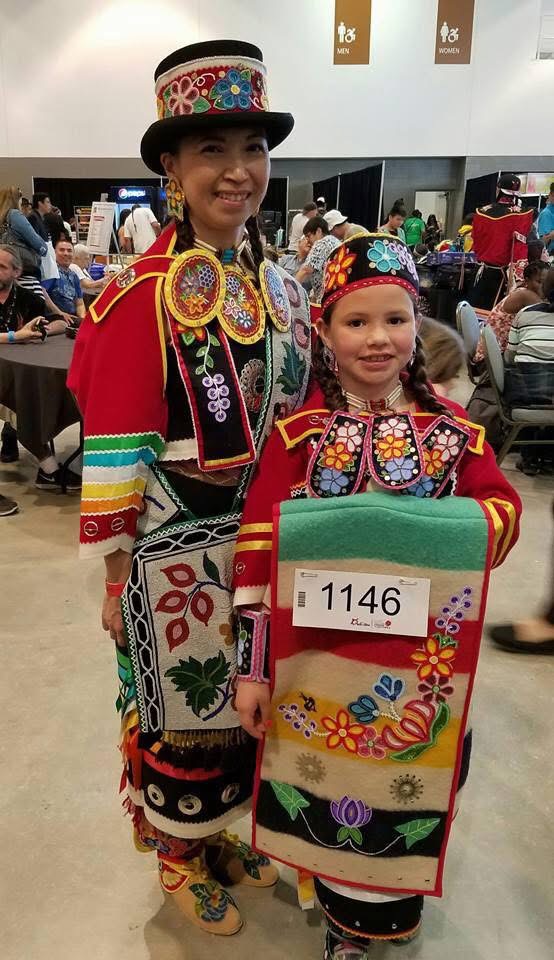
Joanne Soldier and her daughter, Waasayah Munro-Soldier, at the Manito Ahbee Pow Wow in May 2016.
Her first strap dress was made of trade-cloth wool, which she accessorized with a top hat and a Hudson’s Bay blanket arm shawl.
She debuted the regalia at the Manito Ahbee Pow Wow at Winnipeg in 2016. But like Redsky, she soon discovered not everyone was as enthusiastic about the ancestral style as she was.
“It was a bit discouraging,” she said. “People weren’t understanding what I was wearing and what I was trying to do.
Bringing strap dress to the powwow grounds
Just as Redsky had turned to Soldier for solace and support, after Soldier got similar pushback at a powwow, she turned to Marks for advice.
For many strap dress enthusiasts, Marks has been pivotal to the revival of the ancestral tradition, including by offering dress-making workshops — in hopes of restoring the often-dismissed style.
“That level of erasure to this day runs so very deeply,” Marks said. “All those years I was wearing my dresses and dancing at powwows, I would most of the time be the only one.
“I really thought, wow — we’re ready to embrace our dress and bring this back for our women. This is such an important identity piece.”
Dené Sinclair, an Anishinaabekwe who grew up on St. Peters Reserve of Peguis First Nation in Manitoba, attended one of Marks’s sessions in Winnipeg — where she made her first strap dress.
Marks was flown into Winnipeg by Sinclair and others to host a workshop at their request.
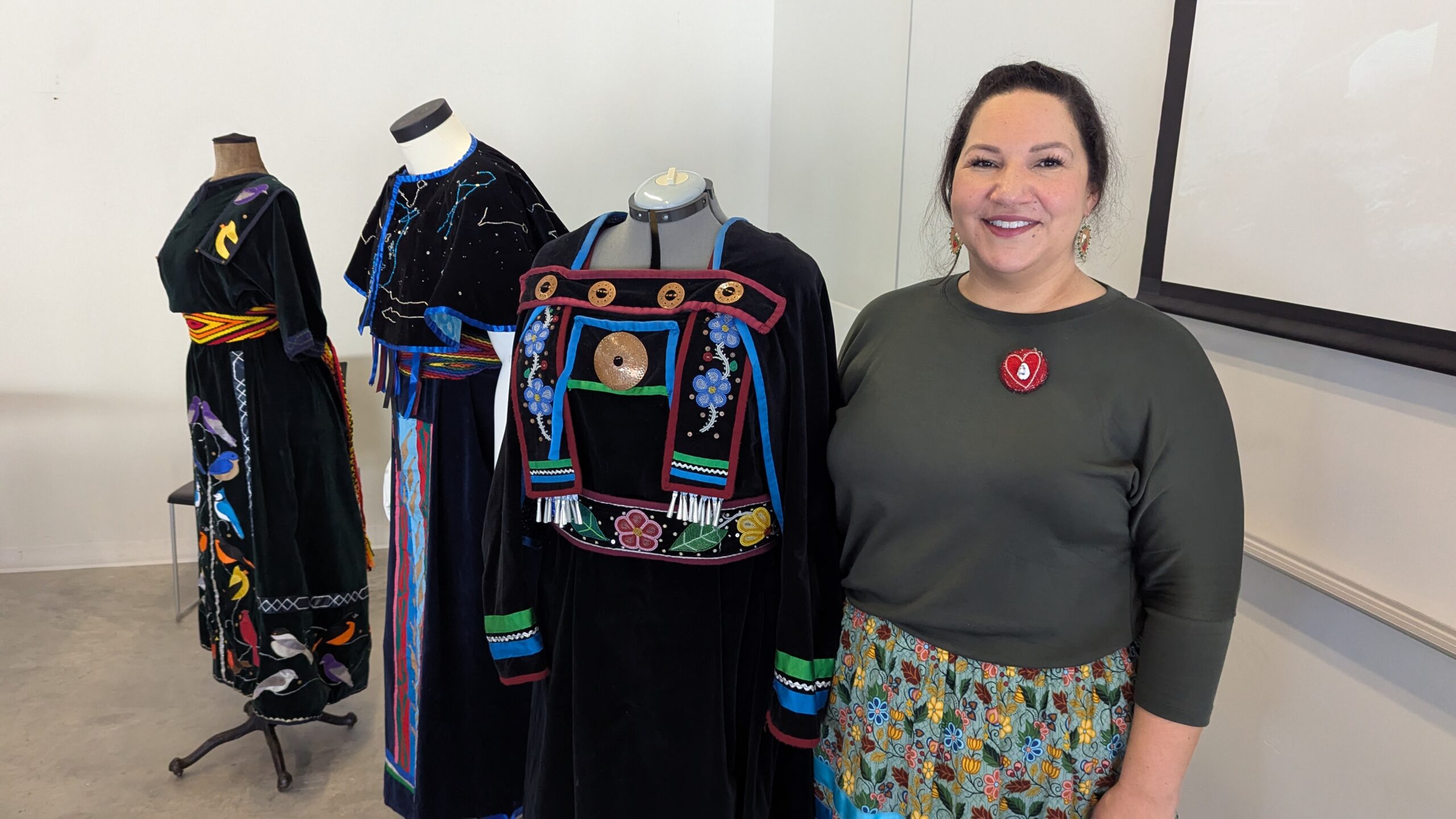
Dené Sinclair, of Peguis First Nation, offers a presentation on ‘Revitalizing the Gookomisinaan Ogoodaas (Grandmothers’ Strap Dress),’ at the University of Manitoba School of Art on March 9.
She proudly wore the garment to Midewiwin ceremonies in 2018 with her late stepmother.
As a language learner and teacher, she passed aasemaa (tobacco) to Elders to understand words for woodland regalia in the Anishinaabemowin language, such as magooday (dress).
“I asked so many Elders and grandmas, ‘What is this dress called? Please tell me,’” Sinclair recalled.
The Elders replied, “It’s just a dress — magooday.”
With help from Howard Copenace of Naotkamegwanning, Sinclair compiled a vocabulary list of words such as agonii’on (sleeves), and anikamaanan (straps).
But finding an Anishinaabemowin word to describe a “woodland style” proved to be more difficult.
“‘Woodland’ is this weird English word,” Sinclair said. “The only word that anyone has ever told me is geteshimowin — which is the old way of dancing.
The word for a person dancing in this old style is mitigonaabeshimo, she added.
“There were no other styles until they came up with the jingle dress,” she said. “‘It’s just a dress’ — that’s the answer I get from all the speakers that I ask.”
Connecting with other women who are reviving the ancestral strap dress traditions has helped Sinclair and Mark — both ceremony sisters of the Midewiwin lodge — to overcome their experiences of judgment and lateral violence on the powwow trail.
“People would just say, ‘That’s not Anishinaabe,’” Sinclair said. “They just don’t think that that’s ours.”
So she suggested to Soldier that they host a strap dress “special” — a type of powwow competition with prizes sponsored by individual organizers, often in honour of a loved one or an important issue.
“We’re gonna host a special,” Sinclair said, “and we’re gonna do it at the biggest powwow I know.”
That high-profile event was the massive Manito Ahbee powwow in May 2024. They titled their special “Welcoming Back the Strap Dress.”
But as the event approached, Soldier still felt “tentative” about how dancers would respond.
“We didn’t know what type of reception we would have,” she recalled.
When the big day arrived, and the announcer called out the competition, Sinclair and Soldier waited nervously, wondering whether many other dancers would take part.
“We were amazed,” quipped Soldier.
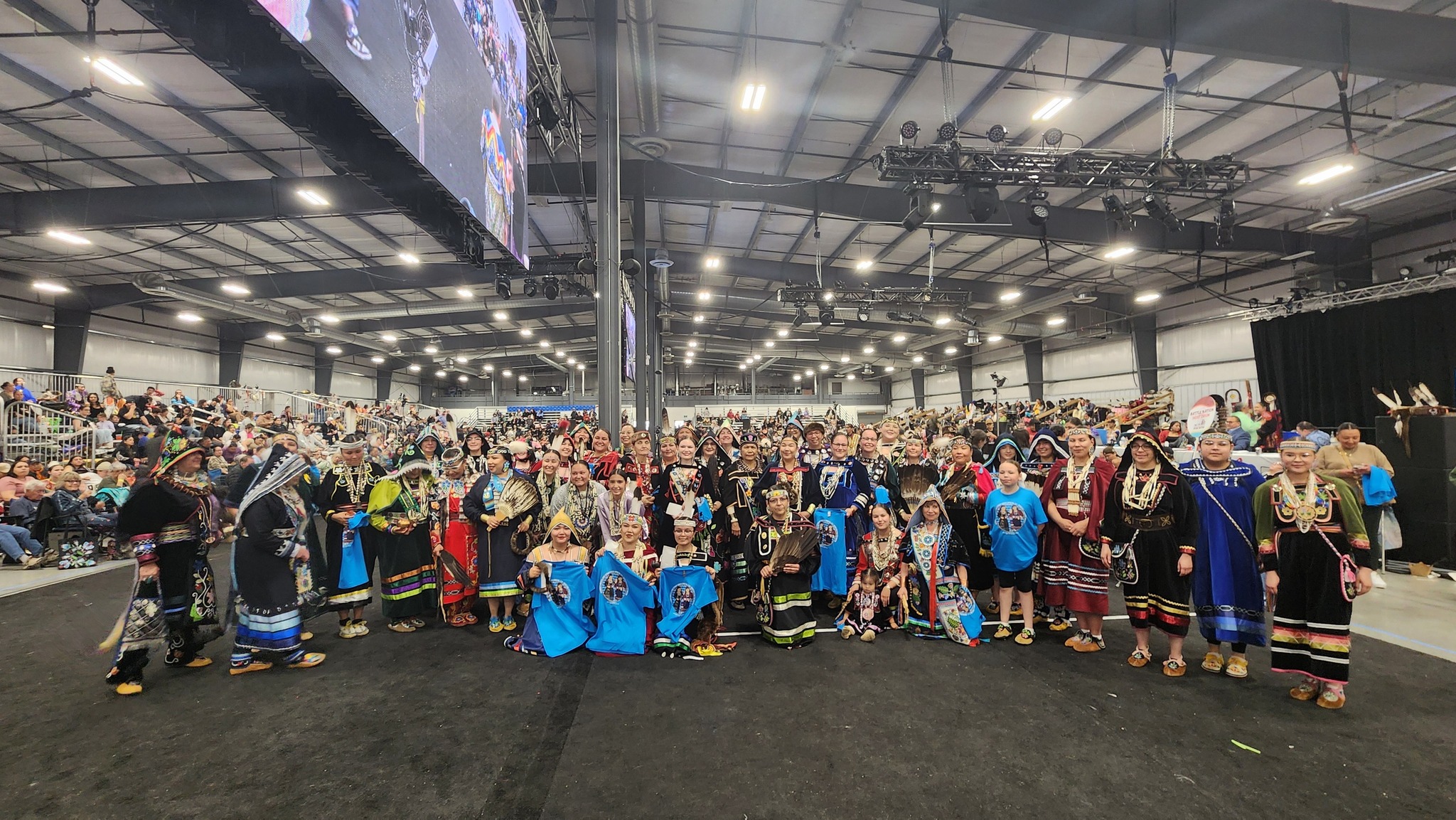
Participants in the Women’s Woodland Strap Dress Special at the Manito Ahbee Pow Wow on May 19, 2025 in Winnipeg.
About 50 woodland dancers showed up — wearing strap dresses in all three historical eras’ styles. They had traveled from across North America.
And in the first song of the special, everyone danced into the powwow circle in a procession behind Sinclair, Soldier and Marks.
The trio’s long, sometimes challenging, quest to revive the strap dress had paid off.
All three credit that pivotal event with bringing wider attention, and acceptance, of the woodland dress. Since then, many videos and photos have been shared of the tradition on social media, and even live-streamed on the website powwows.com.
The circle of strap dress dancers has only grown in the past two years since that powwow special.
And Marks believes the long-forgotten dress is evolving yet again into a new historic era — a time of reclamation.
The powwow special’s organizers are now preparing for their third women’s woodland strap dress special — planned for Winnipeg next October.
“Around powwows and different places that I would travel, you would start to see more and more strap dresses,” Sinclair said proudly, “more and more people coming out of the woodwork.”