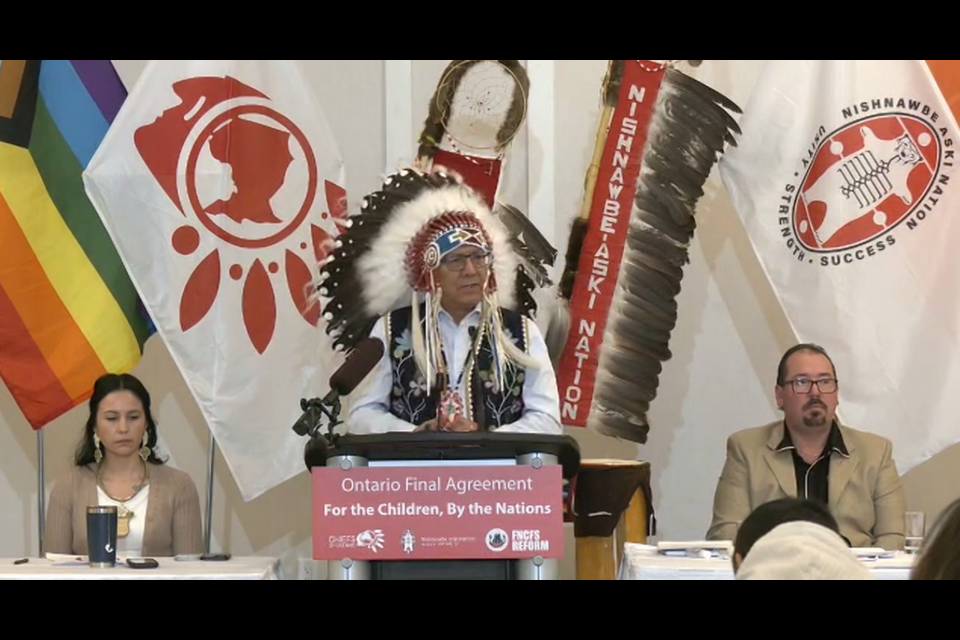
Photo: Nishnawbe Aski Nation Grand Chief Alvin Fiddler speaks at a press conference in Toronto on March 30, 2026.
By Matt Prokopchuk
Local Journalism Initiative Reporter
NWOnewswatch.com
First Nations leaders in Ontario are celebrating a decision by the Canadian Human Rights Tribunal over the future of child welfare.
On Monday, the tribunal approved the Ontario Final Agreement — the nine-year, $8.5-billion deal that the Chiefs of Ontario and Nishnawbe Aski Nation reached with the federal government in 2025 that will give communities control over things like foster care, child protective services and adoption in their First Nations.
“The chiefs have the authority to decide how to look after their own children and what is in the best interests of their children,” Nishnawbe Aski Nation Grand Chief Alvin Fiddler told a press conference in Toronto Monday afternoon after the tribunal issued its decision.
“I’m so full of gratitude to all those that worked so hard to get to where we are today — our chiefs of the Nishnawbe Aski Nation, all the citizens of the Nishnawbe Aski Nation for encouraging us, for pushing us forward to negotiate this agreement.”
The Ontario-specific deal came several months after the Assembly of First Nations voted down a national settlement over child welfare in October 2024. It all stems from a nearly two-decades long human rights complaint, where the tribunal found in 2016 that the federal government discriminates against First Nations children by underfunding child welfare on-reserve and that it hasn’t been providing the same level of service as is given in other communities in Canada.
First Nations in Ontario tasked provincial Indigenous and treaty territorial leadership to negotiate the province-specific agreement after the proposed national deal fell through, Fiddler and others said on Monday.
The human rights tribunal issued its decision through an expedited letter of decision, with a full document with its reasoning to follow. It underscored that further delay would risk further harm to children and families, including the potential loss of a year of funding under the final agreement.
“Ontario First Nations children and youth have been waiting for today’s decision for nearly 10 years,” said Ashley Bach, a member of Mishkeegogamang, who told the press conference she didn’t grow up in the community because she was adopted out at five years of age.
“There have been so many harms against our children over the past decade, and the decades before that, under a discriminatory system that was designed to take us away from our families, our communities, our nations, our traditions and our lands.”
First Nations kids are vastly overrepresented in the child welfare system across the country — with Association of Iroquois and Allied Indians Grand Chief Joel Abram saying that apprehension rates “rival those during the Sixties Scoop,” a period lasting into the 1980s where authorities forcibly took thousands of Indigenous children from their families and placed them in non-Indigenous homes.
June Black, the chief of the Apitipi Anicinapek Nation, said the Ontario Final Agreement is designed to ensure colonial-driven laws don’t do further harm.
“This is not just about responding to a crisis after crisis after crisis,” she said. “It’s about prevention.”
“We’re actually in a place where we can prevent the horrible, horrible past from happening again.”
That means a lot of work at the community level, leaders said on Monday.
“We need to get away from these … colonial laws — get away from that now,” Black said. “Go home and start working with your people, within your communities.”
“In the end, Indigenous child welfare is about raising strong children within strong nations — we must never allow our children to feel the pain of being removed from their communities. We need to stop that.”
The tribunal’s ruling is still subject to a 30-day appeals process, Ontario Regional Chief Abram Benedict said; should that pass without applications for judicial review, he added, there will be a significant “implementation phase” and leaders will set a date when money from the final agreement will start to “flow to our communities.”
“There’s a lot of work to do,” Benedict said. “That is building the capacity in communities, embracing community laws, ensuring that all of the elements that are in this agreement are mobilized and operationalized so that our children, our families, will receive the benefits.”
“So, there’s a lot of work to do in the next several years.”
Fiddler said that type of work has already started in many Nishnawbe Aski Nation First Nations. NAN represents 49 First Nations in the Treaty 9 and Treaty 5 areas across northern Ontario.
“They’ve already started the work,” he said, adding that, for example, North Caribou Lake held the grand opening for its new family services facility earlier in 2026. “In the last year or so, many of our communities are building infrastructure to support these programs and services in their own communities.”
“There are stories like that right across the NAN territory — the communities are anxious to assume, once again, the responsibility of their own children.”
Indigenous Services Minister Mandy Gull-Masty issued a statement Monday afternoon, saying she welcomes the human rights tribunal’s decision and thanks it for its work.
“I want to recognize the Chiefs of Ontario, the Nishnawbe Aski Nation, and First Nations communities across the province who have worked tirelessly, over generations, to be the ones making decisions for their own children,” her statement said. “Your leadership, your advocacy, and your resilience have brought us to this moment.”
“The approved agreement establishes a comprehensive framework for long-term reform, including safeguards to ensure accountability, continuous improvement and sustainability of services beyond the life of the agreement,” NAN said in a media release.
Benedict called the nine-year agreement “the beginning of an opportunity for all of us together.”
“Moving forward with today’s decisions will result in no further delay for our families and our children to receive the justice that they deserve,” he said. “Our communities in this region are ready.”
“You have chosen to exercise your self-determination and this agreement reaffirms that.”