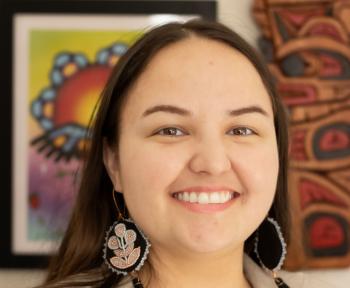
Photo: Kaella-Marie Earle. Photo supplied / Sam Laskaris, Local Journalism Initiative Reporter
By Sam Laskaris
Local Journalism Initiative Reporter
Windspeaker.com
Kaella-Marie Earle, a member of Wiikwemkoong Unceded Territory on Manitoulin Island, has been named president of the Canadian Aboriginal Minerals Association (CAMA), a group founded in 1992 but one that had been on hiatus since the COVID-19 pandemic started in 2020.
Hans Matthews, a member of Wahnapitae First Nation in northern Ontario, founded CAMA and served as its only previous president. He stepped back from his position for personal reasons roughly the same time the pandemic was happening.
“Last year, with the national landscape changing regarding major projects and the increase in mining development in Canada, Hans actually got people from across the country reaching out to him,” to relaunch the organization, Earle said.
“They felt that they needed the kind of support that CAMA has historically provided,” she said. “And so, what he did at that time, was reach out to me and a couple of other people to help him relaunch. And then a couple months ago, he appointed me into the president role.”
Earle said she didn’t think about how much she would be included. “I did agree to help with the relaunch but I didn’t ask for a leadership role. They just appointed me to one.”
CAMA was officially relaunched at an event at the Prospectors & Developers Association of Canada conference held earlier this month in Toronto.
“That was really well received,” Earle said of the launch party. “We had a lot of Indigenous people and mining industry leaders who came. And everyone was pretty excited about what we have to offer. And we were happy. We were happy to know that we were pretty well aligned with what many First Nations, Inuit and Métis groups are looking for in terms of support.”
Earle, who is an engineer, is currently living in Sudbury, Ont.
One of her jobs is working at Natural Resources Canada (NRCan) as a member of the Sustainable Jobs Partnership Council.
“Our job is to provide advice to three ministers and the prime minister on the creation of sustainable work in Canada,” she said. “My strategic focus, both as a member and as chair of the First Peoples advisory committee, is to strategically focus on Indigenous economic empowerment and how the pathway to net zero is playing out in Indigenous communities, especially from a natural resource development point of view.”
Earle said she’s been travelling across the country during the past year listening to Canadians and Indigenous people tell her what’s happening on the labour front.
“I’m very busy with them,” she said. “But I am starting this year to collaborate internationally as well. Our council at NRCan has actually recently just joined an international body on sustainable best practices across the globe.”
The inaugural meeting with this group is scheduled for this week in Scotland.
“And then I’m also collaborating with the International Energy Agency in France,” Earle said. “So, that’s pretty exciting to look at barriers that our Indigenous people face in terms of employment in the energy sector.”
Earle has also had a role at the Canada Energy Regulator serving as vice-chair of the Indigenous advisory committee for the past six years.
“We’ve been helping the executive and the board figure out how to strategically implement the UN Declaration on the Rights of Indigenous Peoples, or UNDRIP, into the way that they operate and weave that through the organization,” she said. “So, a lot of what we’re looking at is free and prior informed consent, how that could work and Indigenous oversight mechanisms.”
Earle’s hectic work life includes being a part-time engineering professor at Brock University in St. Catharines, Ont.
Earle said CAMA has several pillars of operations and the organization is hoping to continue to grow.
CAMA was founded as a volunteer Indigenous-led organization to ensure Indigenous Nations could shape the future of mining instead of being sidelined by it.
“We really want to be the kind of organization that builds bridges in a landscape that’s pretty divided,” Earle said. “So, we did create the first national forum where Indigenous communities and mining companies could meet as partners to enable safe dialogue in a landscape that previously lacked it. And it’s still something that’s so important in the kind of atmosphere that we’re facing right now, both nationally and internationally.”
Earle said that in the past CAMA assisted communities and industry navigate things like environmental protection, community well-being, economic development and long-term agreements.
“And we’ve also done things like shaping standards for Indigenous engagement in mining,” she said.
Another CAMA pillar is operating without prejudice.
“So, CAMA is not for or against any project or for or against any company,” Earle said. “What we want to be is just somebody who is able to provide information and capacity again for that free and prior informed part.”
She added CAMA wants to enable communities to be able to provide consent or, alternatively, not provide consent with confidence according to what is most important to them.
CAMA will revive its annual national gathering. The 2026 conference will be held in Sudbury in early November.