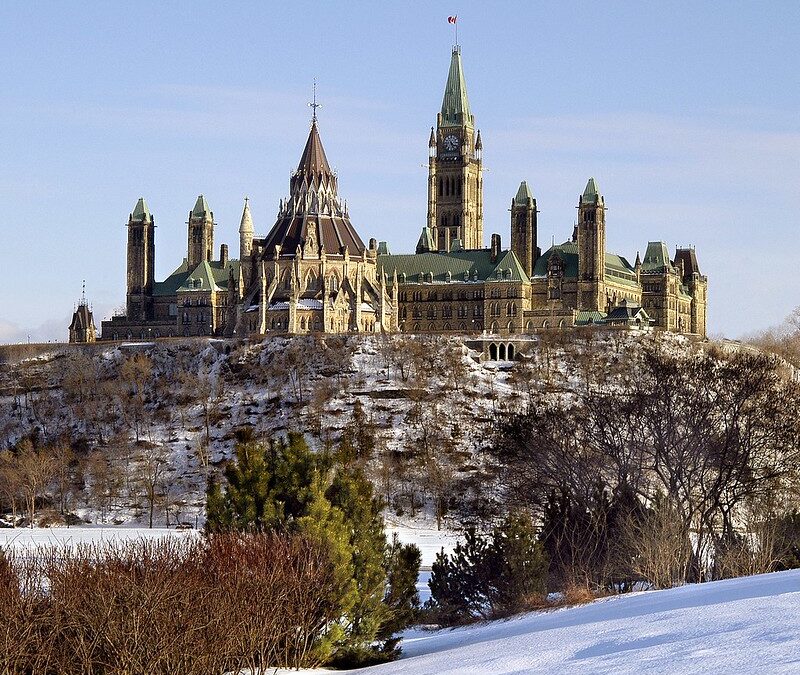
Photo: Parliament Building
By Jacqueline M. St. Pierre
Local Journalism Initiative Reporter
The Manitoulin Expositor
A long-running provision buried deep within the Indian Act—one that quietly narrows the path to federal recognition with each passing generation—has returned to the centre of debate in Parliament.
At issue is the “second-generation cutoff,” a rule that gradually extinguishes status over time. For decades, critics have warned that its mathematics are simple and relentless: each generation narrows the line of eligibility until it eventually disappears.
Now, with Bill S-2 before the House of Commons, all four opposition parties say the time has come to end the rule altogether.
The governing Liberals, however, say more consultation with First Nations is needed before making such a sweeping change.
The legislation, first introduced in the Senate, originally aimed to restore status to roughly 3,500 individuals whose ancestors lost it prior to 1985 under discriminatory provisions of the Indian Act.
For decades, federal policy stripped status from First Nations people who sought basic rights available to other Canadians—voting in federal elections, pursuing higher education or owning property. Those who accepted these rights were deemed “enfranchised,” a bureaucratic term that masked the deeper consequence: the legal erasure of their identity within the federal system.
When Parliament amended the Indian Act in 1985, some of that damage was addressed. But the reforms arrived too late for many families. Thousands who had already lost status—and their descendants—remained outside the registry.
The changes also introduced a new barrier: the second-generation cutoff. Under that rule, status cannot be passed down if a person has both a parent and a grandparent without status.
Over time, the effect compounds.
After hearing weeks of testimony from First Nations leaders and legal experts, senators broadened Bill S-2 to eliminate the rule entirely. The amended version would allow status to continue being passed down so long as at least one parent is registered.
For some communities, the stakes are existential. Chiefs and leaders have warned that if the cutoff remains in place, some First Nations could eventually be left with no federally recognized members in future generations.
The Assembly of First Nations passed a resolution in December supporting the Senate’s amendments, including the adoption of a one-parent rule and funding to help communities absorb new members who regain status.
But as the bill reached second reading in the House of Commons on February 27, debate revealed deep divisions over how quickly those reforms should move.
Opposition presses for immediate change
Conservative MP Billy Morin, critic for Indigenous Services and former chief of Enoch Cree Nation, told Parliament the legislation represents a rare opportunity to correct long-standing discrimination without sending First Nations families back into court.
“The Senate has rightfully challenged the 45th Parliament of Canada to make history with this bill,” he said.
Mr. Morin estimated the reforms could add approximately 22,000 people to the Indian Act registry in the first year alone, followed by between 7,000 and 8,000 annually for several decades.
“The government chooses to focus on excuses,” he said. “But the risk of doing nothing is greater.”
Mr. Morin also questioned the government’s insistence on further consultations.
“With respect, I hear the indecisiveness on the other side of the House when it comes to this bill, which was introduced by the Liberals themselves. I want to respond to some of the concerns they have raised and the notions presented.”
“One is consultation. Of course, consultation is important and is best practice, but First Nations feel they have already been consulted on this for decades.”
He cited the Union of British Columbia Indian Chiefs, which recently stated:
“We cannot…support yet another consultation process on how to end the second-generation cut-off when, through decades of research, court cases, collaboration, engagement, and studies, you are aware that the sex- and race-based discrimination violates s. 15 of the Charter, s. 35 rights….”
Mr. Morin also pointed to concerns raised by Sharon McIver of the Indian Act Sex Discrimination Working Group.
“In light of the Senate’s amendments, the justification for further consultation is extremely unclear,” Ms. McIver wrote to the government. “It seems to be a delay tactic. But the consultation process is also conflating and confusing status, membership, citizenship, and self-government, which are all separate legal issues.”
Mr. Morin added that he has heard the same message repeatedly from First Nations communities.
“I, myself, being a former chief, a status Indian and an MP, have heard time and time again from coast to coast to coast that the second-generation cut-off has been breaking families up since 1985 and it needs to end yesterday.”
He also challenged the government’s interpretation of consultation requirements.
“I also challenge the Liberals to be more principled when it comes to consultation in their loose application of the Mikisew v. Canada 2018 decision principles. How is it that the Liberals can justify further delay through consultation in ending the second-generation cut-off on Bill S-2 but did not consult before passing bills in Parliament, such as Bill C-5, and signing the Alberta MOU?”
New Democratic Party MP Lori Idlout echoed similar concerns about the pace of the legislation.
“When the government wants to pass major projects legislation, it moves quickly,” she said in the House. “Now, in S-2, all of a sudden they worry about the pace.”
“Uqaqtittiji, I will remind the member that those kinds of questions should have been asked when they were expediting Bill C-5,” she added. “They did not take into consideration that there had been different solutions and different things requested by different first nations, Métis and Inuit, yet they were able to expedite the passing of Bill C-5. If they were able to do that with that bill, they should be able to do it with Bill S-2 as amended.”
The Bloc Québécois has also signalled support for the Senate amendments while criticizing the federal government’s approach as incremental. Bloc MPs have condemned the second-generation cutoff as an arbitrary colonial policy that undermines Indigenous identity and have argued that First Nations themselves—not Ottawa—should determine citizenship and membership rules.
Across the opposition benches, parties have largely agreed on several points: the discrimination embedded in the Act must end, concerns about registration costs should not override Charter rights, and the long-term goal must be First Nations jurisdiction over their own citizenship.
Government calls for more consensus
For its part, the Liberal government says the issue is more complex than simply removing the rule.
Parliamentary Secretary Jaime Battiste acknowledged the harms created by the Indian Act but argued that there is no universal agreement among First Nations about how the changes should unfold.
“Mr. Speaker, I think everyone can agree that the Indian Act has challenges, that the Indian Act has created discrimination and that we need to move beyond the second-generation cut-off,” he said.
“However, there is no consensus out there on what the solution is.”
Mr. Battiste posed a question to opposition MPs.
“If there is a community out there that does not want these amendments, if there is a community out there that wants something else, if there is a community that wants to do it themselves without Parliament and the Senate telling them how to run their communities, should we force this on them?”
“Should they not be given the option to opt into something, as opposed to the Senate or Parliament saying they know what is best for that community?”
Indigenous Services Minister Mandy Gull-Masty has similarly said the government recognizes the harm caused by the Act’s status rules but believes broader consensus is needed.
“The second-generation cutoff is a critical issue that must be addressed the right way,” she said.
Consultation—and frustration
Federal officials say consultation on Indian Act registration reforms has been ongoing for years.
Initial discussions between 2018 and 2019 involved more than 650 participants representing 395 First Nation communities or tribal councils. Additional engagement between 2022 and 2025 included more than 500 participants through 55 targeted sessions with specific First Nations communities.
Ahead of tabling Bill S-2, government officials also sent letters to 66 Indigenous organizations in May 2025, with about 40 responding.
Witnesses from major organizations, including the British Columbia Assembly of First Nations, also testified before the Senate committee that studied the bill.
Yet critics argue the issue has already been studied extensively—and that the continued consultations are delaying justice.
The contrast is not lost on observers.
Legislation such as the Lost Canadians Act, which restored citizenship to thousands who had fallen through the cracks of Canada’s nationality laws, moved from introduction to Royal Assent in a matter of months.
Likewise, the controversial Bill C-5 advanced swiftly through Parliament.
The differing pace raises an uncomfortable question: why does urgency appear when governments want it, yet slow to a crawl when the issue is Indigenous identity and rights?
Citizenship beyond the Indian Act
Meanwhile, some First Nations are already developing their own answers.
The Anishinabek Nation has launched a campaign urging Ottawa to adopt the broader reforms contained in the Senate amendments.
At the heart of that effort is the concept of E’Dbendaagzijig—an Anishinaabemowin word meaning “those who belong.”
Adopted by the Anishinabek Nation Grand Council in 2009, the E’Dbendaagzijig Naaknigewin sets out a citizenship framework grounded in inherent rights and Anishinaabe law.
Rather than the federal government determining identity through formulas resembling blood quantum, the framework centres a one-parent rule and the principle expressed in Ngo Dwe Waangizid Anishinaabe—“One Anishinaabe Family.”
Dr. Dawn Lavell-Harvard, a longtime advocate for citizenship reform and Wiikwemkoong band member, says the approach represents a path beyond the limits of the Indian Act itself.
“The Anishinabek Nation Declaration on E’Dbendaagzijig will further support Anishinaabe First Nations to assert our nationhood and implement our Anishinaabe citizenship laws,” she said in a statement.
“Our solution to the second-generation cut-off, voting thresholds and the Indian Act is our inherent rights, Anishinaabe law and our treaty rights.”
Dr. Lavell-Harvard has also participated in the federal government’s Indigenous Advisory Process launched in 2023 to examine the second-generation cutoff and voting thresholds in band membership rules.
That work is tied in part to Canada’s obligations under the United Nations Declaration on the Rights of Indigenous Peoples Act, which requires federal laws to be aligned with the declaration.
The question that remains
Bill S-2 will now continue through the House of Commons legislative process, where MPs may amend it further before sending it back to the Senate.
Only once both chambers agree on the same version will the legislation receive Royal Assent and become law.
Until then, the question hanging over Parliament remains the same one that has lingered for generations: who decides who belongs—and how long Canada will continue to answer that question through the machinery of the Indian Act.