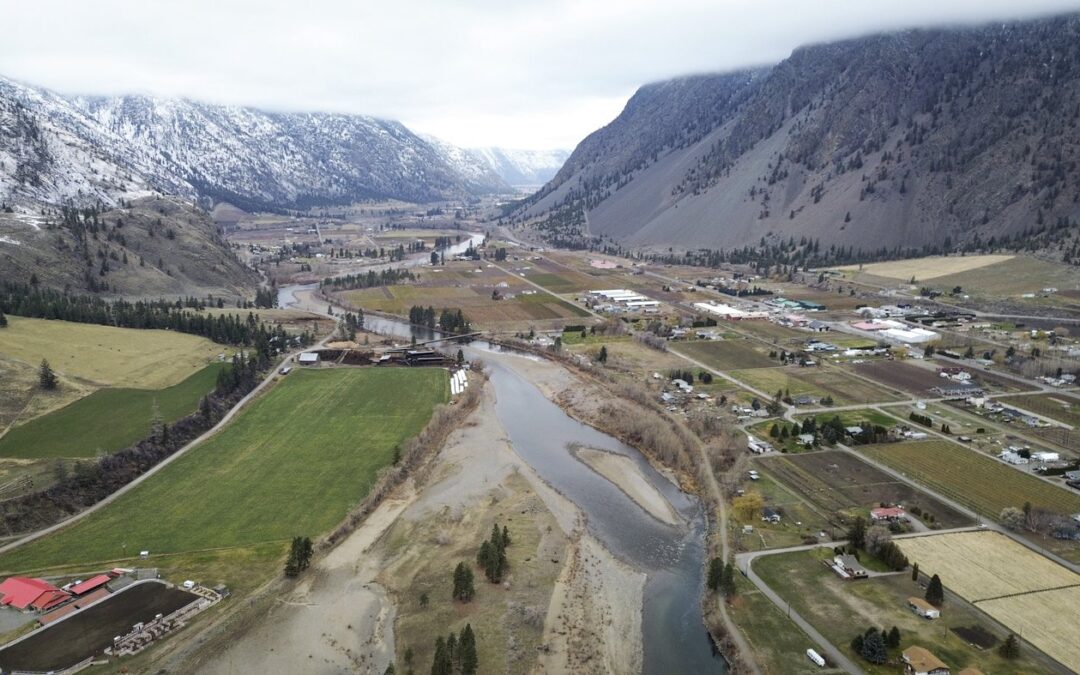
Photo: nməlqytkʷ (The Similkameen River) flowing through the Town of Keremeos in smǝlqmíx homelands in 2024. Photo by Aaron Hemens / Aaron Hemens, Local Journalism Initiative Reporter\
By Aaron Hemens
Local Journalism Initiative Reporter
IndigiNews
A smǝlqmíx (Similkameen) expert is warning that climate change and over-logging could lead to “an extinction event” for fish throughout the Okanagan Basin by 2040.
Lauren Terbasket, a Lower Similkameen Indian Band (LSIB) member who works for the band’s Parks Working Group, shared that these issues have led to warmer water trends across the Similkameen Watershed system in recent years.
That’s why climate resilience must become a priority, said Terbasket.
“The water warming trends indicate that we will be looking at an extinction event — in terms of fisheries — by 2040,” she said.
“That really tells us how important any work that we can do on the system is, in terms of water cooling factor.”
Terbasket shared these findings with regional leaders during an Okanagan-Similkameen Collaborative Leadership Table meeting on Feb. 20. Appearing virtually, Terbasket was one of a handful of experts who were invited to present watershed restoration initiatives happening in the region.
The presentations were designed to help guide and inform the Leadership Table’s working groups on which watersheds to “champion and prioritize” as they develop a framework for their 250-year plan to protect water across the region.
She said the “extinction event” findings come from LSIB’s collaborative work with the Confederated Tribes of the Colville Reservation in decommissioning the Enloe Dam, which is located on nməlqytkʷ (the Similkameen River) just outside of Oroville in Washington.
This information from Washington State, she said, “has given us some really important data in water warming trends, and it’s pretty alarming.”
‘Fish will no longer be able to live in the system’
Terbasket had also touched on these findings during a presentation she gave at a gathering for Indigenous fire keepers last September, where she similarly told the crowd that the warming water rate in Similkameen Watershed “will result in an extinction event in the whole Okanagan system by or around 2040.”
“Fish will no longer be able to live in the system,” she said in September. “It is a risk to the whole other Columbia River fishery.”
The objective, now, is to restore and protect the land, to cultivate a system of climate resilience — one that changes the rate of how the system’s water warms in the future.
“It’s such a big initiative. To me, it kind of looks hopeless. But we have to do something,” she said.
“I don’t know, given climate change, if we can reverse that. But at least we can possibly have areas where fish still live in the system.”
A warming ‘snow-dominated’ system
A transboundary watershed spanning 720,000 hectares, the main vein of the “snow-dominated” system is the Similkameen River, a waterway flowing nearly 200 km from its headwaters in the Cascade Mountain range, to the confluence of sq’awsitkʷ (the Okanagan River, or the Okanogan River, when in America) in Washington.
In addition to several creeks and tributaries, the watershed’s system consists of more than 150 lakes and “probably three times as many wetlands,” Terbasket said, most of which is found in high-mountain areas.
According to Terbasket, the Similkameen system contributes 75 per cent of the Okanagan River’s flow volume, providing cold freshet in the spring that is crucial for cooling the river.
As noted by the First Nations Health Authority, the term “freshet” refers to “the seasonal rise in water levels due to increased rainfall and melting snow, which in turn can lead to flooding.”
That cold water in the Okanagan River is particularly important for salmon, who need cold water to survive as they migrate up the waterway when returning from the ocean to spawn in the Okanagan Basin later in the year.
Last year, warm water temperatures in the Okanagan River, just south of Osoyoos Lake, created a natural phenomenon in the waterway known as a thermal barrier, which occurs when the water is too warm for fish to migrate through.
The thermal barrier ultimately resulted in low numbers for salmon returning to the Okanagan Basin — around 60,000 to 80,000, compared to 491,000 in 2024.
Chad Fuller, the manager of Okanagan Nation Alliance’s fisheries program, cited drought as the reason behind the thermal barrier — specifically the “all-time low” snowpack levels in the Similkameen Watershed.
“Anytime we have a really low snowpack, there’s always going to be a concern,” he told IndigiNews. “That’s the cool water throughout the year that gives us the water that helps the fish.”
Clear-cutting leaving areas ‘wide open’
While mining in the Similkameen Watershed is a concern for both water quality and quantity, Terbasket cited the over-harvesting of forestry as another threat to water, as it “depletes the water holding and distribution capability.”
“Our forests are just checker-boarded with clear-cuts. Some of them are massive,” she said.
The lack of trees results in a lack of shading, leaving areas “wide open.” This not only impacts the watershed’s snow-pack retention capability, as the snow-packs melt faster, but limited shade contributes to warming waterways as well, as there aren’t enough trees to keep water systems cool.
“(The snow-pack) is gone in the early freshet part of the season. So you see massive flows right throughout the winter, when it rains,” she said.
“The river is flooding probably three or four times a year, where it needs to flood just once. Maybe twice, with the spring freshet.”
Drought conditions brought on by climate change, combined with less moisture being retained on the land, is fuelling devastating fires in the watershed — 85 per cent of the Similkameen system has been burnt since 2000, Terbasket said.
This leads to more landslides, which not only reduces water-holding capabilities, but it also results in the saltation of the Similkameen’s water systems with different minerals and sediments.
Striving for that ‘cooling factor’
LSIB and its partners are now undertaking a number of different watershed restoration and protection objectives, one of them being climate resilience.
“The idea is that we start from the base of water, and then we look at land,” Terbasket said.
Critical to the protection and restoration work is ceremony, she said, which she called “one of our foundational laws” — from praying to singing songs for the water.
“The Elders, during our early planning process, gave us the directive that we need to start our work with ceremony,” she said.
Climate resilience, she said, means restoring and protecting the land so that it supports “certain types of trees; that allows for adaptability in water warming conditions; and that allows for fire mitigation.”
This includes planting more deciduous plants and trees — such as cottonwoods and willows — to create more shading and strengthen bank stability. To speed up that restoration process, Terbasket said that they are using “bio-engineering” techniques, like cluster and row planting.
This approach also helps create fire breaks in the system, she said.
Another bio-engineering practice they are utilizing is willow-staking along streambanks, to help with stabilization and promote water cooling via shading. This process includes creating small “stakes” out of live willow trees and planting them into moist soil in the fall or winter.
“By the spring, they have rooted and (are) leaving already. So we see how quickly — once they’re in place — that they start to take,” she said.
There’s also log-pinning initiatives that are designed to encourage slope stabilization and mitigate landslides.
“The importance of undertaking this work for stabilization is really critical, given that we are probably expecting additional drought conditions and more fires in the next few years,” she said.
This protection and restoration work also supports LSIB’s title and rights, as well as food and cultural sovereignty.
Harvested plants and medicines such as huckleberries are impacted by an area’s ability to hold water, she said. Their survival success rate is just one of the indicators of the health of the land and the water system.
“If those keystone species are thriving, we can know that all of those systems and all of those species underneath them are thriving. Water is a key element to that,” she said.
The intention is to help keep the system as a cooling factor, she said.
“If the Similkameen River does not flow into the Okanagan, the salmon don’t make it up into the upper region of the Okanagan generally, because the water is too warm,” she said.
“What we’re striving for is that cooling factor.”