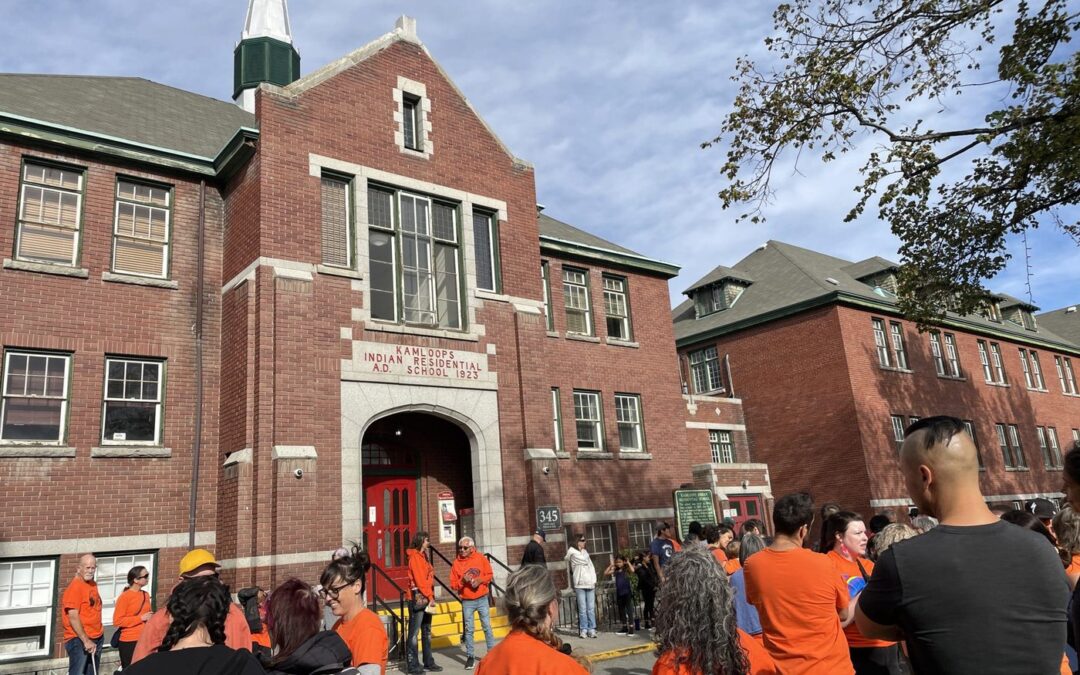
Photo: Before the Kamloops Indian Residential School officially closed in 1978, it was the largest institution of its kind in Canada. Today, the building hosts various Tk̓emlúps te Secwépemc healing and cultural programs. / Photo by Macarena Mantilla/The Wren
The Wren
In the wake of increasing residential school denialism, which has seen local demonstrations and prompted pushback from leaders, Tk̓emlúps te Secwépemc has shared an update on its ongoing investigation into 215 potential burials at the former Kamloops Indian Residential School (KIRS).
After providing a brief background about the investigation, noting it as a “multi-pronged” endeavor which began in 2021, the office of the chief shared that it has been pursuing records from the provincial and federal governments and the Roman Catholic Church of Canada.
“Analyzing such records is critical for several reasons, including determining to which of the 38 Indigenous nations these children belonged,” Tk̓emlúps te Secwépemc shared in the statement Thursday, Feb. 12.
Update: The search for records ongoing
Acknowledging the evolving circumstance of the investigation based on data, tests and new information, the statement shared the process has been “more complex” than initially anticipated.
However, overlapping findings from three unique investigative methods, including ground penetrating radar, LiDAR scanning and the use of historic human remains detection dogs, have provided a primary focus area. Notably, these sections have no utility lines or clay tiles.
While some areas have been ruled out as burials, some areas include signatures that resemble burials, according to the statement.
In the statement Tk̓emlúps te Secwépemc stated it has faced “significant challenges” in getting access to records from the government and Catholic Church.
“Obtaining 88 years of government records and sacramental records from the Roman Catholic
Church of Canada is critical to confirming the identities of the children who attended the school
and those who never returned home, along with the community to which they belonged,” the statement read.
“Our progress has been hindered by government restrictions on certain records and slow response.”
Early investigations rely on historical RCMP, church and government records that are known to be incomplete, in addition to extensive testimonials from survivors.
KIRS operated from 1890 to 1978, and at its highest level of enrollment saw 500 children from 38 Nations pass its threshold. Many of these children never returned home based on family accounts and available records.
In many cases, the names of children who died while attending KIRS and other institutions aren’t known or recorded and “many relevant documents that have yet to be reviewed,” according to the Truth and Reconciliation Commission.
Cultural responsibility and potential outcomes
The statement explained that Indigenous communities “place deep importance on honouring and protecting ancestral remains,” adding with 38 Nations involved, it is Tk̓emlúps’ responsibility to seek agreement among all 119 affected communities.
“Each Nation upholds its own cultural and spiritual protocols for how ancestral remains
must be treated,” the statement read.
The statement listed several options for potential outcomes of the investigation, including preservation of the orchard as a Sacred Site dedicated to memory and healing, or excavating the site.
Excavating remains would involve repatriation, an “extremely complex and sensitive process,” requiring DNA analysis, forensic expertise, consultation with affected Nations and adherence to laws and protocols.
Investigating potential burials at the KIRS site and others is a unique undertaking, and supporting Indigenous-led efforts is vital according to Canada’s special interlocutor on residential school gravesites.
“Canada cannot independently or impartially investigate its own wrongdoing,” the interlocutor’s report on upholding sacred obligations states. “Especially in the context of the government’s deeply ingrained culture of impunity for past and ongoing violence and human rights violations against Indigenous people.”
While Tk̓emlúps te Secwépemc will not be taking interviews regarding this investigation, the Nation will share more information when possible.