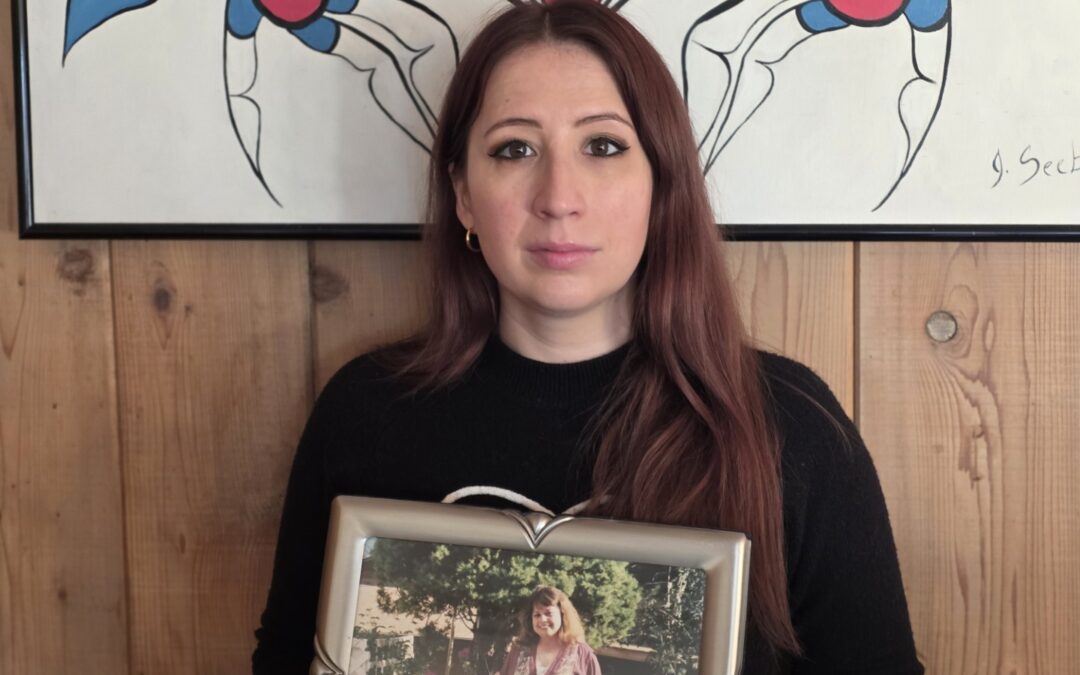
Photo: Angie Seeber holding pictures of her mom and sister – Photo Supplied
By Danielle Dufour
A heart attack took her sister in April of 2021, and a stroke took her mom just seven months later.
At the time, Angie Seeber had just moved back to Lumby, BC, a small town in the Okanagan, due to the COVID pandemic to pursue a career in health.
“My sister Kyla, we got a phone call that she had passed away from a heart attack,” said Seeber. “She just laid down to have a nap, had a heart attack in her sleep, and she never woke back up.”
Kyla, who lived in Alberta with her husband Marc, was only 48 years old when she passed.
“Heart disease presents quite differently in women compared to men,” said Seeber. “For her, there was almost no telltale signs that I’m aware of, like she was just kind of feeling a little tired and slightly run down.”
Then in November, while travelling with her then boyfriend (now husband), she received a devastating phone call from her dad that her mom, Judy, had a stroke.
She drove home quickly to find out that her mom’s stroke was more severe and rare, as it happened on both sides of her brain, and there was nothing the doctors could do for her.
A week before the stroke, Judy had a terrible migraine for the first time. Her family took her to the emergency room as she couldn’t even say her name. She was in great pain.
“They diagnosed it as just a bad migraine and sent her home,” said Seeber.
Judy, who lived an active life, passed away at the age of 67.
“I know how the healthcare system is being so overwhelmed, but I do feel, unfortunately, she got missed and something got swept through the cracks,” said Seeber.
At the time it was unimaginable to go through this, and Seeber said, “These were the two women that were the people I relied on more than anybody … they were really big sources of support, like not just for me, but for our entire family, our community.”
“It was incredibly difficult for me,” said Seeber. “I had just applied to the nursing program at UBC (the University of British Columbia) in the Okanagan, and I decided to postpone schooling.”
She managed to work through her grief by seeing a grief counsellor and journaling and learning more about heart disease.
“That’s when I really got into fitness,” said Seeber. “Specifically long-distance running.”
In an effort to raise awareness and make a difference, Seeber decided to raise money for the Heart and Stroke Foundation (Fund life-saving research | Heart and Stroke Foundation) while participating in marathons.
Seeber and her brother-in-law Marc also became closer through the loss.
“He’s such a close part of our family, and he was there at my wedding … in July last year,” said Seeber. “So that’s the only kind of blessing that got to come out of that situation was that I got to become so much closer to him.”
Seeber’s Indigenous roots stem from her dad’s side, and she is a Métis from the Simpcw First Nations in BC.
“My dad, he was broken,” said Seeber. “He is doing good now. I think it comes with our Indigenous culture … you have a stern level of tenacity and spirit, and also, we have so much family support.”
With the family so close, Seeber and her husband decided to buy her family home and build a suite for her dad.
“We still have that family support, and we still look after one another,” said Seeber.
Now in her third year of nursing school, Seeber recalls her mom Judy telling her that it didn’t matter what role she was working in healthcare because every day you are helping people by making a difference in somebody’s life. “That really resonated with me,” said Seeber.
Bonny Graham, an RN (Registered Nurse) originally from Saskatchewan and a member of Thunderchild First Nation, is currently working in Treaty 6 as the program manager of Community Health and Medical Clinic at Maskwacis Health Services in Alberta.
“We have to realize that our heart is like a pump, and its job is to receive and send out blood to the rest of our body,” said Graham. “When there’s something that disrupts this function, there’s conditions that affect our heart or blood vessels and prevention from doing our work, and this is called cardiovascular disease (CVD).”
While we often see cardiovascular diseases affecting our aging community, Graham said, “I believe that people are being affected by cardiovascular disease earlier in life now as a result of some of our lifestyle choices and having high blood pressure. Physical inactivity and leading a sedentary lifestyle. We gain weight and we put stress on our heart and our blood vessels.”
Smoking is another lifestyle choice that leads to cardiovascular disease because it damages the blood vessels with plaque buildup and reduces the amount of oxygen our blood can carry throughout the body.
The Heart and Stroke Foundation states that cardiovascular disease is the number one killer of women today and is responsible for approximately one in three deaths among women each year. (Connected by the numbers | Heart and Stroke Foundation)
“The risk for post-menopausal women increases due to the decrease in estrogen,” said Graham. “We often see an increase in bad cholesterol and changes in the blood vessels. We often take on additional fat in the abdomen that can make us resistant to insulin and raise the risk of diabetes and its associated role with CVD.”
One person dies in Canada every five minutes from heart conditions, strokes, or vascular cognitive impairments surpassing other diseases, where 13 percent more people die from these compared to all cancer-related deaths. (Connected by the numbers | Heart and Stroke Foundation)
“What I would like people to be most aware of is that in most circumstances we can prevent severe CVD,” said Graham. “With a healthy diet, getting some exercise, quitting smoking, reducing alcohol consumption, and having access to a health practitioner to have blood pressure and blood sugar screening done, we can help prevent or reduce CVD significantly.”
Graham shares her Indigenous knowledge along with some prevention tips:
- Eat more wild meat, berries, and vegetables rather than highly processed, salty, and fatty foods like bacon, bologna, fried chicken, sandwich meats, etc.
- Grow your own food, raise your own meat, and live off the land.
- Incorporate physical activity into our lives. We can walk and enjoy the Creator’s nature. This is a natural medicine that is good for the mind, body, emotions, and spirit.
- Avoid excess alcohol that damages blood vessels and raises blood pressure.
- Try to attain or maintain a healthy weight.
- Stop smoking
- See a healthcare practitioner for preventive care, including blood tests, heart tracings, and advice.
February is heart month
If possible, stop by your local pharmacy and, if able, take your blood pressure. Get screened for diabetes.
Know the signs and symptoms of heart attack and stroke
Heart Attack
- Chest pain—may feel a crushing, heavy pain; pressure; tightness; or squeezing and often lasts more than 5 minutes
- Indigestion—may be confused with heart attack
- Pain in your neck and jaw
- Pain may spread to the left arm or possibly both.
- Women can have pain in the midback
- Short of breath
- Cold sweat
- Feeling nauseated or vomiting
- Dizzy, lightheaded, faint
- Weak or extremely tired
Less common signs/symptoms in women and older adults or diabetics
- Indigestion like heartburn
- No chest pain but may have pain in neck, jaw, or back
- Unusual or extreme tiredness
- Nauseated
- Anxiety or feeling of impending doom
- Call EMS (Emergency Medical Services) should you have any of these symptoms, especially if you also have chest pain; don’t wait, every minute counts and increases your risk of survival.
Stroke
- The signs and symptoms are usually sudden.
- Face drooping on one side and may be numb, or the droopiness may be noticeable to others
- Arm weakness—inability to raise one arm or to keep it raised; wants to lower toward body
- Slurred speech, difficulty speaking, or words are hard for others to understand
- Confusion may occur suddenly
- Blurred vision, change in vision in one or both eyes
- Dizziness or loss of balance and coordination
- Sudden headache – feels like a severe headache
- Numbness or weakness on one side of the body
- Often symptoms are painless.
These symptoms are an emergency; call EMS or get to a healthcare centre or hospital as soon as possible for early intervention that may lessen the complications of stroke.