Photo:
By Shari Narine
Local Journalism Initiative Reporter
Windspeaker.com
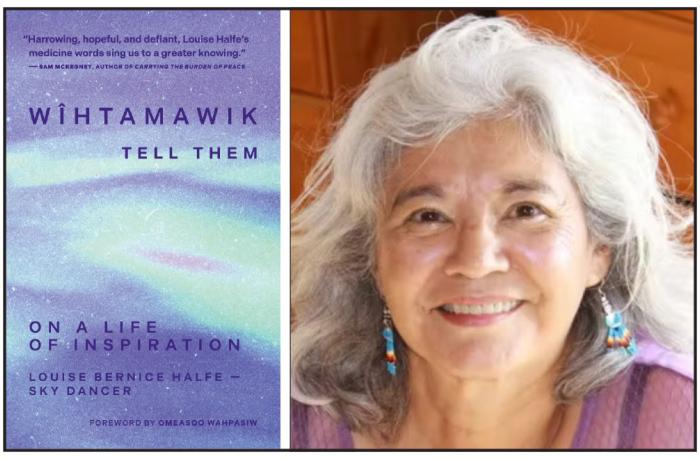
Words matter, writes poet Louise Bernice Halfe-Sky Dancer.
“Kêhtê-ayak (Elders) teach that words must be used with caution,” she writes in “Song of the Starved Soul: A Commentary on Ceremony and Protocol,” one of about 30 essays and presentations she includes in her newest book Wītāmōwik/Tell Them: On A Life of Inspiration. The collection also includes a similar number of poems.
“In the past, I wasn’t aware that that was something I should be aware of,” Halfe told Windspeaker.com.
“I hadn’t been told, ‘Use words with caution’…I know it probably hurt others, and it deeply affects me to know that I went over the line, so to speak. But when I’m writing, I just write as it is. I have to make it real. I have to make it honest,” Halfe said. “Sometimes it’ll penetrate a person differently and… may hurt them, but that’s not my intention. If it hurts them, then it’s a gift to themselves to become aware of, ‘Why did I hurt?’ All these emotions are a gift to ourselves, and we learn from them.”
At the urging of the University of Regina Press, Halfe gathered her essays and presentations from the past and supplemented them with new poetry for the book.
She says she didn’t decide how her work would be organized in the collection.
“I think they have a life of their own,” said Halfe.
Wītāmōwik follows four themes—historical, writing, recovery, and moving on.
In the foreword, Halfe’s daughter Omeasoo Wahpasiw writes, “Although each piece contained here is a journey, none is a leisurely stroll.”
“It’s a hard journey to go deep in and share a story about the events of what happened to the self, to the community, to a bigger world and how it’s impacted one’s life. It’s not easy to go deep into the emotional self to reveal these things,” said Halfe.
But she does just that.
In “The Reserve Went Silent,” she writes, “I see this now./I never saw the searing pain/on my mother’s face, nor experienced/my father’s eyes squeezed to dam his flood./Their world went mute when the pied piper/played his organ through the reservation./My parents never spoke/of the gash that tore through the families/and gutted the whole reserve.”
Halfe admits that when she first started writing she worried about how her work would be judged by her family and community. But she has learned to let that go through therapy and ceremony.
“Once the material is given birth, I don’t worry. I let it do its work,” she said.
In her writing, Halfe stresses how her body, mind, and spirit are connected to the land and to ceremony.
“Life is ceremony,” she said. “The Elders tell us, ask us to pray first thing in the morning and the last thing at night. To be aware that we are always in ceremony…We work with the breath of our wind…We are water. We are the elements that came from the stars. Our body and the body of the land all have those same elements. And we mustn’t forget that.”
Halfe, a member of the Saddle Lake First Nation in Alberta who now resides in Saskatchewan, came to her acclaimed career late in life. Her recognitions and awards include past Saskatchewan Provincial Poet Laureate, Canadian Parliamentary Poet Laureate, and Member of the Order of Canada. Now 73 years old, she has been writing for about 40 years.
“When my kids were little, I would take them to the bookmobile… and through their interest in development of reading, I started my own curiosity of reading,” she said.
Halfe attended Blue Quills Residential school for seven years losing her Plains Cree language and never feeling confident in English. Had she never been taken from home, Halfe said, “If I had the total language in Cree and with English, I think my writing would have been richer. It would have taken maybe different directions from poetry. Maybe I’d be a novelist, but I’m not a novelist.”
None of Halfe’s work is entirely in her Cree language. Many of her poems, written in English, include Cree words or phrases to enhance her message.
“I was never taught syllabics. I don’t write in Cree, but I will think about it in Cree. And I will write it in phonetics… And then I’ll research with other Cree speakers. I don’t do this alone. I rely on my Cree speakers to help me along,” she said.
Cree, she added, is “really profound and rich… (It’s) not only poetic, but one word is so deep and so full of wisdom…I don’t speak it enough, but it’s my guide.”
Halfe recalls “back in the old days” travelling by wagon on trails with her moshum and nôhkom (grandfather and grandmother) to pick berries. “And the language was always spoken and they were always of the land and… they had such reverence that maybe I would have learned it better and absorbed it better and been able to share it better.”
Keeping stories alive is important to Halfe. She offers her email campcoffee@myaccess.ca and encourages people to write to her.
“I don’t want the Elders’ wisdom to die with me. It’s really important we pass on what we know,” she said.
Halfe hopes that Wītāmōwik encourages Indigenous readers to do their own research and “keep on plowing ahead” to learn their stories.
For non-Indigenous readers, she said, “They have to learn to listen to us. They have to learn to respect the land and quit belittling our experiences.”
Wītāmōwik/Tell Them: On A Life of Inspiration, published by University of Regina Press, will be available as of March 3. It can be ordered at https://uofrpress.ca/Books/W/wihtamawik-Tell-Them