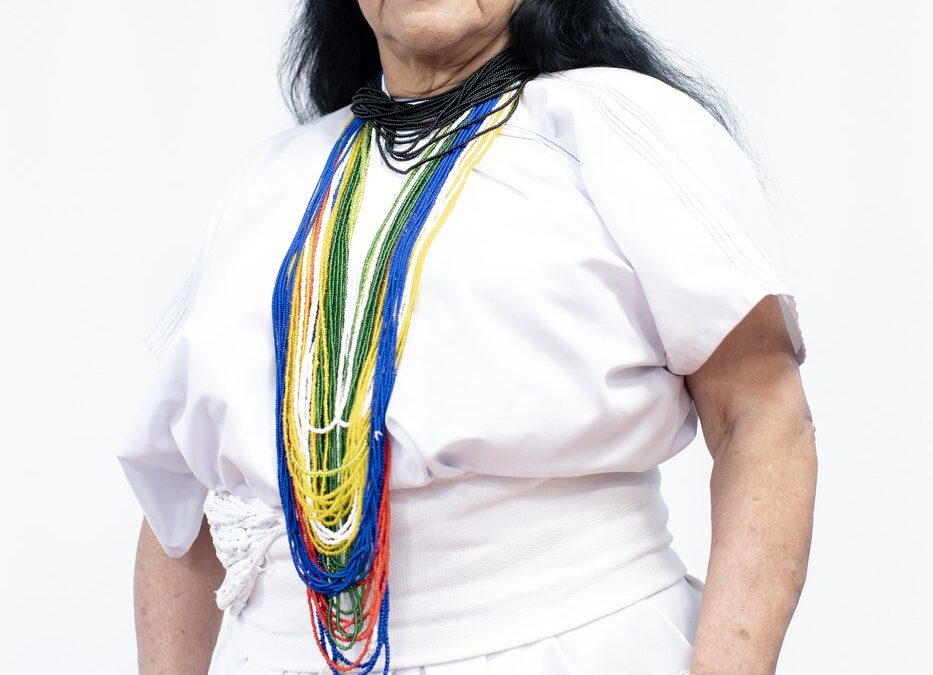
Photo: On Jan. 2, 2026, Leonor Zalabata Torres became the first Indigenous person appointed to the UN Security Council. (Photo courtesy of Leonor Zalabata Torres) / Lucas-Matthew Marsh, Local Journalism Initiative Reporter
By Lucas-Matthew Marsh
Local Journalism Initiative Reporter
Iori:wase
In the wake of the United States military operation in Venezuela on January 3, Leonor Zalabata Torres addressed the United Nations Security Council for the first time.
The Colombian ambassador was no stranger to confrontation. In the past, she faced off against drug traffickers, guerrilla groups and the Colombian military. Now, standing before the UN, she would take a stance against the most formidable superpower the world had ever seen.
In her seven-minute speech, she condemned the unilateral use of force, reaffirmed Latin America as a “zone of peace” and asked the difficult question: what is “the role of this council” as the “foundations for international peace” if one of its members seems to so flagrantly break international law?
Yet, as her words spread across the globe, another historic milestone would be lost in the politics of that moment.
On January 2, Zalabata Torres became the first Indigenous person to be appointed to the UN Security Council. A leader from the Arhuaco Nation, her appointment was hailed as a victory for both human rights activists in Colombia and the broader international Indigenous rights movement. Shaped by Indigenous perspectives from across the world, her voice arrived on the global stage in a period when imperialism is resurging across international politics.
According to Sheryl Lightfoot, a professor at the University of Toronto and Vice Chair of the UN Expert Mechanism on the Rights of Indigenous Peoples (EMRIP), Zalabata Torres’ appointment shattered an “80-year-old barrier” as old as the UN itself.
“Since the League of Nations, Indigenous people have been trying to get into the room in these global conversation spaces and participate,” Lightfoot said. “Ambassador Torres will be the first Indigenous face that we see in that room. So that, in and of itself, is something to celebrate.”
Speaking to Iorì:wase from Colombia’s UN consulate in New York City, Zalabata Torres admitted she never dreamed hers would be that face.
“I never thought that, from the activism that we had as Indigenous peoples, we were going to be able to achieve this,” Zalabata Torres said.
Born in the village of Kwakumuke in 1954, Zalabata Torres came of age at a time when Indigenous peoples faced systemic discrimination across Colombian society.
Fortunately, she came from one of the few families with the means to access formal education outside of her community. Though not a naturally gifted student, her persistence earned her a scholarship to the University of Antioquia — an unprecedented feat for an Indigenous woman at the time.
After she returned to her community to work as a dental assistant, Zalabata Torres would bear witness to the toll that poverty and systemic discrimination had on public health. There is one story, in particular, that has stayed with her over the years: that of a young boy who died from complications related to diarrhea.
“It may seem a very simple case — and they were very often going on within our community — but unfortunately, we did not have enough tools to help…” Zalabata Torres said.
Backed by the local Indigenous authorities, she helped to develop one of the first health services under the Arhuaco nation’s jurisdiction, guaranteeing her people’s right “to live with dignity”.
That advocacy became a natural gateway for Zalabata Torres to enter politics. She emerged as a central figure in the 1999 peace talks between the Colombian state and the Revolutionary Armed Forces of Colombia-People’s Army, convincing the latter to stop targeting Arhuaco villages.
But her role in the protests against the 1990 extrajudicial killing of Arhuaco leaders Luis Napoleón Torres, Hugues Chaparro and Ángel María Torres by military forces would bring her to the UN for the first time, testifying before the UN Commission on Human Rights.
From there, she would go on to sit on various working groups with the UN and helped to contribute to the UN Declaration on the Rights of Indigenous Peoples (UNDRIP).
Although their first meeting has faded from memory, Kenneth Deer, who has been going to the UN to represent the Haudenosaunee for years, recalls meeting Zalabata Torres in one of these working groups.
Always dressed in her nation’s regalia, Deer could sense that Zalabata Torres would “be around for a long time.”
Over the years, Deer and Zalabata Torres, alongside Indigenous activists from the Americas, Oceania and Africa, worked out of the “back rooms” of the UN as part of the broader international Indigenous rights movement.
That movement began in the 1920s, when Haudenosaunee and Māori petitioners to the League of Nations noticed similarities between their respective experiences dealing with treaty violations. It would then pick up steam with both the decolonization and civil rights movements of the 1970s.
Institutions such as UNDRIP and the EMRIP exist “due to all of those solidarities”, built among Indigenous activists over the decades, according to Lightfoot.
Zalabata Torres also cited her involvement in the movement, including a brief diplomatic visit to Kahnawake in December 2022, as deepening her understanding of the shared Indigenous experience.
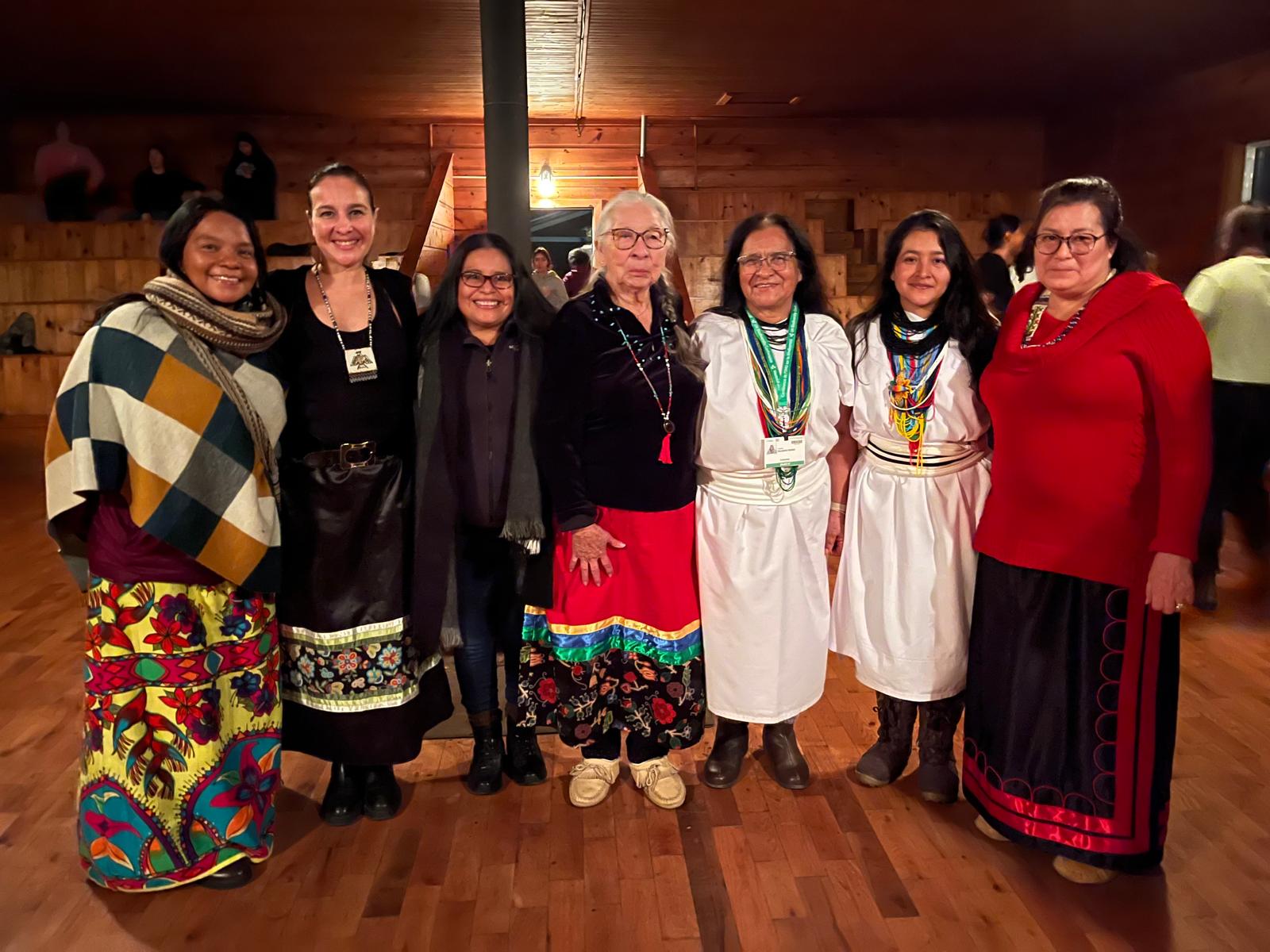
Leonor Zalabata Torres, third from right, stands in the Mohawk Nation at Kahnawake Longhouse during a diplomatic visit to Kahnawake on December 11, 2022. (Photo courtesy of Kenneth Deer)
“We recognize each other as brothers, as sisters,” Zalabata Torres said. “It’s important, this Indigenous movement, not only for the Indigenous peoples, but for humanity itself, because we need to continue taking care of the earth.”
Over the years, Deer watched as Zalabata Torres grew into the role of a diplomat and rose “in leadership in Colombia among Indigenous peoples.”
Initially labelled a “communist” and a political “agitator”, things began to change with Colombia’s 1991 Constitution, enshrining social and political protections for Indigenous peoples. But the real turning point came in 2022, when Gustavo Petro, leader of the left-leaning Humane Colombia party, was elected president of Colombia.
“It’s a result of the participation and inclusion of the Indigenous peoples within the governmental system,” Zalabata Torres said.
President Petro subsequently appointed her as Colombia’s Permanent Representative to the UN, when, according to Deer, she spent the next two and a half years “lobbying states” and meeting with ambassadors.
”She knows the role that she has to play as an ambassador representing Colombia,” Deer said. “But at the same time, infusing Indigenous worldviews and points of view in her work.”
When Colombia won 180 out of a possible 193 votes to assume a non-permanent seat on the UN Security Council in June 2025, Lightfoot called the moment an “extraordinary” accomplishment.
“We could say (statistically) the odds were zero that it would happen,” Lightfoot said. “But now it has.”
Upon receiving his invitation, Deer dropped everything and made the six-and-a-half-hour drive from Kahnawake to New York City on New Year’s Day to attend Zalabata Torres’ swearing-in ceremony.
“I was the only other Indigenous person in the room, besides her husband and her son,” Deer said. “I felt like I was the Indigenous representative for all the other Indigenous people in the world to witness.”
The celebrations were short-lived. The following day, the U.S. would conduct its military strike against Venezuela, leading to the capture of President Nicolás Maduro. While U.S. lawmakers have upheld accusations of drug trafficking against Maduro as justification for the strike, critics around the world have condemned the operation as an act of neocolonialism.
In the operation’s aftermath, U.S. President Donald Trump told reporters that “America’s dominance in the Western Hemisphere will never be questioned again.”
But as far as Zalabata Torres is concerned, that is just an “opinion”.
“I do believe that this is a topic that the world needs to reaffirm: that every power is subject to the law…,” Zalabata Torres told Iorì:wase.
Lightfoot said the experiences of Indigenous activists like Zalabata Torres are vital in this moment, as Indigenous peoples have often been “on the frontlines” or “deeply impacted” by conflicts in which they had no stake.
While firmly rooted in her responsibility to represent the interests of Colombia at the UN, Zalabata Torres admits she drew on knowledge and lessons from Indigenous peoples when making her address to the emergency session on January 5.
“What [Indigenous peoples] have taught us is to have a peaceful understanding with nature, which is necessary to have this coexistence in order for humanity to survive,” Zalabata Torres said.
As the international order continues to shift, Lightfoot said voices like Zalabata Torres’ are critical not only to advancing self-determination but also to “defend what has already been gained.”
How long she will remain in her post remains unclear. With President Petro constitutionally barred from seeking a second term in the upcoming Colombian elections this May, Zalabata Torres is likely to be recalled from the UN.
But for this brief moment, she hopes her appointment will encourage Indigenous peoples, from the Arhuaco Nation and the Haudenosaunee Confederacy to Aotearoa and beyond, to continue the struggle.
“I do believe that the push and support of all of the Indigenous peoples around the world has helped us to achieve and conquer this moment in history,” Zalabata Torres said.
(Published: Feb. 5. 2026. Updated: Feb. 22. 2026)