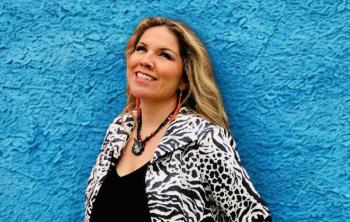
Photo: Singer/songwriter Donita Large. Photo supplied / Windspeaker.com
By Sam Laskaris
Local Journalism Initiative Reporter
Windspeaker.com
Like many others, Donita Large had plenty of time during the pandemic for self-reflection.
Large, a member of Saddle Lake First Nation in Alberta, decided she wanted music to have a more significant role in her life. And that is now the case.
Large has just released The Ancestors, her first original full-length album. “I’m pretty excited about it,” she said.
Large had previously released some singles. She had recorded a gospel album seven years ago that she didn’t put out until a couple of years ago. But until the pandemic happened, the singer never seriously thought she’d write her own material and release an album of original works.
“I had no idea this was what was going to happen for me in the future,” said the Indigenous educator who has worked for the Edmonton Catholic School Division for the past 12 years.
“I’ve been singing my whole life, and I really didn’t consider myself a songwriter at the time. But I had a song and I thought I want to get one song out into the world. That was my goal. And I put a song out.”
After that she got a request to get some band members together and do some shows.
“Then suddenly I had a band. And then I was performing again, doing solo shows. That was different… Then that kind of gained momentum and then I started writing. And from there it kind of came to be that I started to realize I was going tell a story. And then, I connected that the story was going to be about the ancestors.”
As an educator, Large works to support the emotional and mental health of Indigenous students and families.
“I do a lot of work, not just talking about history, but how it plays into today, everything from intergenerational effects to reclaiming our culture to teaching people about who we are based on worldview,” she said. “And what I realized is that these stories are things that are a part of my everyday life and that we have a responsibility to share and to teach in a good way to be able to really talk about reconciliation in a different way to really work towards how we build stronger relationships.”
Large’s musical style is described as folk with some Indigenous sizzle.
“Folk is kind of more generous in that you can have blues and you can have some country and that you can have rock within folk,” she said. “But the Indigenous sizzle part of it is really just that I don’t separate myself as an Indigenous person from the music. And so I have cultural aspects to it, whether it be the storyline, whether it be singing… or even including Cree. So that’s where that comes in.”
The Ancestors includes two different versions of a song called “Sweetgrass”.
“I started doing the song as an acoustic version and so that’s how the song was created,” she said. “But there was a day that I was listening to the song and I could really just hear this other orchestral version of it in my head.”
She opted to explore that further.
“I really like the concept of the orchestral version because for some people it speaks to them differently,” Large said. “And I could hear those sounds, and so I wanted to try it because I really love the sound of strings.”
The Ancestors also includes a song titled “Kokom”, which is dedicated to Large’s late grandmother.
“I wanted to be able to honour her and that relationship that I miss,” she said. “But I also wanted to honour that we all go through grief and loss and that we all probably have somebody we wish we could have that last tea with.”
Yet another song on the album is called “Treat Me So Bad”.
“I’m very open about aspects of my personal story,” Large said. “One of the things I’ve done in my life is I did circles for women who have been in family violence. I did that work for about eight years. And the reason that I chose to do that work is my own history of being in abusive relationships and struggling with things like co-dependency.”
As for music, it’s been a part of Large’s life for as long as she can remember. She started singing in church with family members.
“If you weren’t singing, you were told very strongly to sing,” she said. “Those are some of my memories, which are great because it means that I sang with the majority of my family. I had a very musical family. My aunts and uncles played guitar, played fiddle. So, I just thought everybody’s family sang and had dances. That was just a part of my life. I definitely had that. I just grew up with music, with sounds around me.”
For more information about the The Ancestors album go to https://donitalargemusic.com/store