
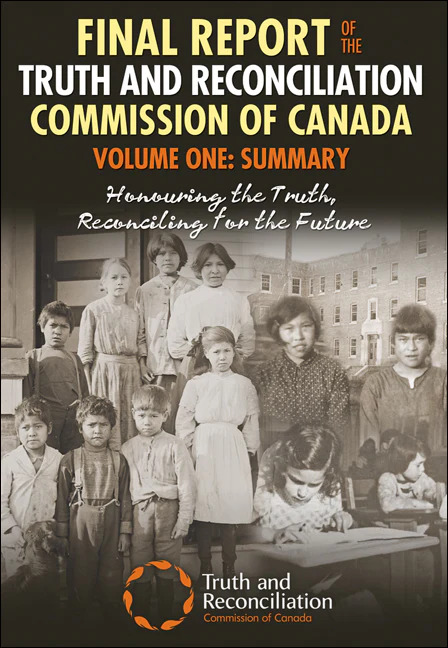
Monday marked the 10th anniversary of the Final Report of the Truth and Reconciliation Commission.
Leaders and dignitaries have taken to mark the historic day:
Prime Minister Mark Carney
“We reflect on the devastating legacy of the residential school system. As a government and as a people, we match remembrance with responsibility – the responsibility to advance reconciliation and create conditions for renewal and recovery. We are moving forward on the Truth and Reconciliation Commission’s Calls to Action. We are advancing the Calls for Justice from the National Inquiry into Missing and Murdered Indigenous Women and Girls. We are also implementing the United Nations Declaration on the Rights of Indigenous Peoples Act in partnership with Indigenous Peoples.
We are building together in health, in education, in economic opportunity, and in housing.We are doubling the Indigenous Loan Guarantee Program and building projects with greater Indigenous equity ownership. We are investing $2.8 billion to build off-reserve, urban, rural, and Northern Indigenous housing, and $1.7 billion to build on-reserve housing. Eighty-five per cent of drinking water advisories on reserve have been lifted, we have allocated an additional $2.3 billion to end the remaining advisories, and in the spring, we will introduce legislation to accelerate this progress.
As we mark 10 years since the Truth and Reconciliation Commission’s Final Report, we pledge to build a future where Survivors are honoured with remembrance, with justice, and with a stronger, fairer Canada. A Canada made stronger by the resilience of Indigenous communities. Reconciliation is a task that must be lived and practised every day. We are seized with the task ahead of us.”
AFN National Chief Cindy Woodhouse Nepinak
“The 94 Calls to Action are a living mandate. It’s been a decade, yet many Calls still remain unfulfilled, systemic injustices endure. Today, we call on the federal government, all levels of government, institutions, and every Canadian to renew their commitment. Implement all 94 Calls to Action in full. We remind all governments that the TRC called upon federal, provincial, territorial and municipal governments to fully adopt and implement the United Nations Declaration on the Rights of Indigenous Peoples as the framework for reconciliation. We call on Canada to uphold these legal commitments and provide sustainable, adequate support for healing, commemoration, and restoration, and support First Nations-led efforts to find, identify, repatriate and commemorate missing children and unmarked graves.
This work is increasingly important at this time when we are confronted with the scourge of Indian Residential School denialism. At the AFN Special Chiefs Assembly this month, First Nations-in-Assembly were loud and clear: Indian Residential School denialism has no place in Canada. It is rooted in ignorance. It is harmful to Survivors, First Nations and all Canadians. We will follow the mandate set forth by Chiefs and urgently press Canada to legislate IRS denialism as the hate crime that it is.
On this anniversary, we encourage all Canadians to reflect on our shared history, on what has been done and what remains to be done. We must reaffirm our individual and collective responsibility to hold space for truth, to listen, to educate, and to act. I urge all Canadians to read the TRC Report and the 94 Calls to Action. Find your place and your role in this essential work. The TRC report showed us a path to the top of the mountain. It is our responsibility to make that climb. We will get there if we travel together.”
Government of Saskatchewan
The Government of Saskatchewan marked the anniversary by releasing the “Dayagen Togada Mani: 10 Years of Action Supporting Truth and Reconciliation in Saskatchewan.
This is a document the government says highlights the province’s efforts in advancing truth and reconciliation efforts.
The document is available here.
“We recognize and appreciate that reconciliation is an ongoing process,” Minister Responsible for First Nations, Métis and Northern Affairs Eric Schmalz said. “This report is an important milestone recognizing how far we have come in partnership with the First Nation and Métis leaders and organizations in our province. The Government of Saskatchewan affirms its commitment to advancing truth and reconciliation in our province through continued action and investment, recognizing that there is still work to be done.”