
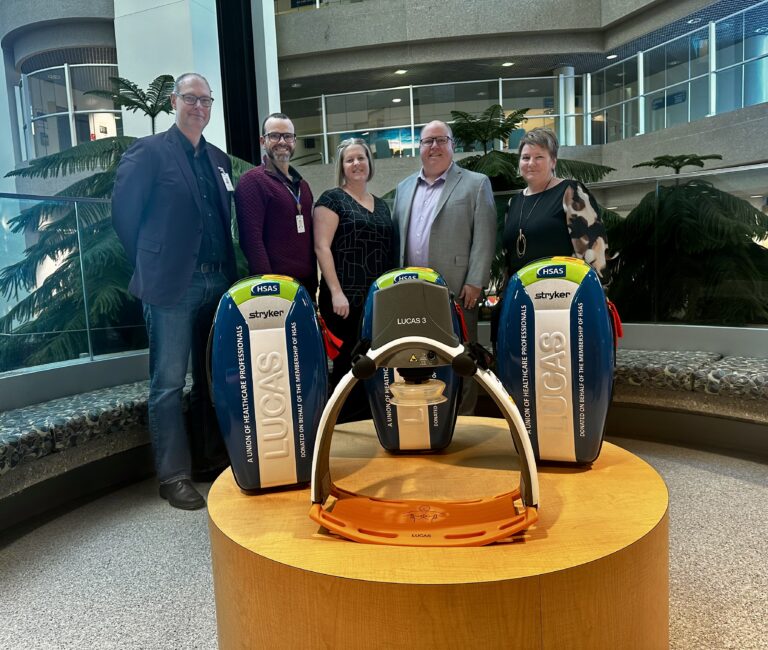
Photo: The Health Sciences Association of Saskatchewan (HSAS)
By Carol Baldwin
Local Journalism Initiative Reporter
Wakaw Recorder
Five emergency teams and the communities they serve across Saskatchewan will soon benefit from enhanced lifesaving technology following the donation of LUCAS 3.1 mechanical chest compression devices from the Health Sciences Association of Saskatchewan to the Saskatchewan Health Authority. These devices will support rural emergency medical services staffed and supported by Health Sciences Association of Saskatchewan members, which includes over 500 paramedics.
The Health Sciences Association of Saskatchewan (HSAS) is a union representing over 4400 specialized health care professionals across the province, who work throughout the SHA, at several privately owned ambulance services in Saskatchewan, and at Canadian Blood Services in Regina. These professionals work in hospitals, emergency services, communities, and long-term care. The Association was founded in 1972 by a group of dedicated professionals who believed that the unique interests of their varied and specialized professions, would be best represented by a separate, independent union.
“Health Sciences Association of Saskatchewan is proud to support rural emergency medical services with this donation,” said Karen Schmid, Health Sciences Association of Saskatchewan President. “Paramedics in rural communities provide critical, life-saving care, often under challenging circumstances and over long travel distances. We are pleased to contribute equipment that will help them continue this vital work and improve patient outcomes across rural Saskatchewan.”
The donation, valued at more than $100,000, will support emergency medical services teams in La Loche, Beauval, Estevan, Weyburn and Esterhazy, communities identified by the Saskatchewan Health Authority as high-priority locations based on call volumes and historical cardiac arrest data. These units will be integrated into service in the coming weeks.
“This donation directly strengthens frontline emergency care in our province,” said Rod MacKenzie, Executive Director, Provincial Clinical & Support Services-Community Care, Saskatchewan Health Authority. “The LUCAS devices support our teams by delivering consistent, high-quality chest compressions, essentially acting as an extra set of hands during CPR. They also enhance provider safety by reducing the need for staff to perform manual compressions for prolonged periods, allowing paramedics to focus on other critical aspects of patient care.”
The chance of surviving an out-of-hospital cardiac arrest is zero for a person who does not immediately receive high-quality chest compressions with minimal interruptions, followed by additional therapy such as a defibrillating shock and/or more advanced care from EMS personnel within minutes.
Performing manual chest compressions correctly is physically demanding for the person delivering them, and the more tired they become, the less effective their compressions become. The LUCAS devices allow rescuers to focus on treating the patient’s underlying conditions rather than delivering manual chest compressions. The LUCAS 3.1 has a Wi-Fi connection to the LIFENET System and integration into CODE-STAT™ 11 Data Review Software.
The LUCAS Chest Compression System are used by emergency care teams around the world, enabling medical professionals to save lives from sudden cardiac arrest and avoid neurological damage during an event by supplying a steady supply of oxygen and life-sustaining circulation through its effective and uninterrupted chest compressions. Studies show that the LUCAS compressions are able to sustain a higher blood flow to both the brain and the heart compared to manual compressions. The LUCAS device delivers chest compressions to a consistent depth of 5.3 cm (2.1 inches) and rate of 102 per minute. (https://www.stryker.com/us/en/emergency-care/products/lucas-3.html)